
What if the audio recording waiting in your studio portal isn't a harsh verdict, but an intimate masterclass tailored just for you? Learning how to use judge feedback to improve dance technique is the most empowering shift an artist can make, turning high-pressure commentary into quiet, elegant refinement.
I know how disorienting it feels to sit with headphones on after an exhausting competition weekend, listening to rapid-fire notes while trying to untangle contradictory advice from different panel members. When subjective artistic commentary clouds your training, it is completely natural to feel overwhelmed. You can easily turn that noise into purposeful growth. In this guide, you will discover how to translate audio critiques into actionable studio habits that safely awaken your turnout, stabilize your core, and elevate your lines. We will walk through a stress-free review routine, masterclass-level conditioning drills, and the exact steps to step back onto the stage radiant with poise.
Key Takeaways
- Reframe adjudicator audio critiques as compassionate, private mentorship designed to nurture your technical longevity rather than define your personal artistry.
- Discover how to use judge feedback to improve dance technique by pairing synchronized video footage with isolated audio feeds to identify consensus mechanical notes.
- Transform subjective aesthetic remarks into tangible studio habits, targeting core engagement, clean pelvic placement, and genuine hip rotation.
- Distinguish discipline-specific requirements across classical ballet, grounded jazz, and fluid contemporary work to refine your kinetic lines.
- Accelerate the physical integration of your corrections by testing new movement patterns in elite convention masterclasses before your next competitive tour stop.
Listening Beyond the Score: Embracing Judge Critiques with Perspective
Every dancer remembers the quiet sting of seeing a score that didn't match the sweat poured across the Marley. When you open your digital critique portal, remember that a point deduction never measures your heart, your courage, or your artistic worth. Learning how to use judge feedback to improve dance technique begins with quiet emotional detachment. Take a deep breath and listen with soft, objective curiosity.
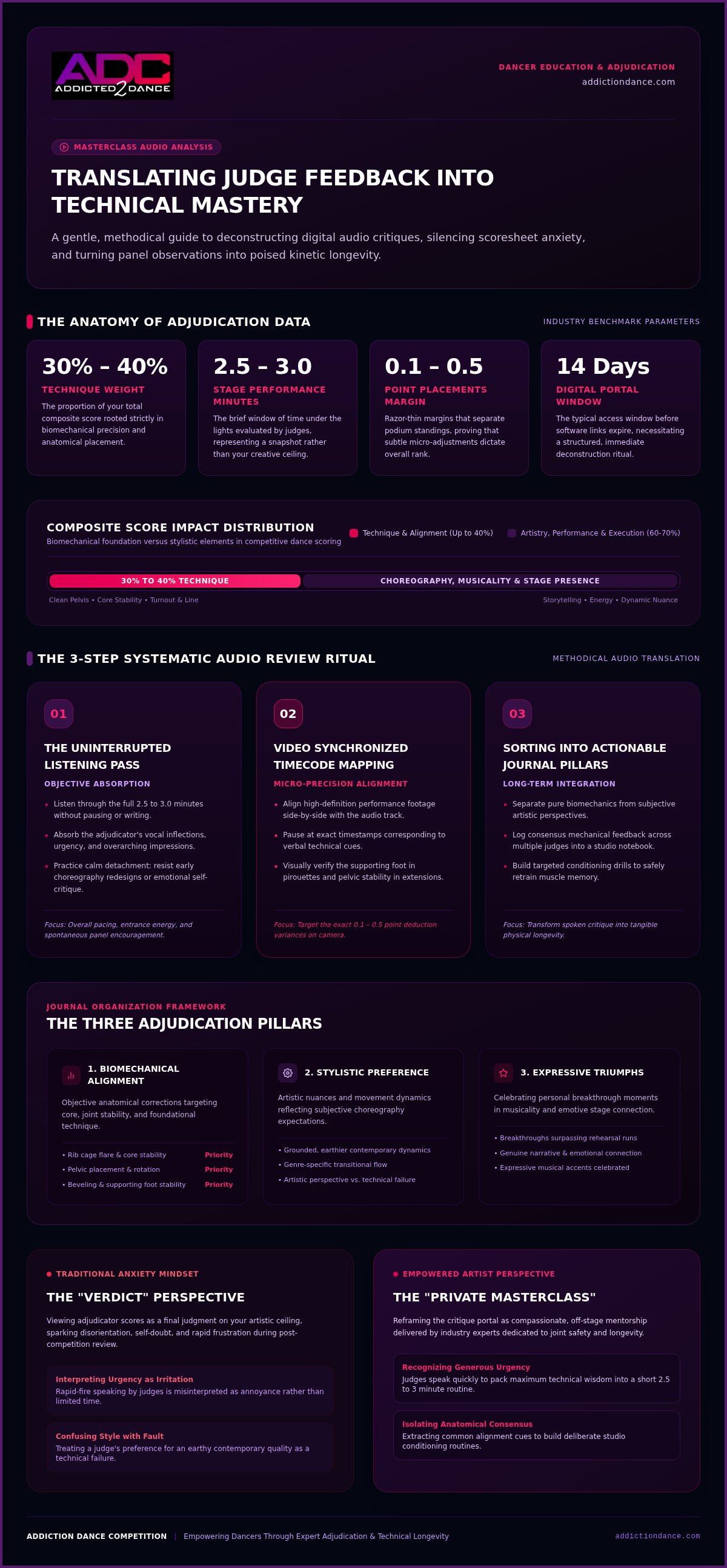
Adjudication is not a trial; it is focused mentorship. On modern competitive circuits, technique typically accounts for 30% to 40% of your total composite score, making biomechanical precision the true foundation of your placement. When you learn to separate subjective choreographic tastes from objective anatomical alignment, critiques transform into an invaluable roadmap for physical longevity.
De-Escalating Scoresheet Anxiety and Reframing the Numbers
Numeric scores are merely single snapshots in time. They reflect 2.5 to 3.0 minutes under bright stage lights, not your ceiling as an artist. Instead of obsessing over aggregate totals or overall ranks, look closely at the mechanical sub-score categories:
- Isolate the alignment notes: Pinpoint remarks regarding rib cage flare, pelvic stability, or beveling through the foot.
- Recognize stylistic preference: A judge might prefer an earthier contemporary dynamic, which is simply an artistic perspective rather than a technical failure.
- Acknowledge your expressive triumphs: Celebrate the performance breakthroughs where your personal storytelling clearly surpassed your previous rehearsal runs.
The True Role of the Adjudicator as an Off-Stage Mentor
Sitting behind the judging table, adjudicators speak quickly because they want to gift you as much technical wisdom as possible during your brief stage performance. Within competitive dance adjudication, that rapid-fire audio is driven by urgency, not irritation. These industry professionals want to see you succeed safely without joint compromise or repetitive strain.
Listen past the rushed tempo of the voice. Notice the gentle inflections of encouragement when an adjudicator celebrates your clean extension or your expressive musicality. Stepping onto the stage at a professional judged dance competition means entering an ecosystem designed to elevate your craft. Once you understand that judges act as compassionate guides invested in your career, understanding how to use judge feedback to improve dance technique becomes an empowering creative journey rather than an emotional chore.
How to Deconstruct Dance Judge Audio Critiques Step-by-Step
Opening an online portal packed with audio files can feel overwhelming without an intentional system. Most major competition software suites provide access through a standard 14-day viewing window before links expire, so establishing a deliberate review ritual ensures you capture every subtle cue. Transforming raw commentary into polished lines requires a methodical ear, calm patience, and structured logging.
Step 1: The Initial Listening Pass Without Immediate Judgment
Pour a cup of tea, grab a notebook, and play each audio track from start to finish without pausing. Listen to how the judge responds to your initial entrance, musical timing, and energy. Resist the urge to rewrite choreography or critique your facial expressions during this first pass. Simply absorb their vocal tone, overarching impressions, and immediate technical reactions across the full three minutes.
Step 2: Timecode Mapping with Video Playback
Next, synchronize the recorded audio track directly alongside your high-definition performance video. Modern adjudication evaluates technical precision through razor-thin margins, where a mere 0.1 to 0.5 point variance determines overall placements. Pause the playback at exact timestamps where deductions occur. You can study how principles of deliberate practice and targeted feedback turn brief comments into lasting habits. Watch your supporting foot during pirouettes, check your pelvis in extensions, and visually verify habits that felt secure on stage but looked ungrounded under the lights.
Step 3: Categorizing Feedback into Actionable Pillars
To master how to use judge feedback to improve dance technique, sort every verbal note into four precise functional pillars inside your dance journal:
- Biomechanical Alignment: Scapular stability, rib cage integration, transverse abdominis engagement, and turnout initiated from the hip socket.
- Articulative Footwork: Rolling through demi-pointe, aggressive metatarsal push-off, and clean beveling on leaps.
- Musical Phrasing: Completing physical extensions across dynamic syncopations rather than rushing to the next hit.
- Expressive Spatial Awareness: Maintaining chin elevation, intentional eye focus, and commanding your performance perimeter.
Isolate consensus corrections flagged by two or more judges on the panel. These consensus notes represent your primary mechanical priorities for the upcoming training month. As you map out your growth for upcoming dates on the Addiction Dance Competition tour, select two specific physical adjustments to anchor your focus, allowing refinement to bloom with quiet grace.
Transforming Judge Notes into Studio Practice: A Practical Routine
Monday evening arrives quickly after an exhilarating weekend under the stage lights. Stepping back into the quiet sanctuary of the studio, the challenge is translating recorded remarks into physical habits. Scientific research into augmented feedback in motor learning illustrates that pairing external expert commentary with deliberate physical repetition dramatically accelerates neuromuscular retention. Masterful dancers do not simply listen to critiques; they weave that insight directly into their warm-ups, conditioning, and daily barre work.
Collaborating with Your Studio Teachers and Choreographers
Approach your instructors as trusted allies in your technical journey. Bring your logged consensus notes to rehearsal and ask for tailored feedback during class. You might say, "The panel noted my ribs flaring in sustained extensions; could you observe my transverse abdominis engagement during adagio today?" Respect your choreographer's artistic vision while inviting their experienced eyes to refine your anatomical placement safely.
Targeted Conditioning for Common Physical Deductions
Address recurring mechanical deductions through focused, gentle conditioning routines outside of full run-throughs:
- Core Stabilization: Practice bird-dog holds and forearm planks to stabilize the pelvis, preventing balance shifts during pirouettes.
- Ankle and Metatarsal Articulation: Work through slow, seated resistance band pointes and flexes to strengthen intrinsic foot muscles and eliminate sickling.
- Hip Flexor Release: Lengthen the psoas through low lunges and active glute engagement so arabesques extend freely without pinching the lumbar spine.
The Re-Filming Check: Measuring Micro-Progress in Rehearsal
True transformation happens through tiny, disciplined increments. During targeted mini-rehearsals, film a single thirty-second phrase under clean studio lighting. Focus entirely on alignment and mechanics rather than outward performance flair. When you watch this footage side-by-side against your weekend performance file, you will visibly confirm whether your turnout initiates correctly from the hip socket or if your supporting heel stays secure on relevé.
Documenting these subtle shifts in muscle memory is precisely how to use judge feedback to improve dance technique over the course of a competitive season. Celebrating these micro-breakthroughs builds a calm, grounded self-assurance that carries you gracefully through every rehearsal.
Diagnosing Style-Specific Corrections: Ballet, Jazz, and Contemporary
Every dance genre channels weight, energy, and breath through entirely distinct pathways. Contradictory comments between judges often stem from differences in stylistic heritage rather than poor execution. Reconciling those critiques means looking at the specific discipline's biomechanical demands.
Ballet and Lyrical: Cultivating Clean Lines and Sustained Breath
Classical disciplines prioritize verticality, rotatory control, and effortless port de bras. When an adjudicator asks for more breath in your upper back, they want you to soften your chest without dumping into the lower lumbar spine. Keep these technical cues top of mind:
- Rib cage knitting: Connect the lower ribs toward the midline using the transversus abdominis to avoid flaring during arabesques and développés.
- Coxafemoral rotation: Initiate turnout deeply from the hip socket, ensuring the supporting patella tracks cleanly over the second toe rather than rolling inward over fallen arches.
- Scapular depression: Lower the shoulder blades smoothly along the rib cage to allow the neck to lengthen into classic epaulement.
Jazz and Musical Theatre: Grounded Weight, Sharpness, and Isolation
Jazz lives low to the floor. Panel commentary highlighting "floating" or "tentative weight" usually flags an insufficiently grounded center of gravity. Deepen your transition pliés to generate authentic propulsion into jumps and parallel pirouettes. Lock your focus onto a sharp, decisive head spot, keeping the working knee connected tightly to your supporting leg during parallel passés. Technical discipline anchors the style, leaving space for genuine theatrical expression to read clearly across the footlights.
Contemporary: Fluid Floorwork and Honest Momentum
Contemporary adjudicators penalize tension disguised as passion. If audio notes call out jarring floor work, focus on bone articulation and momentum pathways rather than falling directly onto joint surfaces. Soften your shoulders and let breath initiate shifts through the spine. Unforced authenticity always registers more powerfully than exaggerated emotional pantomime.
Navigating these stylistic boundaries with finesse is an essential milestone in understanding how to use judge feedback to improve dance technique. To immerse yourself in training that sharpens these exact disciplines, register for upcoming dance conventions and elite masterclasses to refine your craft under top choreographers.
From the Judges' Stand to the Spotlight: Elevating Your Competitive Journey
Scoresheet numbers fade, but refined habits become permanent artistic power. When you deliberately integrate constructive notes, your routine transforms from practiced steps into an arresting performance. The competitive arena is an incubator for excellence, offering clear milestones along your artistic journey.
Maximizing Convention Masterclasses to Reinforce Corrections
Studio rehearsals offer a protected space, but convention ballrooms provide the ultimate testing ground. Taking your technical breakthroughs straight into the classroom allows you to test new motor patterns in real time. Place yourself near the front of the room during elite masterclasses. Feel the energy of the faculty, invite their corrections, and bridge what you heard on your weekend audio files with hands-on professional instruction.
Immersion changes everything. Experiencing a premier dance competition and convention allows you to receive a technical note on the competitive stage on Saturday and workshop the underlying anatomical placement with master teachers on Sunday morning. This fluid exchange bridges competitive pressure and masterclass education, accelerating your physical progress ten-fold.
Tracking Growth Across the Season Toward Nationals
True competitive resilience begins when you evaluate each tour stop as an educational chapter. Hardware and adjudication pins celebrate momentary execution, but your personal standard of excellence defines your season. Before packing your garment bags for your next regional city, revisit your earliest critique logs:
- Audit recurring technical notes: Verify that foundational corrections flagged during early winter tour stops have become automatic muscular habits.
- Evaluate artistic presence: Notice how physical stability in your core frees your upper body to tell richer, more compelling stories.
- Establish national benchmarks: Shift your competitive goals toward peak alignment, precision, and endurance for the 2027 National Tour and Nationals Branson 2027.
Understanding how to use judge feedback to improve dance technique turns every stage performance into a triumph of self-discovery. When the house lights dim and your music begins, you will step into the spotlight grounded, radiant, and completely sure of your craft.
Step Into the Spotlight with Refined Confidence
Your competitive journey is defined not by a score, but by the quiet dedication you bring to every rehearsal. Mastering how to use judge feedback to improve dance technique transforms rapid-fire commentary into an intimate blueprint for physical longevity. By filtering consensus corrections, conditioning deep core stabilizers, and honoring your artistic voice, you cultivate lasting mastery that commands attention.
When you are ready to bring those refined lines back to the stage, seek out environments that genuinely nurture your growth. Experience fair, constructive evaluations delivered by industry-respected adjudicators within an uplifting, high-energy atmosphere. Take your physical breakthroughs directly into elite masterclasses across premier destinations nationwide. Register for your next regional tour stop with Addiction Dance Competition, and step into the lights grounded, inspired, and ready to shine.
Frequently Asked Questions
How should dancers handle contradictory comments from different judges on the same panel?
Bifurcate objective anatomical alignment from subjective stylistic taste immediately. If one adjudicator requests deeper pliés while another focuses on upper-body stillness, both can be true. When two notes directly clash on performance aesthetics, defer to your home studio director. Prioritize mechanical safety first, and treat differing artistic viewpoints as a natural reflection of an adjudicator's professional background.
What is the best way for parents to support dancers while listening to critiques?
Create a calm, non-judgmental space and enforce a brief cooling period before opening audio files. Resist the urge to react defensively to point deductions or critique harshness. Instead, praise your dancer's courage, validate their feelings, and encourage them to view adjudicators as caring industry mentors. Your steady reassurance helps your child process notes through an educational lens rather than personal defeat.
How many times should a dancer listen to their audio critiques after a competition?
Listen through the recordings exactly twice with focused intention. Use the first pass simply to absorb general impressions, emotional tone, and artistic notes without stopping. Complete a second pass with a notebook in hand, pausing alongside video playback to map specific timecodes. Over-listening beyond this structured routine often causes unnecessary performance anxiety instead of productive studio practice.
Can addressing judge feedback help dancers earn masterclass convention scholarships?
Refining foundational technique directly increases your visibility in elite masterclasses and convention audition rooms. Convention faculty look for adaptable students who self-correct alignment, track their knees over their toes, and maintain core control under fatigue. Understanding how to use judge feedback to improve dance technique ensures your body instinctively executes clean fundamentals, allowing your artistry to stand out effortlessly when faculty award prestigious tour scholarships.
What should a dancer do if a judge comments on choreography rather than technique?
Share choreography-specific notes directly with your studio teacher without making independent routine changes. Adjudicators often comment on musical cuts, staging pathways, or transitions, which belong under the choreographer's creative jurisdiction. Your personal focus must remain centered on execution, dynamic phrasing, and physical placement. Trust your instructor to decide whether adjustments serve the routine's overall competitive vision.
How quickly can dancers expect to see noticeable technical improvements from critique notes?
Measurable biomechanical adaptations generally require three to four weeks of consistent, deliberate rehearsal. Muscle memory does not shift overnight. Dancers who implement focused conditioning drills and film mini-rehearsals weekly can see visible corrections by their next tour stop. Discovering how to use judge feedback to improve dance technique is a steady process of physical repetition, patience, and progressive neuromuscular refinement.
Why do judges frequently comment on foot articulation and ankle alignment?
Clean footwork forms the physical base for total-body alignment and injury prevention. Adjudicators watch the feet closely because sickling, rolling arches, or weak metatarsal articulation instantly destabilize pirouettes, compromise knee tracking, and ruin aesthetic lines. Demanding clean articulation through the demi-pointe protects your joints while maximizing extension, ensuring your movement remains powerful, safe, and visually immaculate.


