

What if the difference between an empowering weekend on stage and a disheartening awards ceremony comes down to simple calendar math? As studio directors and educators, we pour our hearts into every rehearsal, yet nothing dampens our excitement faster than the quiet stress of placement confusion. Having dance competition age divisions explained clearly from the start protects our dancers, ensuring every performance meets the judges with fairness, balance, and artistic equity.
We understand how vital it is for young artists to be evaluated alongside their true developmental peers, without worrying that mixed-age groups will skew a category unfavorably. In this guide, you will discover exactly how competitive brackets operate, from universal January 1st cutoff dates to group average calculations and experience tiers, so you can register your routines with complete confidence. Ahead, we map out standard industry divisions from Mini to Senior, examine crucial bump rules, and share clear methods to prepare your studio for regional stages and national finals.
Key Takeaways
- Master standard industry brackets from Mini to Senior so your dancers take the stage alongside their developmental peers.
- See dance competition age divisions explained through the universal January 1st cutoff date, creating complete registration certainty for your studio.
- Learn the precise composite math and "drop the decimal" rules that govern duos, trios, and large group routines.
- Distinguish between chronological age categories and training-based skill levels to ensure fair adjudication for every entry.
- Transform age division transitions into inspiring milestones that build artistic maturity and stage confidence.
Standard Dance Competition Age Divisions: Understanding the Typical Brackets
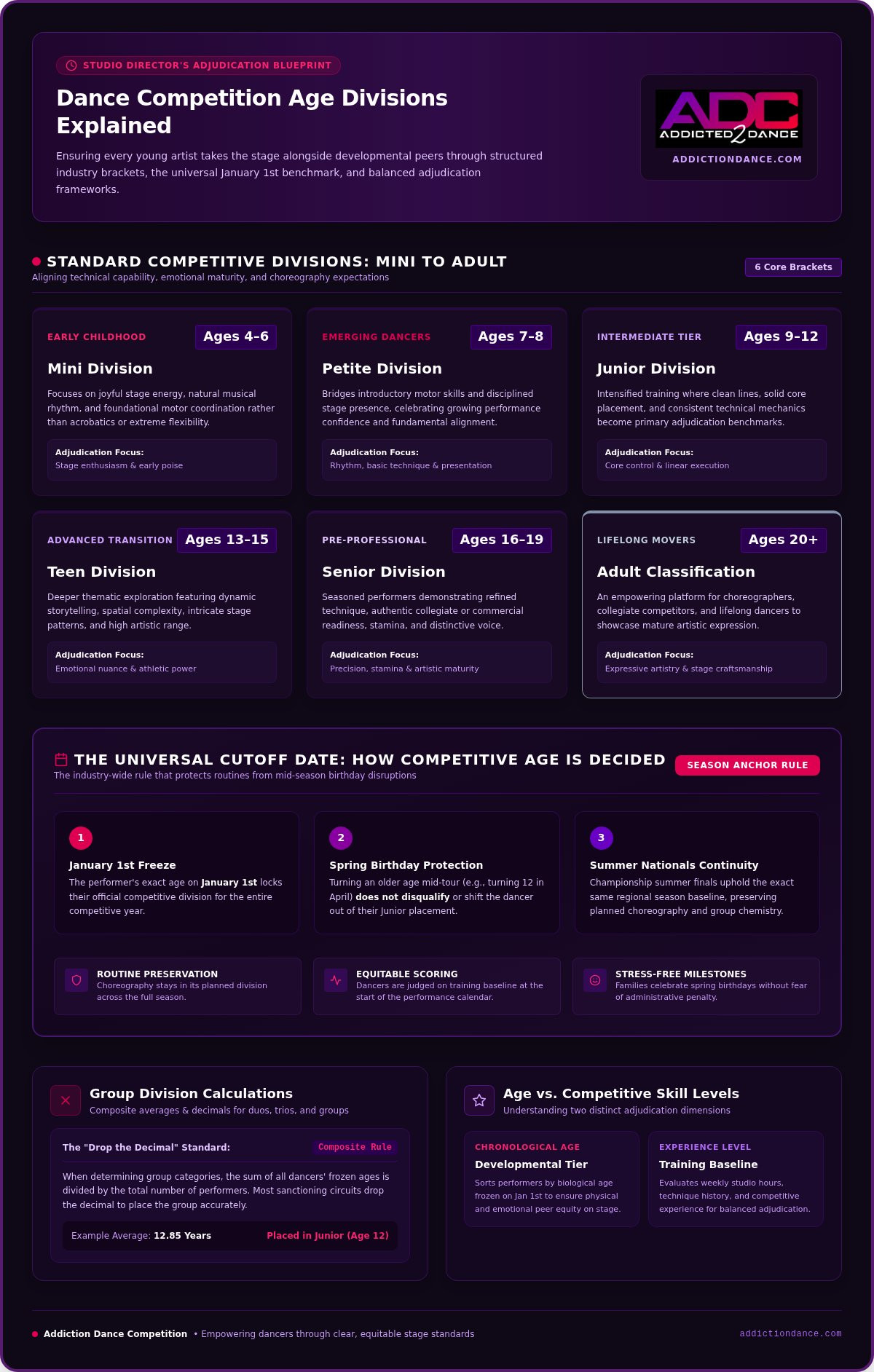
Every young artist deserves an adjudication experience that honors where they are developmentally. In competitive dance, age brackets do not simply sort rosters. They create safe, inspiring benchmarks where technical capability and emotional maturity align. When you see dance competition age divisions explained through this developmental lens, the structure feels less like administrative red tape and more like an intentional safeguard for your dancer's self-esteem.
Most commercial circuits organize stage entries across five to six core brackets. These tiers protect young dancers from feeling overwhelmed while giving seasoned performers a platform that celebrates pre-professional polish.
Early Childhood Divisions: Mini and Petite Dancers
Our youngest performers bring unmatched energy to the stage. Mini divisions warmly welcome children aged four to six, while Petite brackets typically embrace emerging dancers aged seven to eight. At this tender stage, adjudicators look for joyful performance quality, musical rhythm, and foundational motor control rather than extreme flexibility or difficult acrobatics. It is all about celebrating stage enthusiasm and early performance poise.
Intermediate Categories: Junior and Teen Divisions
As training intensifies, dancers transition into intermediate territory. Junior brackets generally support performers between nine and twelve years old, where clean lines and solid core placement take center stage. Teen divisions bridge ages thirteen to fifteen. Here, choreography deepens significantly:
- Dynamic Storytelling: Routines move beyond clean technique to explore nuanced emotional expression.
- Spatial Complexity: Dancers master intricate stage patterns, directional shifts, and partner work.
- Artistic Range: Dancers demonstrate athletic power alongside lyrical softness.
Studying these intermediate tiers helps clarify how dance competition age divisions explained by reputable directors nurture sustainable progress rather than premature burnout.
Advanced Stages: Senior and Adult Classes
Senior divisions showcase seasoned performers aged sixteen through nineteen. These young artists display refined technique, mature storytelling, and authentic collegiate or commercial readiness. Adjudicators evaluate their precision, stamina, and individual voice. For dancers aged twenty and older, dedicated Adult classifications provide an uplifting space where choreographers, collegiate dancers, and lifelong movers can continue their artistic expression under the stage lights.
The Universal Cutoff Date: How a Dancer's Competitive Age Is Decided
Few administrative moments create as much quiet panic for parents as a spring birthday. A mother often pulls me aside in February, worried that her daughter turning twelve in April will abruptly disqualify a solo set for the Junior division. Fortunately, the professional circuit protects dancers from that sudden disruption. Understanding how dance competition age divisions explained through a single calendar anchor preserves consistency for studios traveling city to city all year long.
Across the majority of competitive circuits, your dancer's age freezes on a specific date. For the 2027 season, that date is universally January 1, 2027. This industry-wide policy aligns closely with the developmental frameworks promoted by National Dance Education Organization standards, prioritizing stability over arbitrary mid-year changes.
The January 1st Benchmark Rule
Whatever age your dancer is on January 1st becomes their official age for the entire season. If a performer is eleven on New Year's Day, she competes as an eleven-year-old through June. It makes no difference if she celebrates her twelfth birthday between regionals in Chicago and Las Vegas. Directors simply submit official birth certificates during early registration to lock the roster in place. This clear approach offers genuine benefits:
- Routine Preservation: Choreography stays in its planned division across the entire competitive year.
- Equitable Scoring: Dancers are evaluated based on their training baseline at the start of the performance calendar.
- Stress-Free Milestones: Families celebrate spring birthdays without fear of disqualifying their routines.
National Championship Age Rollover Policies
Summer national events uphold this same regional season baseline. When qualifying routines head to prestigious stages like the Branson National Championship, the age locked on January 1st travels right along with them. Dancers never face unexpected reclassification before hitting the stage. As you plan your summer schedule, checking tour dates on the 2027 National Tour calendar offers peace of mind that your dancers remain in the exact brackets they worked all winter to master.
Clear age guidelines build trust between studios and adjudication panels. When dance competition age divisions explained with transparency set the baseline, every young performer can step onto the stage knowing the platform is fair, supportive, and grounded in integrity.
Calculating Group Age Divisions: Averages, Decimals, and Drop Rules
Placing an ensemble into the correct bracket can feel intimidating when your roster bridges multiple grades. Choreographers frequently blend varying skill sets and ages to tell a compelling story, which naturally raises questions about where that piece ultimately competes. Rather than forcing you to guess, the industry relies on an objective mathematical formula. Having dance competition age divisions explained at the ensemble level gives you total confidence when submitting duos, trios, and large group routines.
Every group division rests on a composite average. By combining performer ages and applying clear arithmetic rules, competitions ensure that every routine lands in an equitable bracket.
The Step-by-Step Average Age Calculation Formula
Determining your group's competitive placement takes just three straightforward steps. First, list the confirmed age of every dancer as of the cutoff date. Next, sum those numbers together and divide by the total count of performers. Finally, apply the standard "drop the decimal" rule.
- Sum the Ages: Add every performer's competitive age together into one total figure.
- Divide Evenly: Divide that total number by the exact number of dancers in the routine.
- Drop the Decimal: Always discard the decimal point without rounding up.
Consider a small group of five dancers aged 10, 11, 12, 13, and 13. Their ages total 59. Dividing 59 by 5 gives you 11.8. While typical classroom rounding would push that number up to 12, the dance industry drops the decimal entirely. This routine officially competes at an average age of 11, comfortably placing it in the Junior bracket.
Managing Wide Age Spans in Large Production Numbers
Large production numbers celebrate studio community by bringing seven-year-olds and seventeen-year-old seniors together on a single stage. Parents sometimes worry that older performers will unfairly pull the routine into an unreachable tier, or conversely, that older dancers will overpower a younger category. Adjudicators evaluate these massive routines on visual balance, transitional fluidity, and theatrical staging rather than individual age differences.
Many circuits also implement a safeguard known as the bump rule. This guideline prevents a routine from competing more than one division below its oldest dancer, regardless of the mathematical average. If a routine includes an adult performer aged twenty or older, it automatically transitions to an adult category. Keeping dance competition age divisions explained clearly through these mathematical principles ensures every ensemble competes on fair and transparent ground.
Age Divisions vs. Competitive Skill Levels: Decoding the Difference
One of the most frequent misconceptions I encounter from dance families is the assumption that age alone dictates who their child competes against. A thirteen-year-old dancer taking the stage for her very first solo should never have to face a seasoned pre-professional who has trained twenty hours a week since kindergarten. That matchup would be disheartening for the beginner and uninspiring for the veteran. Having dance competition age divisions explained alongside experience tiers brings clarity to how judges actually evaluate routines.
While age brackets reflect chronological and emotional maturity, competitive levels measure studio training intensity. When these two systems work in tandem, every performer receives adjudication tailored to their actual journey. You can explore professional judged dance competition standards to see how rubric scoring honors both artistry and technical execution across every division.
The Role of Weekly Studio Training Hours
Circuits generally establish three distinct performance tiers based on accumulated weekly rehearsal time:
- Recreational or Novice: Designed for dancers training under three to four hours weekly, focusing on foundational technique and stage enjoyment.
- Intermediate: Geared toward developing dancers training approximately five to eight hours weekly across core styles like ballet, jazz, and contemporary.
- Advanced or Elite: Reserved for dedicated pre-professionals training nine or more hours weekly, showcasing advanced technical precision and performance nuance.
Why Level Placement Protects Performer Confidence
Evaluating dancers through both age and skill tier protects their passion. Beginning dancers gain genuine validation competing against peers with similar technical foundations. They can celebrate their hard-earned double pirouettes without feeling overshadowed by peers executing quadruple rotations on relevé. At the same time, advanced performers receive the rigorous, constructive feedback they crave from master choreographers.
Precision placement creates an uplifting environment where growth flourishes naturally. When you are ready to give your dancers an inspiring, professionally adjudicated stage, register your studio for our 2027 tour events across cities like Chicago, Omaha, and Nashville. Seeing dance competition age divisions explained and executed with integrity ensures that every young artist leaves the stage feeling empowered, respected, and motivated for their next performance.
Empowering Your Dancer: Navigating Competition Brackets with Grace
Watching a young performer step into an older bracket is one of the most rewarding moments in studio life. That transition signals artistic evolution, emotional maturity, and newfound physical capability. It can also bring a touch of nervousness for both dancers and parents. When you have dance competition age divisions explained as markers of personal growth rather than hurdles, you help your dancer embrace the shift with pride, resilience, and genuine excitement.
Every step up the competitive ladder invites dancers to refine their artistic voice. Celebrating effort over hardware transforms competition weekends into formative experiences that build lifelong confidence.
Supporting Dancers During Division Transitions
Advancing into brackets like Teen or Senior changes the adjudication landscape. Judges begin listening for deeper musical interpretation and looking for sustained technical control. Preparing your dancer emotionally for this refined feedback keeps them grounded:
- Shift the Definition of Success: Emphasize personal artistic breakthroughs rather than immediate high-score trophies in a brand-new division.
- Prioritize Audio Critiques: Treat judge commentaries from industry-respected master teachers as personal masterclasses designed to unlock the next level of training.
- Acknowledge the Milestone: Remind dancers that simply belonging on that higher stage represents years of consistent studio discipline.
The Value of Convention Masterclasses Across Divisions
Classroom environments bridge division jumps beautifully. Immersing dancers in elite dance conventions and masterclasses lets them stand alongside older peers without the immediate pressure of a judging sheet. They observe professional work ethics firsthand, absorb fresh choreography combinations, and audition for meaningful dance competition scholarships that fuel future training goals.
Finding the Right Stage for Your Dance Family
Choosing an event partner that champions transparency ensures your dancers feel valued in every division. When circuits provide real-time dance competition livestream access, grandparents, teammates, and extended family can cheer on routines from anywhere in the country. From regional tour stops to the prestigious Branson National Championship, the upcoming 2027 National Tour creates an uplifting environment where every age category receives the celebration it deserves. With dance competition age divisions explained clearly from the start, your studio can step onto every stage with focus, grace, and unmatched enthusiasm.
Bring Complete Confidence to Your Next Competition Season
Behind every unforgettable routine is thoughtful preparation. With dance competition age divisions explained through clear mathematical formulas, stable January 1st cutoffs, and transparent training tiers, administrative guesswork disappears. Your dancers can focus entirely on what matters most: sharing their authentic artistry and growing together as an ensemble.
Every performer flourishes when evaluated within a fair, family-friendly, and uplifting environment. Our circuit pairs transparent age divisions with professional adjudication from industry-respected master choreographers. Whether your studio joins us for tour stops in Chicago and Las Vegas or sets its sights on the Branson National Championship, we provide the inspiring platform your dancers deserve. Explore the 2027 National Tour with Addiction Dance Competition to secure your studio's place on stage this season.
Frequently Asked Questions
What are the most common age divisions in dance competitions?
Most commercial circuits divide entries into Mini (ages 8 and under), Junior (ages 9 to 12), Teen (ages 13 to 15), Senior (ages 16 to 19), and Adult (ages 20 and over). These standardized brackets ensure that dancers compete against peers with matching physical maturity and emotional understanding. Having dance competition age divisions explained through these five core tiers provides a clear roadmap for your studio across regional and national stages.
How do dance competitions calculate my child's competitive age?
Your child's competitive age is established by their age on the circuit's designated cutoff date, which is universally January 1st for the season. If your dancer is ten years old on January 1, 2027, she will dance as a ten-year-old for every regional stop and national final that season. Studio directors submit birth certificates to verify rosters, giving parents complete clarity before the season begins.
What happens if a dancer has a birthday during the competition season?
A mid-season birthday will not affect your dancer's age division at all. Because competitive ages freeze on January 1st, a performer who turns thirteen in March remains in the Junior division through late spring regionals and summer championships. This freeze prevents sudden routine alterations and lets young dancers celebrate personal milestones without worrying about mid-year category shifts.
How is the age division determined for a dance duo, trio, or group?
Ensemble placements are determined by calculating the composite average age of all participating performers. Directors add the January 1st ages of every dancer in the routine together and divide that sum by the total number of performers. Knowing how dance competition age divisions explained at the group level operate ensures choreographers can blend different ages harmoniously while keeping the entry fair and compliant.
Do competitions round up or drop the decimal when averaging group ages?
The standard convention across competitive circuits is to drop the decimal completely rather than round up. If a small group produces a mathematical average of 12.9 years, the 0.9 is discarded. The routine enters the Junior 12-year-old division rather than the Teen bracket. This universal drop-the-decimal standard protects routines from being artificially pushed into older categories.
What is the difference between an age division and a competition level?
An age division reflects a performer's chronological age, while a competition level reflects their weekly training commitment. For example, a fourteen-year-old dancer will always be in the Teen age bracket, but she might compete in a Novice tier if she trains three hours weekly, or an Elite tier if she trains ten or more hours. Dividing entries by both metrics ensures equitable adjudication.
Can a dance routine compete in a higher age division than its average age?
Yes, many circuits allow routines to enter a higher age bracket, especially when applying the bump rule. This rule prevents an ensemble from competing more than one division below its oldest dancer. If a routine averages a Junior age but includes a seventeen-year-old Senior, the piece bumps up to Teen. Similarly, any routine with a dancer aged twenty or older moves to Adult.


