
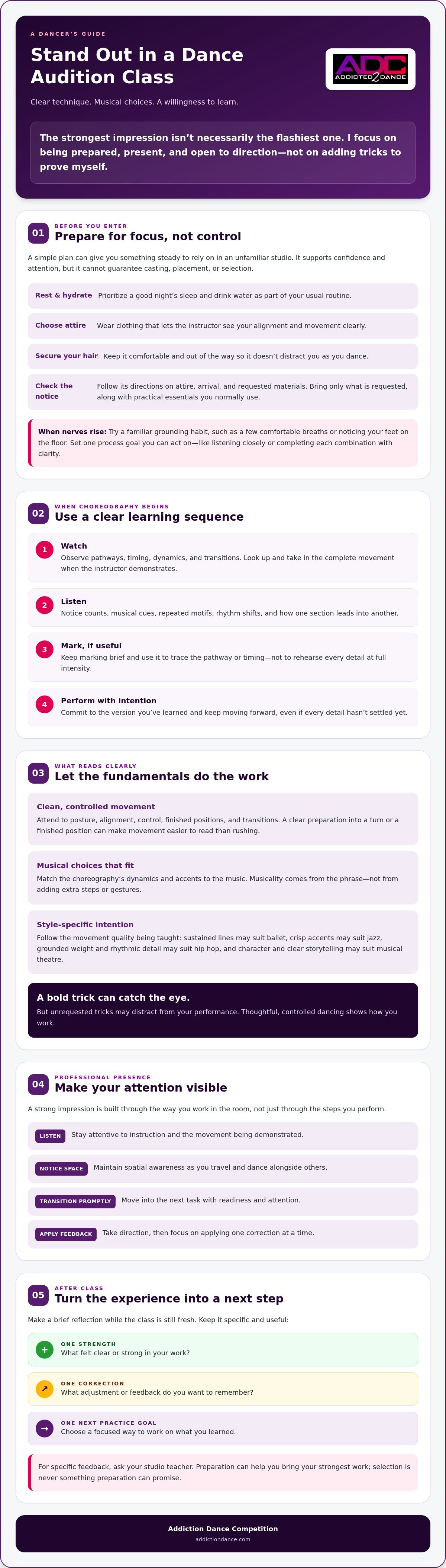
The flashiest dancer in the room isn’t always the one who makes the strongest impression. If you’re wondering how to stand out in a dance audition class, focus on what lasts: clear technique, musical choices, and the ability to take direction. A bold trick can catch the eye, but thoughtful, controlled dancing shows an instructor how you work.
It’s natural to feel pressure when you’re being watched and learning choreography at the same time. Nerves can pull your attention away from the music, while trying too hard to impress can blur your movement. You don’t need to be the loudest person in the room. You need to be prepared, present, and willing to learn.
This guide covers practical ways to prepare, manage nerves, and make artistic choices that feel clear and genuine. You’ll learn what to prioritize in the room, how to show confidence without overperforming, and how to leave a professional impression. The goal is your strongest work, not a collection of tricks.
Key Takeaways
- Use a simple preparation plan to enter an unfamiliar audition room focused and ready to learn, while remembering preparation can’t guarantee selection.
- To learn how to stand out in a dance audition class, listen closely, mark choreography if useful, and perform each phrase with clear intention.
- Let clean fundamentals and controlled transitions make your movement readable. Adding unrequested tricks may distract from your performance.
- Build a professional impression through attentive listening, spatial awareness, prompt transitions, and applying one correction at a time.
- After class, note one strength, one correction, and one next practice goal, then ask your studio teacher for specific feedback.
How to Stand Out in a Dance Audition Class Starts Before You Enter
An unfamiliar studio, a room full of dancers, and an instructor you’ve never met can make the first few minutes feel intense. A calm preparation plan won’t remove every nerve, but it gives you something steady to rely on. The goal isn’t to control the outcome. Preparation can support your confidence and focus, but it can’t guarantee casting, placement, or selection.
In the performing arts, an audition is a way to assess performers for an opportunity or role. This audition process overview offers useful context; for your class, the specific instructions in the audition notice should guide your preparation.
Audition-class readiness comes down to preparation, focus, and openness to direction. Keep the practical details simple:
- Rest: Prioritize a good night’s sleep so you can arrive alert and ready to absorb choreography.
- Hydrate: Drink water as part of your usual routine, rather than trying to compensate at the last minute.
- Choose clothing: Wear attire that lets the instructor see your alignment and movement clearly.
- Prepare your hair: Secure it in a way that feels comfortable and keeps it from distracting you as you dance.
- Check materials: Bring only the items or documents the notice requests, plus practical essentials you normally use.
What should you prepare before audition day?
Read the audition notice carefully, then check it again before you leave. Follow its directions on attire, arrival, and requested materials instead of relying on assumptions about what every audition requires. Lay out your clothing and pack the evening before if that helps you feel organized. A little planning can leave more attention for the work in the room.
How can you settle nerves before class begins?
Choose a familiar grounding habit, such as a few comfortable, unhurried breaths or noticing your feet resting on the floor. There’s no need to force yourself to feel completely calm. Set one process goal you can act on, like listening closely or completing each combination with clarity. Nerves are a normal response to being observed and challenged; they aren’t proof that you’re unprepared.
This is the first practical step in how to stand out in a dance audition class: arrive ready to focus, not preoccupied with guessing what the instructor wants. Once class begins, your preparation can support the musicality, clarity, and responsiveness you bring to each combination.
Show Technique, Musicality, and Fast Learning in the Audition Class
Once the choreography starts, give yourself a clear order of operations: watch, listen, mark if useful, then perform. First, observe the instructor’s pathways, timing, dynamics, and transitions. Listen for counts and musical cues. If marking helps you remember the sequence, keep it brief and return your attention to the demonstration. Then dance the phrase with intention, even if every detail hasn’t settled yet.
Trying to perfect each step while the instructor is still teaching can make you miss what comes next. Focus first on the movement’s structure: where you travel, how the phrase is timed, and what follows each action. Look for repeated motifs or counts, then connect them to the full combination. As you perform, prioritize clean fundamentals and controlled transitions. A clear preparation into a turn or a finished position can make the movement easier to read than rushing through the phrase.
How do you pick up choreography quickly?
Listen for the phrase as a whole, not just individual steps. Notice where the movement repeats, where the rhythm shifts, and how one section leads into another. If marking is appropriate, use it to trace the pathway or timing, not to rehearse every detail at full intensity. When the instructor demonstrates again, look up and take in the complete movement. Then commit to the version you’ve learned and keep moving forward.
How can you make technique and musicality visible?
Let your fundamentals support the style rather than compete with it. Attend to posture, alignment, control, and finished positions, while following the instructor’s movement quality. Musicality comes from matching the choreography’s dynamics and accents to the music, not adding extra steps or gestures. The right choice depends on the phrase: a ballet combination may call for sustained lines, while jazz may emphasize crisp accents. Hip hop may use grounded weight and rhythmic detail; musical theatre may call for character and clear storytelling. Follow the direction in the room rather than applying one approach to every style.
Clear timing and readable movement help an instructor see your choices, technique, and response to the choreography. That’s a stronger foundation for how to stand out in a dance audition class than trying to make every moment bigger. To keep developing your performance and learning in new settings, explore dance conventions and elite masterclasses as further opportunities to work with industry-respected teachers and choreographers.
Do Tricks Make You Stand Out in a Dance Audition Class?
More tricks don’t automatically make a stronger audition impression. A difficult skill can draw attention, but only if it belongs in the phrase and you can execute it with control. Adding an unrequested turn, jump, or other flourish may interrupt the timing, change the choreography, or leave you scrambling to rejoin the group. The instructor is assessing how you respond to the material, not simply how many skills you can display.
There’s no universal formula for what makes a dancer memorable. The strongest choice depends on the combination, its style, and the instructor’s direction. If the choreography already includes a skill you perform confidently, focus on making it precise and musically connected. If it doesn’t, respect the phrase as given. Purposeful execution often communicates more than extra movement.
When should you use a strength or signature skill?
Use a strength when the choreography allows it and you can maintain timing, control, and a clean transition into the next movement. If inserting a signature skill means rushing a count or taking space from another dancer, leave it out. Versatility shows in more than difficulty: clear dynamics, expressive detail, and the ability to adapt to different movement qualities can reveal a wider range of artistry.
A helpful check is to ask: Does this choice support the choreography, or am I adding it just to be noticed? If the instructor invites individual interpretation, make a choice that feels authentic while staying within the phrase’s structure. If the direction is specific, follow it. Coachability is part of the impression, too.
How can you be memorable without competing against classmates?
Keep your attention on your own performance rather than tracking who is dancing bigger, faster, or more confidently. Watching classmates to copy their choices can pull you away from the instructor’s choreography and your own timing. Instead, commit fully to the movement you’ve been given. Calm, grounded focus reads as confidence without needing to dominate the room.
Stay aware of spacing, especially during travel or turns. Adjust when needed, avoid cutting across another dancer’s pathway, and keep transitions orderly. Respectful class conduct doesn’t make your performance smaller; it helps the whole room work safely and clearly. In learning how to stand out in a dance audition class, aim to be distinct through the quality of your execution, not by taking movement or attention away from others.
Use Feedback, Focus, and Professional Class Etiquette to Make an Impression
A professional impression is built in small moments: listening while the instructor speaks, moving promptly when it’s time to reset, and staying aware of the dancers around you. These habits keep the class focused and show that you can contribute to a respectful working environment. They also help you stay present, rather than spending attention on what others might think.
Make feedback actionable with a simple loop: listen, apply one correction, and carry it into the next repetition. If the instructor asks for a clearer accent, for example, choose that as your focus on the next run. You don’t need to overhaul everything at once. A specific adjustment, made with continued energy and attention to the choreography, shows that you can respond in real time.
What does coachability look like in an audition class?
Coachability is visible in your movement, not just in a nod or a verbal “yes.” Take in the direction, identify the change, and try it in the next repetition. Receive correction calmly without letting your performance energy disappear. If the note isn’t clear, wait for a suitable pause and ask a brief, relevant question. Applying feedback can make a strong impression, but it can’t guarantee selection or a scholarship.
If you’re curious about how feedback and evaluation work in a competition setting, read this professional dance judging guide. Adjudication and audition classes are different contexts, but understanding evaluation can help dancers reflect thoughtfully on performance choices.
What class etiquette helps you stand out positively?
Arrive ready to participate, then follow the instructor’s directions about where to stand, how to travel, and when to move between combinations. While someone else receives instruction, stay attentive rather than starting a side conversation or rehearsing in a way that distracts the room. Keep your spacing considerate, and offer fellow dancers the same respect you’d hope to receive.
Good etiquette isn’t about being silent or shrinking back. It’s about helping the class run smoothly while staying engaged in your own work. That kind of steady focus is part of how to stand out in a dance audition class: it supports your performance and shows care for the shared space.
To keep building your performance and professionalism in a learning environment, explore dance conventions and elite masterclasses as opportunities to learn from industry-respected teachers and choreographers.
Turn Audition-Class Preparation into Your Next Dance Opportunity
An audition class can offer more than a single outcome. Whether or not you’re selected, the experience can show you what’s working in your dancing and where you’d like to grow. Reflect while the class is still fresh, then turn one useful observation into a focused next step.
How should you reflect after an audition class?
Jot down the choreography you remember, any corrections you received, and a few observations about how you handled the class. Keep the reflection balanced: note one strength, one correction, and one next practice goal. Separate what you could control, such as listening, focus, and effort, from the final decision. That distinction helps you learn from the experience without treating the outcome as a complete measure of your ability.
Make your next goal specific enough to guide practice. If you noticed that transitions felt rushed, work on connecting movements with control. If a correction was difficult to apply, ask your studio teacher for feedback on that precise area. A clear question gives your teacher something concrete to respond to and keeps you from trying to change everything at once.
Where can dancers keep building performance experience?
Continued learning can help you strengthen the skills you used in class. Addiction Dance Competition conventions and elite masterclasses offer opportunities to learn from industry-respected teachers and choreographers. They are learning experiences, not audition classes. For a broader look at how dancers can approach events, explore this dance competition and convention guide.
Competitions provide another setting to apply performance preparation, artistry, and professionalism, with professional judging. Dancers may also have opportunities to earn scholarships or special awards, though no award is guaranteed. If you’d like to understand that part of the competition experience, read this dance competition scholarship guidance.
Progress comes from returning to the work with curiosity. Reflect, ask for focused feedback, and choose a next step you can practise with intention. That steady approach keeps your development moving forward, whatever the result of one audition class.
Carry Your Best Work into the Next Opportunity
Standing out isn’t about adding the most tricks. It’s about arriving prepared, dancing with clarity and musicality, and staying open to direction. When you focus on what you can control, you give the instructor a clear sense of your technique, artistry, and professionalism.
After class, take a moment to note one strength, one correction, and one goal to work on next. That small reflection can turn an intense audition experience into useful momentum. It’s a practical way to keep developing how to stand out in a dance audition class, whatever the outcome.
Keep building your performance skills through new learning and performance experiences. Addiction Dance offers conventions and elite masterclasses with industry-respected teachers and choreographers, along with competitions featuring professional judging. Explore Addiction Dance competitions and conventions to see what learning opportunities may fit your dance journey.
Trust your preparation, stay curious, and let your dancing speak with confidence.
Frequently Asked Questions
How do you stand out in a dance audition class?
Stand out through clear technique, musicality, and focused learning, not by trying to outdo the dancers around you. Watch the demonstration, listen for timing and pathways, then perform the choreography with commitment. Follow the instructor’s direction and stay aware of the class around you. Preparation and respectful conduct help you present your work confidently, but no approach can guarantee selection. Focus on the choices you can control.
What should I wear to a dance audition class?
Follow the audition notice first, since clothing and footwear preferences can vary by instructor, style, and event. Choose attire that allows you to move comfortably and makes your alignment visible. Secure your hair so it won’t distract you while dancing, and wear the footwear specified in the instructions. If the notice doesn’t specify an outfit, avoid assuming one look works for every audition, and choose practical dancewear suited to the class.
Do tricks help you stand out in a dance audition?
A trick can show a strength when it fits the choreography and you can perform it with control. It isn’t automatically more impressive than clean timing, musicality, or a thoughtful performance. Avoid inserting extra movement if it changes the instructor’s choreography, disrupts a transition, or pulls you out of the phrase. A useful test is whether the skill supports the movement as taught. Choose clarity and suitability over difficulty for its own sake.
How can I learn choreography faster in an audition class?
Watch the demonstration closely and listen for counts, pathways, and changes in direction. Break the combination into manageable sections, notice repeated movement or rhythms, then connect the sections into one phrase. Mark briefly if it helps and the instructor’s process allows it, but return your focus to the demonstration and full movement. If you miss a detail, rejoin at the next clear moment rather than freezing or losing focus on what comes next.
What do dance audition instructors look for in a class?
Expectations vary by audition, so read the posted criteria instead of relying on a universal formula. In class, aim to show clear movement, musical responsiveness, focus, and an ability to apply direction. Professional conduct includes following instructions, managing your spacing, and staying attentive while others receive feedback. These qualities help you present your work well, but they don’t promise a particular result, casting decision, or scholarship.
How do you handle nerves during a dance audition class?
Use a familiar routine before class, such as steady breathing and one simple process goal: listen closely, for example, or finish each phrase with clarity. While dancing, bring your attention back to the next count or instruction instead of judging the whole experience. If you make a mistake, rejoin the choreography and keep performing with intention. Nerves are common; they don’t mean you’re unprepared or incapable.
What should I do after a dance audition class?
While the experience is fresh, note one thing that went well, one correction you received, and one goal for your next practice. Ask your studio teacher for feedback on a specific area, such as transitions or musical timing. Keep the result in perspective: selection isn’t the only measure of progress. Dancers in Chicago, Akron, Omaha, Richmond, Las Vegas, Minneapolis, Miami, Houston, Grand Rapids, Memphis, Detroit, Bloomington, Philadelphia, Pittsburgh, Boston, Nashville, St. Louis, Davenport, Milwaukee, and Birmingham can check current event details for further learning through conventions and masterclasses.


