
What if your next step in contemporary dance isn’t another weekly class, but a focused masterclass that invites you to move, listen, and create in a new way? I see contemporary dance workshops in Nashville as an opportunity to explore fresh movement while honoring each dancer’s individual path. It’s natural to wonder whether an event-based class suits your age and experience, and what you might take away from it.
The best choice begins with understanding the format. A masterclass can complement ongoing studio training by introducing new movement ideas, encouraging exploration of musicality and artistry, and sharing insight from an industry-respected teacher or choreographer. A convention places focused learning within a broader event experience, welcoming dancers of different ages and skill levels in a professional, family-friendly environment.
In this guide, I’ll explain what contemporary training may involve, compare event-based masterclasses with recurring instruction, and offer practical ways to choose and prepare for a learning opportunity. The aim is to help you arrive ready to learn, adapt, and make meaningful progress without feeling you need to prove yourself in every moment.
Key Takeaways
- Contemporary training can bring movement exploration, musicality, technique, and artistry together in a learning-focused class.
- Assess fit by considering goals, experience, teaching approach, and familiarity with styles like ballet, jazz, hip hop, or musical theatre.
- Compare a focused masterclass with a broader convention experience to choose the format that best supports your next learning step.
- Prepare for contemporary dance workshops in Nashville by setting a goal, reviewing event details, staying open to corrections, and reflecting afterward.
- Addiction Dance Competition conventions and elite masterclasses offer event-based opportunities to learn from industry-respected teachers and choreographers.
Contemporary Dance Workshops in Nashville: What the Experience Can Include
A contemporary dance workshop is a guided learning session where dancers explore movement, technique, musicality, and expression rather than present a finished performance. The focus is on developing as a dancer: trying ideas, making adjustments, and noticing how movement communicates. For a helpful overview of what contemporary dance is, it’s useful to know that the style draws on varied movement approaches rather than one fixed vocabulary.
In contemporary dance workshops in Nashville, dancers may explore movement, timing, and ways to shape a phrase with greater intention. Technique gives dancers tools for control and clarity; artistry asks them to make choices that bring those tools to life. The balance depends on the teacher and class focus, so approach a workshop as a chance to learn, not as a promise of one particular routine or structure.
A performance is created to be watched. A workshop is designed for dancers to participate, practice, and develop. Event-based masterclasses offer focused learning experiences that differ from recurring weekly studio classes. They can bring a fresh perspective to ongoing training without replacing the regular practice that builds consistency over time.
What happens in a contemporary dance workshop?
A teacher may introduce a movement idea, demonstrate a combination, and guide dancers as they practice. As they work, dancers can explore how a change in dynamic affects a phrase, how timing shapes musicality, and how transitions connect one movement to the next. Expressive choices matter, too: a gesture can feel different depending on its energy, focus, and intention.
There isn’t one structure every workshop follows. Some sessions emphasize technique; others make more room for interpretation and creative exploration. Listening closely, watching demonstrations, and staying receptive to feedback help dancers make the most of the teacher’s approach.
Who may benefit from Nashville-area contemporary training?
Dancers looking for new movement ideas to complement their current studio training may value the different perspective a masterclass offers. Contemporary movement can also complement experience in ballet, jazz, hip hop, or musical theatre by inviting dancers to consider transitions, musical phrasing, and expressive intent in new ways.
Parents and studio leaders can assess an educational event by considering the dancer’s experience, goals, and comfort learning in a group. Addiction Dance conventions and elite masterclasses welcome dancers of different ages and skill levels, with instruction from industry-respected teachers and choreographers in a positive, professional environment. A dancer doesn’t need to arrive with every movement mastered. Curiosity, focus, and a willingness to adapt are strong foundations for learning.
How to Choose a Nashville Contemporary Dance Workshop That Fits
A worthwhile workshop meets the dancer where she is and offers a clear next step. Before choosing among contemporary dance workshops in Nashville, consider what the dancer hopes to develop, how she responds to new teaching styles, and whether a focused class or a broader event experience feels like the right fit.
Match the workshop to your dance goals
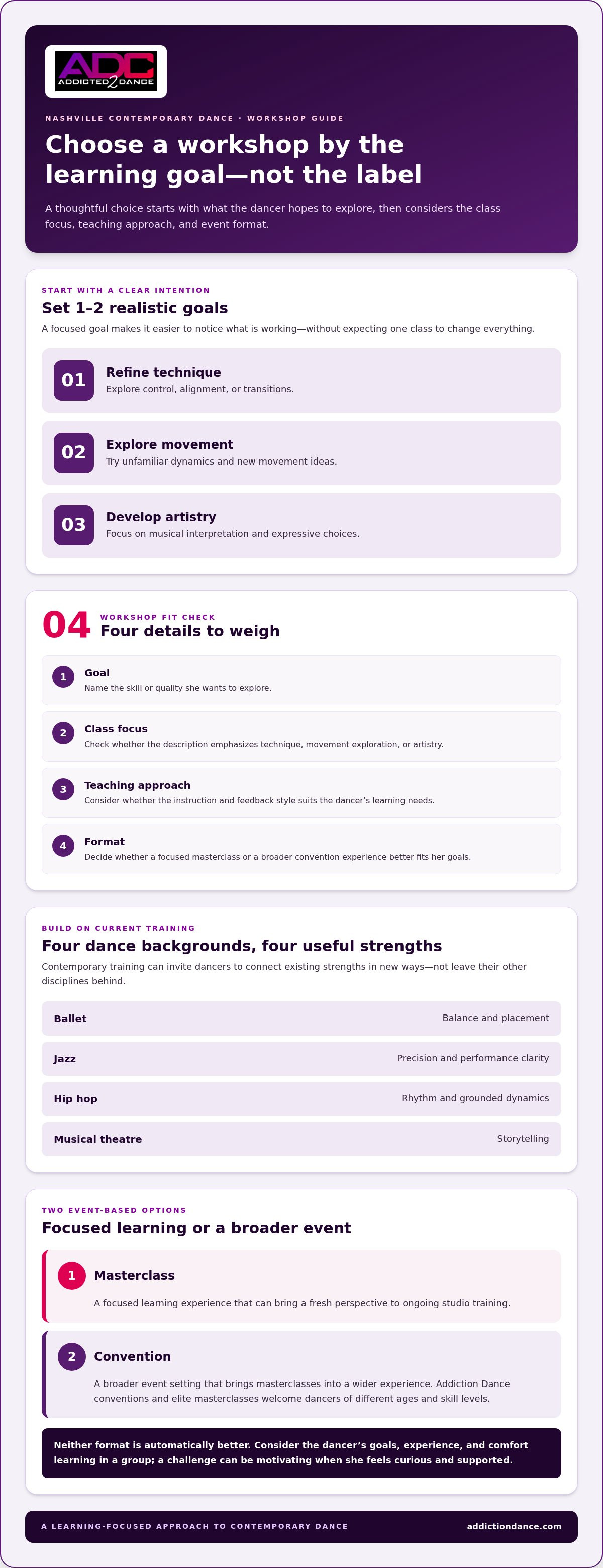
Start with one or two realistic goals. A dancer refining technique might focus on control, alignment, or transitions. Someone seeking movement exploration could aim to try unfamiliar dynamics, while a performer interested in artistry may focus on musical interpretation and expressive choices. Specific goals make it easier to notice what’s working without expecting one class to change everything.
Parents and studio leaders can weigh a dancer’s readiness and interests together. A challenge can be motivating when the dancer feels curious and supported; the most advanced-sounding option isn’t necessarily the best fit.
Understand class level, teaching style, and format
Clear demonstrations and constructive feedback help dancers understand how to approach movement, make adjustments, and keep learning when a phrase feels unfamiliar. Read the event description for its intended audience and learning focus. Dancers should bring the foundations of their current training while staying open to a teacher’s distinct approach.
Experience in ballet can support balance and placement; jazz can build precision and performance clarity; hip hop can inform rhythm and grounded dynamics; musical theatre can strengthen storytelling. Contemporary training can invite dancers to connect these strengths in new ways, without asking them to leave their existing disciplines behind. Regional programs such as professional dance training also reflect the range of serious dance education available in Tennessee.
- Goal: Identify the skill or quality you want to explore.
- Class focus: Notice whether the description emphasizes technique, movement exploration, or artistry.
- Teaching approach: Consider whether the stated instruction and feedback style suits the dancer’s learning needs.
- Format: A single masterclass offers a focused learning experience; a convention brings masterclasses into a broader event setting. Neither format is automatically better. Choose according to the dancer’s goals and interest in a wider convention experience.
The best workshop fit aligns with a dancer’s goals, experience, preferred learning approach, and readiness for the event format. For Nashville-area dancers drawn to focused learning within a larger event, explore Addiction Dance conventions and masterclasses.
Nashville Workshop or Dance Convention: Which Training Format Suits You?
Choosing between a focused masterclass and a dance convention comes down to the kind of learning experience a dancer wants. One offers a concentrated opportunity to work within a particular class; the other places learning within a broader event. For dancers considering contemporary dance workshops in Nashville, neither format is automatically the better choice. The fit depends on the dancer’s goals and the event’s published program.
| Consideration | Focused masterclass | Broader convention |
|---|---|---|
| Learning scope | Concentrates attention on a particular class or learning experience. | Can bring together a wider range of educational sessions. |
| Teacher exposure | Offers a focused chance to learn from the teacher leading that session. | Can introduce dancers to multiple teachers and choreographers, depending on the event. |
| Event atmosphere | Centers on the class and the work being explored. | Places classes within a larger gathering, which may include competition experiences. |
| Potential fit | May suit a dancer with a specific area of curiosity or a focused learning goal. | May appeal to a dancer seeking a broader event experience and varied learning opportunities. |
When a focused masterclass may be the right fit
A masterclass gives a dancer space to concentrate on one learning experience, whether the aim is to explore unfamiliar movement, build confidence, or develop artistry. Its value comes from engaging fully with the work, not from trying to master every detail at once. Consider this format when its stated focus matches the dancer’s interests.
What a convention can add to the learning experience
A convention can broaden the frame. Event-based sessions may introduce dancers to industry-respected teachers and choreographers, while the gathering itself offers a distinct atmosphere from regular studio instruction. Depending on the event’s programming, educational sessions may sit alongside competition experiences. That combination can be energizing. Read the published program to understand what the event includes rather than assuming every convention follows the same structure.
For a wider look at how conventions and competitions fit together, explore the dance competition and convention circuit guide. If a broader event experience is appealing, the 2027 National Tour guide offers additional context.
Both formats can complement ongoing studio training. A focused class may support a specific interest; a convention may offer a wider learning environment. Let the dancer’s goals lead, then choose the event format that makes those goals feel within reach.
How Nashville Dancers Can Prepare for a Contemporary Masterclass
A little preparation makes it easier to stay present, take in new ideas, and get more from class. For dancers attending contemporary dance workshops in Nashville, the goal isn’t to arrive knowing every movement. It’s to arrive ready to listen, adapt, and learn.
Preparation helps dancers make more of a masterclass by giving them a clear focus while leaving room to respond to new movement.
Before class: set a goal and prepare to learn
Keep the plan simple. Choose a technical focus, such as control through transitions, or an artistic one, such as making movement feel more intentional. Then use this four-step sequence to prepare and carry the learning forward:
- Set a goal. Choose one clear area to explore. A manageable focus can help you notice useful details without turning class into a test.
- Review event information. Read the published participation guidance so you understand what to expect and can prepare accordingly. Masterclasses can have different structures.
- Prepare mentally. Take a calm, curious approach. Listen closely to the teacher, stay open to unfamiliar movement, and remember that learning a phrase takes attention and practice.
- Reflect afterward. Note one idea, correction, or movement quality you’d like to revisit while the experience is still fresh.
If you’re traveling to an event from elsewhere in the Nashville area, use the location and timing in the event details to plan your route. Give yourself room to arrive settled rather than rushing in with your attention elsewhere. The aim is simply to be ready to participate.
After class: turn new ideas into continued progress
Reflection gives a single learning experience somewhere to go next. Write down what stood out: perhaps a teacher’s note about timing, a different way of approaching a transition, or a quality of movement you hadn’t explored before. You don’t need to capture every detail. One specific takeaway can be enough to revisit thoughtfully.
A young dancer might share that note with a parent; a dancer continuing studio training could discuss it with a teacher or studio leader. Together, they can consider how the idea fits into ongoing practice. The point isn’t to recreate the class exactly or expect instant results. It’s to carry a useful observation forward, keep learning, and let new movement ideas inform the dancer’s development.
For an event-based learning experience, explore Addiction Dance conventions and elite masterclasses, where dancers learn from industry-respected teachers and choreographers.
Explore Addiction Dance Conventions and Masterclasses for Nashville Dancers
For dancers exploring contemporary dance workshops in Nashville, event-based learning can be a meaningful way to encounter new movement perspectives beyond regular studio practice. Addiction Dance hosts conventions and elite masterclasses at events across the United States. These sessions connect dancers with industry-respected teachers and choreographers in a supportive, professional environment.
What dancers can gain from event-based masterclasses
A masterclass gives dancers the chance to engage with a teacher’s approach and consider movement from a fresh perspective. A choreographer may bring a different emphasis on musicality, dynamics, transitions, or performance intention. The learning is not only about picking up movement. It can also invite dancers to notice how they make choices and communicate through movement.
Technique and artistry work together. Technical development supports clarity and control; artistry helps a dancer bring intention and individuality to that foundation. Exposure to new ideas gives dancers material to consider and carry into ongoing training, while the event setting offers a distinctive opportunity to learn alongside dancers with varied backgrounds.
Addiction Dance events welcome dancers of different ages and skill levels. The focus remains on participation and growth, with professional instruction and a positive, family-friendly atmosphere. Scholarship or special-award opportunities may also be part of the broader event experience. These are opportunities to pursue, not guaranteed outcomes, and they don’t define the value of what a dancer learns in class.
Take the next step toward your dance experience
Dancers, families, and studio leaders can explore event information together and consider what kind of learning experience best supports the dancer’s interests. For families who want to understand scholarship opportunities, this dance competition scholarship guidance offers helpful context.
A contemporary masterclass can be one part of a dancer’s broader development: a chance to listen closely, explore new ideas, and return to training with something meaningful to consider. Nashville dancers are warmly invited to explore Addiction Dance events and masterclasses and find an event experience that feels right for their next step.
Take Your Next Step in Contemporary Dance
The right learning experience starts with a clear goal. A focused masterclass can offer space to explore a particular movement approach, while a convention can bring dance education into a broader event setting. For contemporary dance workshops in Nashville, consider the dancer’s experience, interests, and readiness to learn in a group, then prepare to listen, adapt, and carry useful ideas into ongoing practice.
Addiction Dance conventions and elite masterclasses offer educational sessions led by industry-respected teachers and choreographers. Events welcome dancers of different ages and skill levels in a supportive, professional environment, with scholarship and special-award opportunities to pursue. These opportunities can enrich the event experience, though outcomes are never guaranteed.
Ready to explore an event-based learning opportunity? Explore Addiction Dance conventions and masterclasses and find inspiration for your next step. Every class is a chance to grow with curiosity, confidence, and a little more artistry.
Frequently Asked Questions
Are there contemporary dance workshops in Nashville for beginner dancers?
Beginner dancers can explore event-based learning, and the best fit depends on the session description and the dancer’s comfort level. Addiction Dance events welcome dancers of different ages and skill levels. Nashville-area dancers and families can use event information to understand the intended participants and learning focus, then consider whether the dancer feels ready to learn in a group setting.
What should I expect at a contemporary dance workshop?
Expect a learning experience centered on movement, not a finished performance. A teacher may introduce movement ideas, demonstrate a combination, and guide dancers through practice. The class may invite attention to dynamics, timing, transitions, technique, and expressive choices. Each workshop’s approach can differ, so arrive ready to listen, adapt, and try unfamiliar movement rather than expecting to master every phrase immediately.
How is a dance convention different from a workshop or masterclass?
A workshop or masterclass is generally a focused learning session, while a convention places educational sessions within a broader event experience. Conventions may bring dancers into contact with multiple teachers and choreographers, and some events combine learning with competition experiences. Programming varies, so read the event details to understand its scope. Neither format is universally better; the right choice depends on the dancer’s interests and goals.
Can contemporary dance workshops help improve technique and musicality?
A workshop gives dancers a chance to develop technique and explore musicality through guided movement practice. A dancer might focus on control during transitions, notice how timing changes the quality of a phrase, or explore how dynamics shape expression. Progress depends on the dancer’s engagement and continued practice. A masterclass can complement regular studio training by offering new movement ideas to reflect on afterward.
What should I bring to a contemporary dance masterclass?
Start with the event’s published participation guidance, since preparation details can differ. In general, choose clothing that allows you to move comfortably, and bring any personal items you usually need for dance training. Follow the event information for instructions about attire or other class needs rather than assuming every session has the same requirements. Arriving prepared can help you focus on the teacher and the movement.
Are Addiction Dance conventions suitable for dancers of different ages and skill levels?
Yes. Addiction Dance events welcome dancers of different ages and skill levels in a supportive, professional, and family-friendly environment. Dancers can approach an event with their own goals, whether they’re developing technique, exploring artistry, or gaining experience learning from industry-respected teachers and choreographers. Families and studio leaders can use event information to understand the learning experience and help dancers feel prepared to participate.
Can dancers earn scholarships at dance conventions or masterclasses?
Scholarships and special awards may be opportunities within the broader event experience, but they aren’t guaranteed. Dancers can take part with a focus on learning and growth, while treating any award opportunity as an additional possibility rather than the measure of a successful experience. Review event information for scholarship details, as opportunities and processes can vary between events.
How can Nashville-area dancers find Addiction Dance event information?
Nashville-area dancers, families, and studio leaders can explore event information through the Addiction Dance website. The wider circuit also connects dancers in Chicago, Akron, Omaha, Richmond, Las Vegas, Minneapolis, Miami, Houston, Grand Rapids, Memphis, Detroit, Bloomington, Philadelphia, Pittsburgh, Boston, Nashville, St. Louis, Davenport, Milwaukee, and Birmingham. Use the published details to learn about the event experience and its educational opportunities, and consider how they align with the dancer’s age, experience, and interests. Reviewing those details together can help families choose a meaningful next step.


