

The most electric moment on a modern stage doesn't always come from a heavy bass drop. It often begins with the quiet, razor-sharp precision of a perfect tendu. Mastering dance competition ballet isn't just about following tradition; it's about commanding the room with a level of elite discipline that other styles simply can't touch. I understand that the pursuit of technical perfection often feels like a heavy burden. You might worry that classical work feels too rigid or even a bit predictable compared to the high-energy flair of contemporary styles. It's natural to feel anxious when every fingertip and turnout angle is under a professional microscope.
You're ready to move beyond the fear of a wobbling pirouette and step into your power as a premier artist. This guide will show you how to transform technical precision into a sophisticated performance that captures every judge's heart on our 2027 National Tour. We'll explore the nuances of adjudication, the secret to balancing grace with athletic power, and how to secure life-changing scholarships at Nationals Branson 2027. Let's redefine what it means to be a classical powerhouse on the professional stage.
Key Takeaways
- Discover how ballet has transformed from a foundational requirement into a high-impact, show-stopping category on the modern stage.
- Master the "Big Three" of dance competition ballet, including turnout, lines, and foot articulation, to secure elite adjudication scores from our industry experts.
- Learn to bridge the gap between technical perfection and genuine emotional grace, ensuring your stage presence resonates with every judge.
- Gain professional insights into selecting mature music and sophisticated costuming that balances classical tradition with national tour excellence.
- Explore how our Elite Masterclasses and the 2027 National Tour provide the ultimate platform for aspiring soloists to win prestigious scholarships.
The Evolution of Ballet in the Modern Dance Competition
Ballet has shed its reputation as the quiet, academic cousin of the competition world. It's no longer just a "requirement" for technical points; it's a show-stopping headline event. On the 2027 National Tour, we see ballet routines that command the same electric energy as a high-octane jazz piece. This shift happened because dancers and judges alike realized that a dance competition ballet performance is the ultimate display of athletic power and artistic control. It is the technical heartbeat of every other style. When a dancer masters the turnout and placement of classical work, their potential in every other category sky-rockets.
I've watched the industry move toward a more integrated approach. We're no longer looking for a museum piece. We want to see how classical integrity holds up under the bright lights of a professional, high-production stage. This evolution honors the past while embracing the momentum of the present. It's about finding that sweet spot where tradition meets the thrill of the spotlight.
Classical vs. Contemporary Ballet: Understanding the Difference
The distinction between classical and contemporary categories is vital for your competition strategy. Classical ballet focuses on the established repertoire, demanding strict adherence to historical technique and specific epaulement. It's the gold standard of discipline. Contemporary ballet, however, invites more movement exploration. It allows for a grounded center and modern lines while keeping the dancer's balletic foundation intact. High-level events, such as the Prix de Lausanne, have long shown how both styles are necessary to create a versatile, professional-grade artist. Choosing the right category depends on your dancer's unique strengths, whether they excel in the rigid beauty of a variation or the fluid grace of modern choreography.
The Prestige of the Ballet Category
Winning a title in the ballet category carries a specific kind of weight. It signals to the entire community that your studio values the long-term health and technical longevity of its students. This prestige isn't just about a trophy; it's about visibility. Scouts and judges often look to the ballet category first when identifying talent for dance competition scholarships. A strong classical showing proves that a dancer has the focus and grit required for professional training. It sets a sophisticated tone for your entire team's reputation, proving that your dancers are as disciplined as they are talented.
Adjudication Excellence: What Judges Look for in Ballet
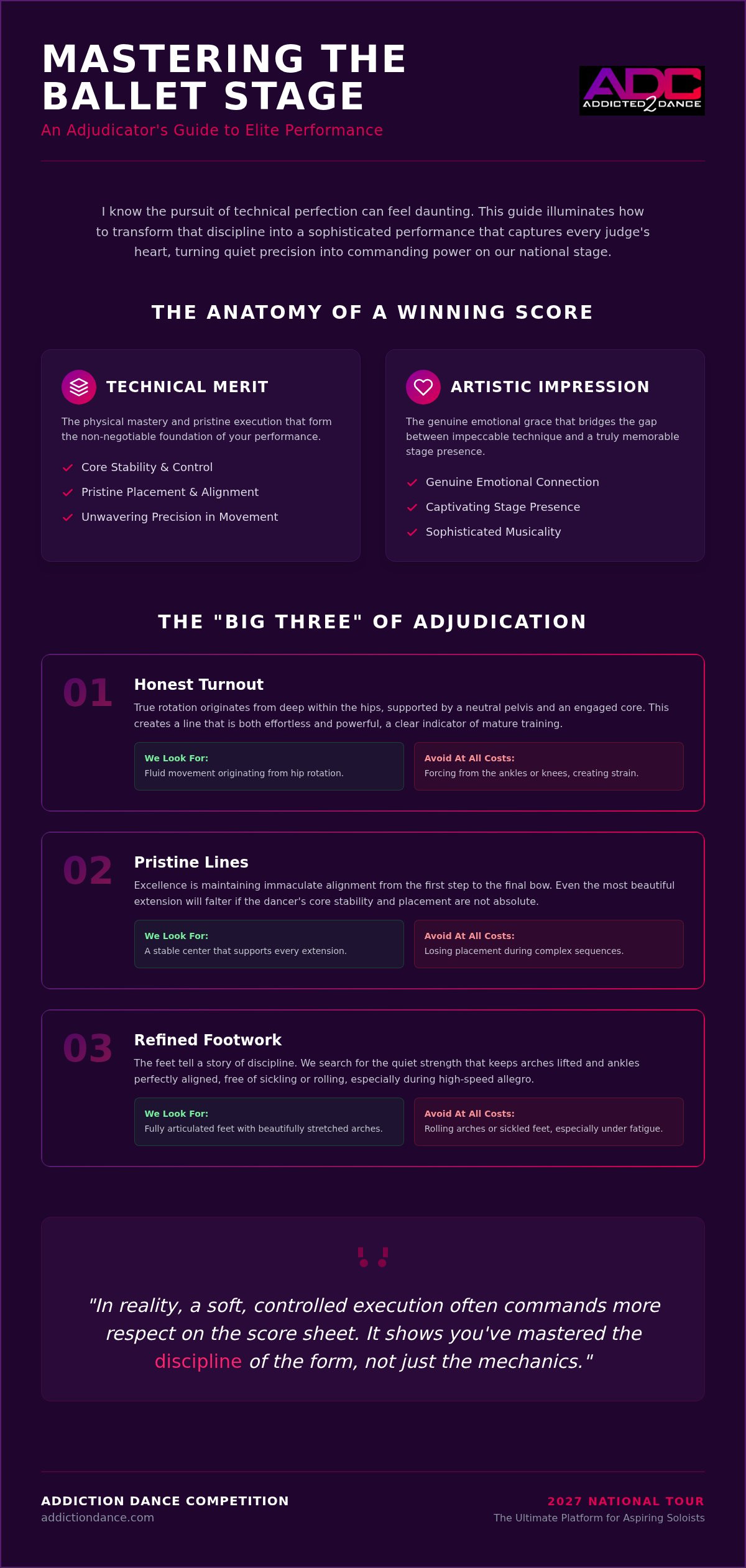
Elite adjudication is a precise art, especially when evaluating dance competition ballet. When you step onto the stage of our 2027 National Tour, our judges are looking for more than just a sequence of steps. They are searching for the "Big Three": turnout, lines, and foot articulation. It's easy to fall into the trap of thinking aggressive power equals a higher score. In reality, a soft, controlled execution often commands more respect on the score sheet. This refined approach demonstrates a level of maturity that separates a student from a professional artist. It shows that you've mastered the discipline of the form rather than just the mechanics.
The score sheet typically balances technical merit with artistic impression. While your technical score reflects your physical mastery, your artistic score captures your ability to communicate. Organizations like the National Endowment for the Arts highlight how dance serves as a vital pillar of cultural expression; our judges look for that same soul in your variation. Achieving a consistent score across both categories requires a deep understanding of core stability. Without a stable center, even the most beautiful lines will falter under the pressure of the spotlight. Precision is the foundation, but grace is what wins the day.
The Technical Foundation: Turnout and Placement
Honest turnout is a non-negotiable requirement in the ballet category. Our judges look for rotation that originates from the hips, not forced from the ankles. A neutral pelvis is the key to this effortless look. When you engage your core correctly, your movement becomes fluid rather than strained. We often see dancers lose their placement during high-speed sequences, leading to rolling arches or sickled feet. True excellence is maintaining that pristine alignment from the moment you walk on stage until your final bow. It's about the quiet strength that keeps your technique anchored.
Articulate Footwork and Extension
Power in ballet starts from the floor. Every jump and transition must demonstrate strength through the metatarsals. It isn't just about how high your legs go; it's about the integrity of the line you create. A leg at ninety degrees with perfect placement will always outscore a "high" leg that compromises the hips. While your lower body executes these powerful movements, your upper body must remain soft and expressive. This contrast creates the "wow" factor that leads to a winning adjudication. If you're looking to refine these nuances before your next event, you can explore our upcoming tour dates to see where you can showcase your growth.
Artistry and Grace: Bringing the Soul to the Stage
Technical mastery is the entry fee for the stage, but artistry is what earns the crown. Mastering the soul of a dance competition ballet solo requires a psychological transition from the mirror to the audience. I've seen many gifted dancers lose their connection to the piece because they're too focused on the mechanics of a turn. To truly excel, you must move beyond the "competition face," that frozen, artificial smile that masks genuine feeling. Instead, find a vulnerable, emotional core that resonates with the back of the house. This shift from internal correction to external expression is what creates a prestigious performance.
Your gaze is one of the most powerful tools in your artistic arsenal. Use your eyes to lead the judges through your story; don't just stare at a fixed point on the wall. When you project your focus beyond the stage lights, you invite the audience into your world. Breath is equally vital. It's the secret to making grueling technique look effortless. By breathing into your movements, you create a sense of ease that masks the physical demand of the choreography. This allows you to project confidence and elite status without losing the delicate vulnerability that makes ballet so captivating.
The Nuance of Port de Bras
Expansive, breath-filled arms are the hallmark of a sophisticated soloist. To avoid a robotic or stiff appearance, always initiate your port de bras from the back muscles rather than just the shoulders. This creates a more grounded, powerful line that fills the entire stage. Pay close attention to the relationship between your head, neck, and shoulders. A gentle tilt of the head or a subtle soften of the neck can transform a standard position into a stunning silhouette. It's these small, refined details that signal to a judge you've moved beyond basic training into true artistry.
Musicality and Phrasing
Elite performers don't just dance on the beat; they dance through the music. Sophisticated musicality involves a deep understanding of phrasing and the use of rubato. This means knowing when to linger in a balance or when to accelerate through a transition to emphasize a moment of technical brilliance. When you treat the music as a partner rather than just a background track, your performance gains a new level of maturity. This rhythmic intelligence is often what differentiates a high-scoring soloist from an intermediate performer on our 2027 National Tour. It shows a level of professional polish that is impossible to ignore.
Preparation for the Spotlight: Logistics and Aesthetics
Success on the 2027 National Tour depends on a meticulous attention to detail that begins long before you step into the wings. In the world of dance competition ballet, your aesthetic choices are just as critical as your technical execution. Selecting music that complements your dancer's maturity is the first step toward a sophisticated performance. A young student shouldn't be saddled with a heavy, dramatic score they can't yet inhabit emotionally. Conversely, an elite soloist needs a piece that allows for complex phrasing and artistic depth. It's about finding a sound that feels authentic to the performer's current stage of training.
Costuming requires a delicate balance. You want to honor classical tradition while incorporating the "wow" factor necessary for a high-production national stage. Think of your attire as a professional branding exercise. Your look, from the sparkle on your tutu to your stage-appropriate makeup, should project prestige. Transitioning from the collective energy of a dance competition group category to the solitary focus of a ballet solo is a significant mental shift. It requires a specific kind of quiet confidence that only comes from knowing every detail is in place. Your hair and makeup must be clean and secure, ensuring nothing distracts from your lines.
Selecting the Perfect Variation or Original Piece
Deciding between a classical variation and a newly choreographed work is a strategic move. A classical variation connects you to the history of the art form but leaves no room for error. Our judges know these variations inside and out. Original choreography, however, allows you to highlight specific strengths and hide technical gaps. Regardless of the choice, ensure the routine has a well-structured climax. A 2-minute competitive piece needs a moment of technical brilliance that leaves the judges breathless. It's the difference between a good routine and a winning one.
Stage Presence and Professionalism
Your performance begins the moment you are visible to the judges. Mastering the entrance and exit is non-negotiable. These are your first and last impressions; make them count. Professionalism also means handling the unexpected with poise. If a shoe ribbon slips or a transition feels slightly off, keep your focus. We visit diverse cities like Houston and Detroit, and each venue may offer different floor types like Marley or wood. Being prepared for these logistics ensures you remain in control of your experience. You can register for our 2027 National Tour to secure your spot in the spotlight and showcase your professional polish.
The Addiction Experience: Elevating Your Ballet Journey
The 2027 National Tour isn't just a series of dates on a calendar. It's a prestigious platform designed for the serious artist who refuses to compromise on quality. In the world of dance competition ballet, we provide a stage that finally matches the intensity of your daily training. Our high-production environments in major cities like Chicago and Las Vegas ensure that your classical work is presented with the respect it deserves. We've created a space where technical precision meets high-energy production, allowing you to feel like a professional the moment you step into the wings.
Our convention weekends offer a distinct advantage that you won't find at a standard competition. You're invited to take the lessons learned in an Elite Masterclass and apply them directly to the stage that same evening. This immediate application demonstrates the kind of adaptability and grit that industry scouts look for. You'll have the chance to network with professionals who truly value classical excellence, helping you build the versatility required for a modern career. We focus on the whole dancer, ensuring you leave each event with more than just a score.
The Path to Nationals Branson 2027
Your journey through our high-energy regional events leads to one ultimate destination: Nationals Branson 2027. This championship is the premier celebration of a season's worth of discipline and growth. We've cultivated a family-friendly environment that fosters confidence in young classical artists, proving that elite competition doesn't have to be cold or intimidating. Qualifying your ballet routine for this event means joining a community that celebrates your technical mastery and artistic soul. It's the perfect way to close your season with prestige and poise.
Mastering the Future of Classical Performance
I've seen how the modern stage has transformed dance competition ballet into a category of unmatched prestige. Success is no longer just about hitting a pose; it's about the seamless fusion of honest turnout, articulate footwork, and a soul-stirring artistic gaze. By prioritizing these elite standards, you aren't just preparing for a score sheet. You're building a professional foundation that will carry you through a lifetime of performance. The discipline you cultivate in the studio today is the same strength that will captivate an audience tomorrow.
Our 2027 National Tour offers the perfect environment to showcase this growth. With tour stops in premier cities like Chicago, Miami, and Las Vegas, you'll have access to our elite professional judging panel and technical masterclasses. Everything we do leads to the prestigious Nationals Branson 2027 championship, where your dedication to classical excellence is celebrated on the grandest scale. It's a journey defined by grace, powered by technique, and rewarded with professional recognition.
Secure your spot on the 2027 National Tour and experience the Addiction difference.
I'm so excited to see the grace and strength you bring to our stage this season. Your journey to the pinnacle of ballet excellence starts now.
Frequently Asked Questions
Is it better to perform a classical variation or an original ballet piece?
Choosing between a classical variation and an original piece depends entirely on your dancer's technical maturity and comfort level. A variation connects the performer to historical repertoire, which is highly respected by our professional judging panel. However, original choreography allows you to tailor the movement to a soloist's specific strengths. On our 2027 National Tour, we value both approaches as long as the execution maintains classical integrity and professional polish.
Do I need to wear a traditional tutu for the ballet category?
You don't have to wear a traditional stiff tutu for the ballet category, though your costume should always reflect the style of your piece. In cities like Philadelphia or Boston, a tutu is often the standard choice to help judges evaluate hip placement. If you're performing a more lyrical ballet piece, a soft skirt or clean leotard might be more appropriate. Always prioritize a look that projects prestige and ensures the dancer feels confident.
How do judges score ballet differently than jazz or contemporary?
Judges evaluate dance competition ballet with a specific focus on technical fundamentals like turnout, placement, and foot articulation. While jazz or contemporary categories often reward high-energy tricks and athletic dynamics, ballet adjudication is about the "Big Three": turnout from the hips, clean lines, and articulate metatarsals. We look for a soft, controlled execution that demonstrates a deep understanding of the classical foundation. This technical precision is vital for earning high scores at our regional events.
What are the requirements for the pointe category at Addiction Dance?
To compete in the pointe category at Addiction Dance, a dancer must demonstrate significant technical security and ankle strength. We generally recommend that only advanced soloists who have been training en pointe for several years enter this category. Our judges look for correct weight placement over the box and a neutral pelvis during transitions. It's essential that the choreography matches the dancer's level to ensure safety and a sophisticated performance on our national stage.
How can I improve my ballet score at my next regional competition?
Improving your ballet score at your next regional competition in cities like Chicago or Houston starts with refining your transitions. Judges often see dancers focus only on the big leaps or turns while neglecting the steps in between. Focus on using your breath to phrase the movement and maintaining a stable core throughout the routine. Attending our Elite Masterclasses mid-season is a fantastic way to get specific feedback for your dance competition ballet solo.
Are there specific scholarships for ballet dancers at the 2027 National Tour?
Yes, we offer prestigious scholarship opportunities specifically for top-tier ballet performers throughout the 2027 National Tour. These awards are designed to bridge the gap between competition and convention education, providing dancers with access to further training and elite masterclasses. Our industry-respected judges identify soloists in cities like Minneapolis or Birmingham who show exceptional promise. Winning a scholarship at a regional event can pave the way toward elite recognition at our Nationals Branson 2027 championship.
How should I handle music selection for a competitive ballet solo?
Music selection should always complement the dancer's technical level and emotional maturity. Avoid tracks that are overly dramatic or heavy if the soloist is not yet ready to inhabit that character. For classical work, ensure the recording is high-quality and has a clear rhythm that supports the dancer's phrasing. In cities like Miami or Detroit, a well-chosen piece of music can be the "wow" factor that helps a routine stand out on our high-production stage.
What is the best way to prepare for a ballet masterclass at a convention?
The best way to prepare for a ballet masterclass at our conventions in Las Vegas or Nashville is to arrive with a focused, professional mindset. Wear clean, traditional dancewear that allows the instructor to see your lines clearly. Be ready to take corrections gracefully and apply them immediately, as this shows the versatility judges look for. These classes are a premier opportunity to learn from experts who value classical excellence, so treat every minute as a chance to grow.


