
What if the difference between a high-gold and a platinum trophy isn't the choreography itself, but the specific dance competition group category you selected during registration? It's a question that keeps many dedicated studio owners awake as the 2027 National Tour approaches. I understand the delicate pressure of ensuring every dancer is placed where they can excel. You've poured your heart into the studio, and the last thing you want is for a Bump Rule or an age averaging error to overshadow your students' hard work. It's frustrating when registration feels like it's working against your artistic vision.
I'm here to offer a sophisticated roadmap that transforms registration anxiety into absolute competitive confidence. We'll explore how to master group divisions and age categories to position your studio for elite success. You'll gain a clear understanding of how to categorize every routine with precision. This ensures a streamlined experience for our 2027 National Tour. From the vibrant energy of our regional stops to the prestigious stage at Nationals Branson 2027, your dancers deserve the most fair divisions possible. Let's refine your strategy and prepare your groups for their most successful season yet.
Key Takeaways
- Learn how to organize your teams by size to ensure every small group of 4 to 9 dancers competes on a perfectly level playing field.
- Master age averaging as of January 1 and understand the 'Bump Rule' so you don't inadvertently place your dancers in the wrong division.
- Evaluate performance levels with expert intuition, placing your dancers in the league that best celebrates their current training and technical growth.
- Refine your selection of each dance competition group category by looking closely at the dominant technical elements and stylistic details of your routine.
- Prepare for a seamless registration experience for the 2027 National Tour as you guide your routines toward the spotlight at Nationals Branson 2027.
The Architecture of Group Categories: Sizes and Definitions
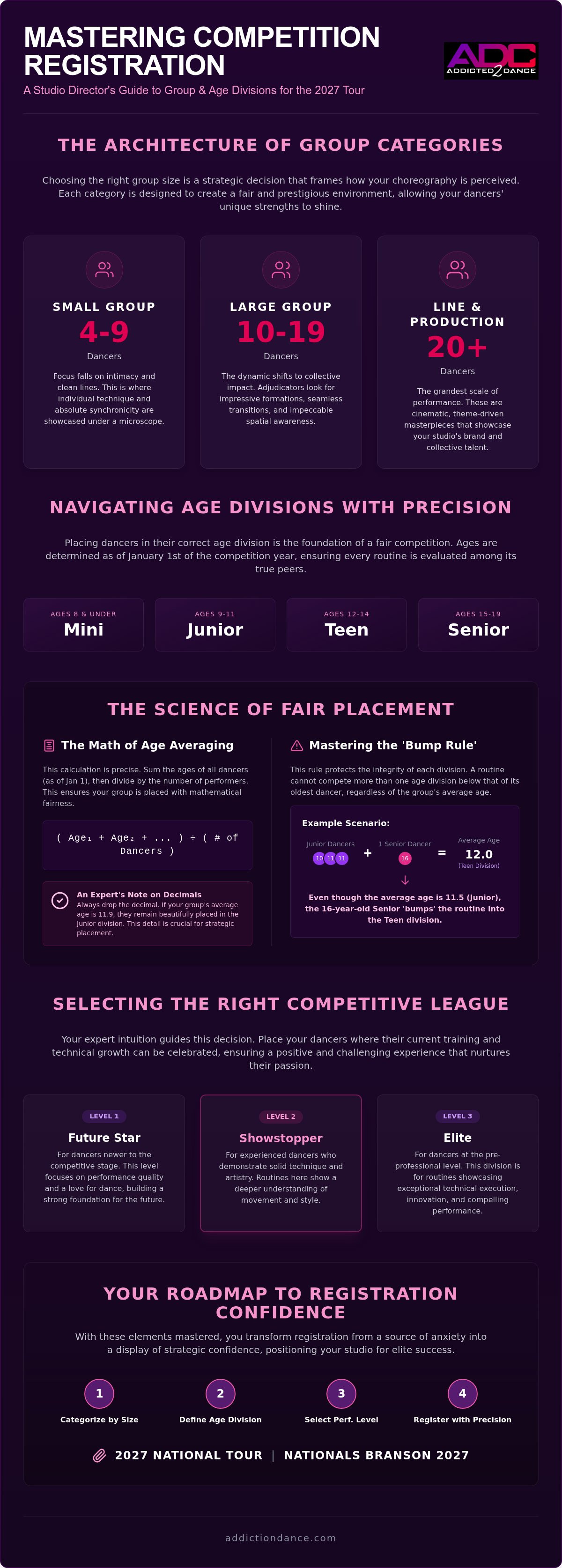
Precision is the heartbeat of competitive dance. Choosing the right dance competition group category is far more than a simple headcount. It's a strategic decision that defines how your choreography is perceived by the adjudicators. These divisions are carefully crafted to maintain a fair and prestigious environment for every performer. When you master these definitions, you set the stage for excellence during the 2027 National Tour.
- Small Groups: Comprising 4 to 9 dancers, these routines focus on intimacy, clean lines, and absolute synchronicity.
- Large Groups: Usually 10 to 19 dancers, where the visual impact of formations and transitions takes center stage.
- Lines and Productions: The grandest scale of performance, featuring 20 or more dancers and complex thematic elements.
Small vs. Large Groups: Finding the Balance
The size of your group dictates where the judging panel will focus their attention. In a small group, individual technique is under a microscope. Every transition and every extension is visible to the naked eye. This intimacy allows for a nuanced performance that highlights your dancers' technical growth. It's a beautiful way to showcase elite talent in a concentrated format.
Transitioning to a large group changes the dynamic entirely. Once you reach 10 dancers, the focus shifts toward the collective wow factor. Many studio owners find that a 9-person group often feels more cohesive than a 10-person group. This is often due to the logistical spacing of regional stages. A smaller group allows for more breath and movement, while a larger group requires impeccable spatial awareness to avoid a cluttered look. You don't want the technical brilliance of your dancers to be lost in a crowded formation.
The Power of Lines and Productions
Lines and Productions represent the pinnacle of studio pride. A Line typically features 20 or more dancers, emphasizing high-energy unison and powerful staging. These routines are designed to command the entire stage with momentum and prestige. They offer a unique opportunity to blend different age groups into one high-impact performance that reflects your studio's culture.
Productions take this concept to a cinematic level. A 'Production' is a theme-driven masterpiece with at least 18-20 performers. These routines allow you to showcase your studio's brand identity through elaborate storytelling and costuming. Bringing a massive production to Nationals Branson 2027 is the ultimate way to celebrate your studio's collective talent and artistic vision. It's about creating a memory that lasts long after the final curtain call; it's about the legacy you build on stage.
Navigating Age Divisions and the 'Bump Rule' with Precision
Success on the stage begins long before the first beat of music. It starts with the meticulous placement of your dancers into the correct age division. This ensures that every routine faces fair, high-caliber competition. Standard splits usually follow the Mini, Junior, Teen, and Senior model. Mini captures the magic of those 6 and under. Juniors range from 9 to 11. Teens hold the 12 to 14 bracket. Seniors dominate the 15 to 19 range. Understanding these boundaries is essential for choosing the right dance competition group category.
The Math of Age Averaging
Calculating your average age is a precise science. Take the age of every dancer as of January 1 of the competition year. Add them together. Divide by the total number of performers. Here's a crucial tip: don't round up. If your average is 11.9, you remain in the Junior division. However, stay vigilant. Small roster changes for the dance competition national tour 2027 can shift your category instantly. If a single dancer over 20 joins the group, you'll trigger the Adult category. It's a technicality that requires your constant attention during registration. Managing a mixed-age group is an art form. You have to balance the technical needs of your seniors with the developmental pace of your juniors. This balance is what makes a routine truly stand out at Nationals Branson 2027.
Strategic Mastery of the Bump Rule
The 'Bump Rule' exists to protect the integrity of the event. It prevents older, more advanced dancers from overwhelming younger divisions. Simply put, a routine cannot compete more than one age division below its oldest member. Imagine a group of 10-year-olds with one 16-year-old Senior. Even if the average age is 11, that single dancer acts as a technical anchor. They 'bump' the entire routine into the Teen division. Every dance competition group category at Addiction is designed to celebrate growth while maintaining this professional standard.
As a choreographer, this is your moment to shine. If your group bumps up, you must elevate the difficulty. Don't let your younger dancers feel outclassed. Instead, use the older dancer’s maturity to push the technical boundaries of the whole team. This strategic pivot ensures your group remains a formidable force. If you're feeling unsure about your specific placements, you can always review our competition rules to find the perfect fit for your studio.
Performance Levels: Selecting the Right Competitive League
Integrity is the foundation of every prestigious studio. Choosing the perfect performance level is a masterclass in leadership, requiring you to place your dancers in an environment where they can truly thrive. When you select a dance competition group category at Addiction, you're choosing a league that honors their current training and future potential. It's a delicate balance of technical skill and artistic readiness that defines their experience on the 2027 National Tour.
The tiers are designed to ensure every dancer feels successful. Novice or Beginner levels are perfect for those starting their journey or training fewer hours. The Intermediate or Competitive league is the vibrant heart of the circuit, where solid technique meets performance quality. For those with pre-professional aspirations, the Elite or Advanced level offers the ultimate challenge. I've always found that honest placement is the highest form of respect we can show our students. Avoid the temptation of 'sandbagging' to win trophies. Placing a group in a lower level than they belong stunts their growth and diminishes the prestige of the event. Authenticity breeds excellence.
Evaluating Training Hours and Experience
Setting a studio-wide standard for level placement creates a culture of clarity. You might decide that dancers training under 3 hours weekly belong in Novice, while those dedicating 6 or more hours are ready for Intermediate or Elite tiers. Correctly identifying the dance competition group category for each routine ensures that your teams aren't overwhelmed or under-challenged. Sometimes you'll have an 'Elite' dancer in a 'Competitive' group. In these cases, look at the group's collective impact rather than one individual's skill. You can use insights from a dance competition and convention weekend to gauge where your students stand against their peers and adjust their levels for future tour stops.
The Psychological Impact of Level Placement
The emotional growth of a dancer is just as vital as their technical progress. Nurturing confidence starts by placing groups where they can realistically succeed and feel proud of their work. For your Teens, competing in the Elite level can be a transformative 'stretch' goal that pushes them toward professional standards. The Elite level is the category where artistry and flawless technique are equally scrutinized. When they step onto that stage at Nationals Branson 2027, you want them to feel like they belong among the best. This sense of belonging is what fuels their passion and keeps them striving for the pinnacle of their craft.
How to Choose the Optimal Category for Your Routine
Strategic category placement is the final brushstroke on your choreographic masterpiece. It requires a gentle touch and a professional eye to ensure each piece is seen in its best light. To begin, analyze the dominant technical elements of the work. If your routine is heavy on balletic lines but features a modern soundtrack, you must decide if it truly fits the Lyrical mold or if it's better suited for Open. Step back and review the music and costuming choices. These subtle details often dictate the difference between a high-energy Jazz routine and a character-driven Musical Theater piece. Next, check the 'Open' category for those beautiful fusion pieces that defy traditional labeling. You should also audit your group size with care. Adding or removing just one dancer can shift your dance competition group category from a Small Group to a Large Group. This move might completely change your competitive landscape. Finally, consult the 2027 tour schedule. Knowing the category density in your specific region allows you to place routines where they have the absolute best chance to shine.
Style-Specific Categorization Strategy
When does a Jazz routine become 'Musical Theater'? It's all about the character. If your dancers are lip-syncing or portraying a specific role with theatrical flair, Musical Theater is likely your home. Differentiating 'Lyrical' from 'Contemporary' is equally nuanced. Lyrical follows the emotional journey of the lyrics, while Contemporary is often more abstract. It focuses on floor work and unconventional movement patterns. Be mindful of the 'Acro' rule as well. Most professional circuits allow a maximum of three gymnastic tricks before a routine must move to the Acro category. This precision ensures you aren't penalized for technical overlaps and that your dancers are adjudicated by the right specialists.
Maximizing Your Studio's Presence at Regionals
Smart studio owners spread their entries across categories with intention. You don't want to spend the weekend competing against your own routines. Use the 'Small Group' for your highest-scoring technical dancers to highlight their elite precision and individual growth. For a truly unforgettable experience, leverage 'Productions' for Nationals Branson 2027. These massive routines build incredible studio spirit and showcase your entire brand on a grand scale. It's about more than a trophy; it's about the collective energy of your studio family. To ensure your routines are positioned for the highest honors, explore our guide to maximizing potential at Nationals Branson 2027.
Elevating Your Group Performance with Addiction Dance
Your studio's journey deserves a stage that matches its ambition. At Addiction Dance Competition, we've curated a high-energy production environment where professional excellence is the absolute standard. Our 2027 National Tour is specifically designed to celebrate the unique artistry found in every dance competition group category. We maintain a family-friendly, positive atmosphere that respects the dedication of your dancers and their families. Here, elite adjudication meets a polished event experience, ensuring that every performance is evaluated with the expertise and nuance it deserves. It is a space where your hard work is honored with a world-class production.
Join the 2027 Tour in Your City
We are thrilled to bring this prestigious event to iconic hubs across the country, creating a sense of momentum and prestige for your entire team. Our schedule features major stops in Chicago, Las Vegas, and Nashville, offering your studio a chance to shine in a premier competitive setting. For family members who can't join the travel team, our regional livestream provides an immersive, high-quality experience from the comfort of home. To ensure your routines are placed exactly where they belong, I recommend that studio owners finalize their rosters and entries early. Registration for our most popular cities often reaches capacity quickly, so securing your preferred group spots now is the best way to guarantee a seamless tour experience for your families.
From Regional Stage to Branson Glory
The regional circuit is the foundation for something even more spectacular at the end of the season. Your success on tour leads directly to the prestige of the Branson National Championship 2027. This flagship event is the ultimate destination for routines that have truly mastered their dance competition group category. It's an environment where group excellence is rewarded with national titles and life-changing dance competition scholarships. Your leadership and strategic placement throughout the season are the primary keys to unlocking this level of success for your dancers. We are honored to be part of your studio's story and cannot wait to see your dancers command the stage with confidence in 2027.
Step Into the Spotlight for the 2027 Season
Your journey toward competitive excellence is a deliberate path paved with artistic vision and technical precision. By mastering every dance competition group category, you've already done the heavy lifting to ensure your students compete on a fair and prestigious stage. You understand that the right placement isn't just about the trophy; it's about the confidence your dancers feel when they know they're exactly where they belong. This strategic foundation is what allows their talent to truly radiate under the lights.
At Addiction, we're proud to support that vision with professional judging from industry-respected teachers and high-energy, family-friendly production standards. We invite you to bring that brilliance to our Nationals Branson 2027 flagship event, where group excellence is celebrated at the highest level. Your leadership is what transforms a simple routine into a life-changing performance. The 2027 season is approaching quickly, and the stage is waiting for your studio's unique brand of excellence. Secure your studio's spot on the 2027 National Tour today to ensure your preferred cities and categories are locked in. I truly look forward to witnessing the incredible artistry and growth your dancers will display on our tour.
Frequently Asked Questions
What is the 'Bump Rule' in dance competitions?
The Bump Rule prevents a group from competing more than one age division below its oldest member. If you have a senior dancer in a junior group, the entire routine must move up to the teen division. This maintains a level playing field and ensures that younger dancers aren't competing against significantly more mature performers. It's a hallmark of professional adjudication standards that protects the integrity of every dance competition group category.
How do I calculate the average age for a dance competition group?
You calculate the average age by adding the ages of all performers as of January 1 and dividing by the total number of dancers. It's essential to use the age of each student on that specific date to maintain consistency throughout the 2027 National Tour. If the result is a decimal, you drop the decimal rather than rounding up. This precise calculation ensures your routine is placed in the most competitive and fair age bracket.
Can a group routine include dancers of different performance levels?
Yes, you can include dancers with varying experience, but the routine must be entered at the level of the highest-ranking dancer. If a single 'Elite' performer joins a 'Competitive' group, the entire routine must compete in the Elite league. This approach encourages studio owners to be mindful of group composition. It ensures that every routine is adjudicated against peers with similar technical training and intensity, fostering a truly professional environment.
What is the difference between a Small Group and a Large Group?
The primary difference between these divisions is the number of performers on stage. Small groups consist of 4 to 9 dancers and often focus on synchronicity and individual technique. Large groups include 10 to 19 dancers, which allows for more complex formations and high-impact visual transitions. Choosing the right dance competition group category depends on whether you want to highlight intimate technical details or the collective power of a larger ensemble during the performance.
When should a routine be entered into the 'Open' category?
You should use the 'Open' category for routines that blend multiple styles or include elements that don't fit into traditional genres like Jazz or Lyrical. This is the perfect home for fusion pieces, ethnic dances, or highly conceptual work that defies standard labeling. It allows your choreography to be judged on its own artistic merits without the constraints of specific stylistic rules. It's a space for true innovation and creative boundary-pushing.
Are props allowed in all group dance categories?
Props are generally permitted in most categories, provided they don't damage the stage or pose a safety risk to the performers. However, routines that rely heavily on massive set pieces or complex props are often best suited for the Production category. You should always ensure that props can be moved on and off the stage within the allotted time. Safety and efficiency are paramount to maintaining the high-energy flow of our professional events.
How do I register my studio for the 2027 National Tour?
Registration is managed through our secure online portal, where you can select your preferred cities and tour stops for the 2027 National Tour. I recommend gathering your full roster and birth dates early to streamline the process. You'll need to specify the size and style for every routine to ensure each one is placed in the correct category. Securing your spot early is the best way to guarantee your studio's participation in our most popular events.
What is the time limit for a Production routine?
Production routines at our events are allowed a maximum of 8 minutes, which includes the time needed for set-up and strike. This extended duration gives you the space to build a complex narrative and showcase a large number of dancers. It's a generous window for storytelling and brand building. Because these routines are theme-driven masterpieces, they require careful timing to ensure the energy remains high from the first note to the final pose.


