
What if the most meaningful connection you make at a dance convention begins with a simple question about class, not a pitch about your ambitions? Even confident performers can feel unsure about approaching someone new, especially when they don’t want to interrupt or seem pushy. The best networking tips for dancers at conventions start with curiosity, courtesy, and genuine interest in the people sharing the room with you.
A convention is a place to learn, and that shared focus gives conversations a natural starting point. You don’t need to collect contacts or make every interaction count. A warm introduction, a thoughtful question, and good timing can open the door to a professional relationship at your own pace.
This guide covers how to prepare before an event, start comfortable conversations during classes and breaks, and follow up afterward. You’ll also learn how to respect a teacher’s time and choose a clear next step for staying in touch. Addiction Dance Competition events offer a setting to practise these skills while learning alongside dancers and industry professionals.
Key Takeaways
- Think of convention networking as connection through shared learning, not self-promotion or collecting contacts.
- Use a simple conversation rhythm: choose a suitable moment, introduce yourself, ask a relevant question, listen, and close graciously.
- Build rapport through curiosity and mutual respect, rather than interrupting, name-dropping, or pushing for opportunities.
- Use these networking tips for dancers at conventions to make a flexible before, during, and after plan, with one realistic intention for the event.
- Follow up thoughtfully after a promising conversation, keeping your next step comfortable and respectful.
Networking for Dancers: Connection Over Self-Promotion
Even confident performers can feel unsure about approaching someone new. A dance convention brings people together in a focused, high-energy setting, but you don’t need a polished pitch or a list of people to impress. The most useful networking tips for dancers at conventions begin with a simple idea: connect through the learning and movement you already share.
A network is a set of relationships formed between people, and understanding social networks can help put convention connections in perspective. For dancers, networking means building respectful relationships with peers, teachers, choreographers, and studio communities through shared learning and dance. It isn’t asking for a favor, pressing for an opportunity, or trying to hold someone’s attention. It’s showing interest, listening well, and treating each exchange with care.
Authentic networking means building meaningful connections through shared interests, not collecting contacts for what they might provide.
What networking means for a dancer at a convention
Connection can start with a peer who approached a combination differently, a teacher’s note that helped a movement click, or a conversation about the styles represented in class. Curiosity gives you something genuine to ask about. Courtesy helps you notice whether the other person is open to talking, and attentive listening makes the exchange feel reciprocal rather than rehearsed.
Keep the stakes small. A brief, positive exchange can be worthwhile even if it doesn’t lead to another conversation. You might acknowledge a classmate’s thoughtful interpretation of a phrase or thank a teacher for a useful correction when the moment allows. Then let the conversation end naturally. A gracious close is part of building trust, too.
What dancers can gain from genuine convention connections
Conversations with other dancers can introduce you to different training experiences, creative perspectives, and ways of approaching the work. Peer encouragement can also make an intensive learning environment feel more welcoming. A thoughtful exchange with a teacher or choreographer may offer a new point of view, but it shouldn’t be treated as a promise of future access or opportunity.
These connections can help you feel more engaged in class. Listening to how others interpret movement or respond to feedback may draw your attention to details you’d otherwise miss. At Addiction Dance conventions, dancers learn from industry-respected teachers and choreographers in a positive, family-friendly environment. That shared focus creates natural opportunities to connect without requiring every interaction to lead somewhere. Participate fully, stay open to others, and let professional relationships develop at a comfortable pace.
How to Start Conversations with Dancers and Teachers at a Convention
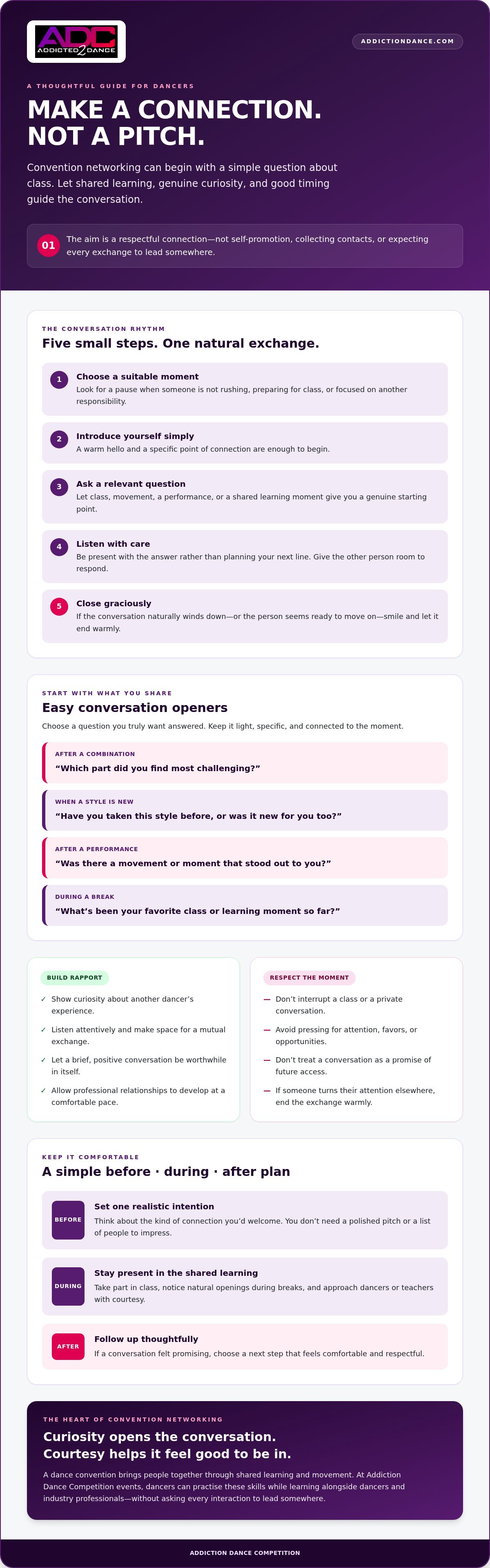
A good conversation doesn’t need a clever opening. It needs good timing, a genuine point of connection, and room for the other person to respond. Use this simple rhythm: notice an appropriate moment, introduce yourself, ask a relevant question, listen, and close graciously.
Easy conversation starters for convention breaks and classes
Choose a moment when people aren’t rushing into class or getting ready. A brief introduction with your name and a specific connection gives the other person an easy way into the conversation. Keep it natural and adapt the words to your age, confidence, and dance style.
- “Hi, I’m Maya. I really enjoyed that combination. Which part did you find most challenging?”
- “I’m Jordan. Have you taken this style before, or was it new for you too?”
- “That performance was inspiring. Was there a movement or moment that stood out to you?”
- “I’m Alex. What’s been your favorite class or learning moment so far?”
Ask something you genuinely want to know, then listen instead of planning your next line. If the other dancer seems engaged, continue with a related thought. If they give a short answer or turn their attention elsewhere, smile and let the exchange end warmly.
How to approach instructors with respect
Teachers are often balancing class, conversations, and the flow of an event. Before approaching, check whether the instructor seems available and follow any event guidance about when or where conversations are appropriate. Don’t interrupt a class, a private conversation, or a moment when the teacher appears to be moving on to another responsibility.
When the moment feels suitable, introduce yourself and ask one focused question about something specific from class. For example: “I’m Riley. Could you share one detail I should focus on as I practise that transition?” A concise question is easier to answer than a long personal pitch or a request for special attention. If the teacher has only a moment, thank them and step away graciously.
Respectful convention conversation means choosing a considerate moment, asking with genuine interest, listening fully, and accepting the other person’s cues. That keeps the exchange warm without placing pressure on either person. For broader ideas about growth in dance education, the National Dance Education Organization shares professional development opportunities, including conferences and courses.
Practising these skills in a shared learning environment can make introductions feel more comfortable over time. Addiction Dance conventions bring dancers together to learn from industry-respected teachers and choreographers, creating a natural setting to try a thoughtful opener and listen with care.
How to Network at Dance Conventions Without Feeling Transactional
Networking doesn’t ask you to impress everyone in the room. It also doesn’t require turning each introduction into a request for an audition, invitation, or favor. At a convention, relationships can grow from the shared work of learning dance. A good conversation may simply leave both people feeling seen, encouraged, or glad they exchanged a few words.
Approaching someone only to list achievements, name-drop, or steer the conversation toward what they can offer may feel pressured. Showing genuine curiosity about a class, a style, or another dancer’s perspective creates space for a more balanced exchange. The goal isn’t to perform offstage. It’s to meet people with the same care and presence you bring to the studio.
Signs a conversation feels genuine rather than forced
Notice whether the conversation has room for both people. Share a thought about the class, listen to the other person’s response, and let the topic develop naturally. If you mention your interests, keep it relevant and simple, such as explaining that you’re exploring a particular style because you enjoy its musicality. You don’t need to turn that detail into a pitch about your potential.
A genuine conversation doesn’t have to be long or lead to a professional result. If either person needs to move on, a warm “It was lovely talking with you. Enjoy the next class” is a complete and courteous ending. Knowing when to close an exchange respects both people’s time and keeps connection from becoming an obligation.
How to handle shyness, nerves, or a quiet response
If approaching an instructor feels intimidating, begin with a peer or join a small group conversation where the shared class gives everyone common ground. Set a gentle goal: offer a brief introduction or contribute one thought. You don’t need to create an immediate deep connection. These networking tips for dancers at conventions leave room for different comfort levels and personalities.
A quiet response isn’t a verdict on your social skills. The other person may be tired, focused, or ready to move on. Respect that cue without taking it personally. You can also choose your own boundaries: it’s fine to pause, leave a conversation that feels uncomfortable, or observe before joining in. Connection should feel considerate in both directions, not like a test you have to pass.
A Practical Before, During, and After Plan for Convention Networking
A little preparation can make convention conversations feel more manageable without turning the event into a networking assignment. Use this flexible checklist to stay focused on learning, connect at your own pace, and follow up thoughtfully if a conversation feels worth continuing. These networking tips for dancers at conventions are a guide, not a quota.
Before: Set one simple intention
- Choose a realistic goal. You might hope to meet a peer, ask a teacher one class-related question when they’re available, or feel more comfortable joining a conversation.
- Consider your point of connection. Think about a style you’re curious about, a class you’re looking forward to, or whose perspective you hope to learn from. Keep the reason grounded in genuine interest.
- Prepare a natural introduction. Your name and one relevant detail are enough: “Hi, I’m Sam. I’m enjoying exploring contemporary movement.” You don’t need to memorize a pitch.
- Make room for the event itself. Prioritize your classes, comfort, and any event guidance. Networking should complement your convention experience, not compete with it.
During: Stay present and read the moment
Let conversations grow from what’s happening around you. A class, a combination, or a shared learning moment can give you an easy starting point. Ask a question you genuinely want answered, listen to the response, and let the exchange end naturally if either person needs to move on. You don’t need to speak to everyone or keep track of every introduction. One thoughtful interaction can be enough to meet your intention.
If plans shift, that’s fine. You may feel more comfortable talking with a peer than approaching a teacher, or prefer to focus on class that day. For context on how conventions fit into the broader event experience, explore this guide to the dance competition and convention circuit.
After: Follow up with care
If someone shared a preferred way to stay in touch, use that channel and make your message specific enough to jog their memory. For example: “Hi, it was lovely meeting you after class. I enjoyed hearing your perspective on the combination, and I’m glad we had a chance to talk.” Keep it appreciative and brief. There’s no need to attach an immediate request, send repeated messages, or expect a particular response timeline. A warm follow-up opens the door, and the other person can decide whether and when to respond.
Ready to practise your intention in a shared learning environment? Explore Addiction Dance conventions as an opportunity to learn alongside dancers and industry-respected teachers.
Put These Dance Convention Networking Tips into Practice at Your Next Event
Strong convention connections don’t come from trying to meet everyone. They grow through small, considered choices: approach with curiosity, respect the other person’s time, and follow up thoughtfully when it feels appropriate. These networking tips for dancers at conventions are most useful when they support your learning, not when they become another performance to perfect.
Turn a class into a natural connection point
Shared learning gives you a meaningful place to begin. Instead of offering a general compliment, refer to a moment that genuinely caught your attention: a challenging transition, a new way of interpreting a phrase, or a teacher’s explanation that helped a movement make sense. Then leave room for the other dancer’s perspective. A conversation can be valuable even if it ends after a few exchanges.
Conventions bring dancers with different styles, experiences, and training backgrounds into the same learning environment. Stay open to those differences without comparing or assuming you know someone’s path. A peer may offer a useful perspective, while a brief exchange with a teacher can deepen your understanding of the work. Neither interaction needs to promise a future opportunity to matter. For a broader view of how conventions relate to event experiences, explore the dance competition and convention circuit.
Choose a next step that feels right for you
Before your next event, choose one realistic intention. Perhaps you’ll introduce yourself to a dancer in class, ask one thoughtful question, or follow up with someone after a conversation you enjoyed. Let that intention guide you, but give yourself permission to adjust. A meaningful convention experience can include focused learning, quiet observation, and connection in whatever balance feels comfortable.
Addiction Dance conventions and elite masterclasses bring dancers together to learn from industry-respected teachers and choreographers. They offer a shared setting to practise these habits, meet fellow dancers, and stay focused on your development. Connections may continue, or they may simply make the event feel more engaging in the moment. Both are worthwhile possibilities, not promised outcomes.
Let education lead, and let connection grow naturally alongside it. If you’re ready to explore an opportunity to learn, connect, and grow, Explore Addiction Dance events.
Build Genuine Connections at Your Next Convention
Meaningful convention networking doesn’t require a perfect introduction or a room full of new contacts. The strongest networking tips for dancers at conventions come down to a few thoughtful habits: approach with curiosity, respect people’s time, and follow up with care when a conversation feels worth continuing.
Let shared learning do some of the work. A class or a moment of progress can offer a natural way to connect with fellow dancers, while a small intention keeps networking comfortable and focused. Not every exchange needs to lead somewhere. A positive conversation can be valuable in its own right.
Addiction Dance hosts conventions and elite masterclasses across the United States, bringing dancers together to learn from industry-respected teachers and choreographers. If you’re ready to explore an event where learning and connection can happen side by side, Explore Addiction Dance events.
Take one small step at your next convention. A genuine hello is a strong place to begin.
Frequently Asked Questions
How do you start a conversation at a dance convention?
Start with a shared moment, such as a class or combination, and choose a time when the other person doesn’t seem rushed. Introduce yourself by name, then ask a genuine, open question: “What did you think of that transition?” Listen to the answer and let the conversation develop naturally. These networking tips for dancers at conventions work best when you’re curious, respectful, and comfortable ending the exchange after a few words.
What should a dancer say to a choreographer at a convention?
Offer a brief introduction and ask one focused question about the choreographer’s class or a movement detail you’re working to understand. For example: “I’m Jordan. I enjoyed the musicality in that phrase. What should I focus on as I practise it?” Choose a moment when the choreographer appears available and event expectations allow conversation. Avoid a long pitch or request for special attention, and thank them graciously if they can only respond briefly.
Is networking at a dance convention only for advanced dancers?
No. Networking is simply respectful connection through shared learning, so dancers don’t need advanced training or a professional résumé to participate. Addiction Dance events serve dancers of different ages and skill levels. The organization’s United States focus includes communities such as Chicago, Akron, Omaha, Richmond, Las Vegas, Minneapolis, Miami, Houston, Grand Rapids, Memphis, Detroit, Bloomington, Philadelphia, Pittsburgh, Boston, Nashville, St. Louis, Davenport, Milwaukee, and Birmingham. Check event details for relevant opportunities.
How can shy dancers network at conventions without feeling awkward?
Begin with a small step rather than expecting yourself to lead a long conversation. You might introduce yourself to a peer, join a small group, or ask one question about a class you shared. Listening counts as participation, too. If the other person responds briefly, it doesn’t mean you’ve failed; they may simply be focused or ready to move on. Let your comfort guide how much you engage.
Is it appropriate to contact a dance teacher after a convention?
It can be appropriate if the teacher shared a preferred contact method or has a public professional channel intended for messages. Keep your note courteous, concise, and connected to the convention, such as thanking them for a class and mentioning a specific idea you found useful. Avoid assuming they’re available for ongoing advice or a personal response. If no contact method was offered, respect that boundary and leave the interaction there.
How do you follow up with someone you meet at a dance convention?
Use a contact channel the person shared, and remind them where you met. A short message might say, “It was lovely talking after class. I appreciated hearing how you approached that combination.” Keep the tone warm and appreciative, without attaching an immediate request. Follow up once, then give them space to respond in their own time. A thoughtful message can continue a conversation, but it doesn’t obligate the other person to reply.
What are good conversation starters for dancers at conventions?
Ask about something you genuinely noticed or enjoyed. Try, “Have you studied this style before?” or “Which part of that class challenged you in an interesting way?” You could also ask what a fellow dancer thought of a performance or learning moment. Specific questions make it easier to respond than a generic compliment, while leaving room for different experiences. Keep your opener simple, then follow the other person’s interest and cues.


