
What if you don’t need to get rid of your nerves to perform with confidence? A solo can bring up real worries: forgetting choreography, making a visible mistake, or not knowing what to do in the moments before you walk onstage. Learning how to mentally prepare for a dance solo isn’t about demanding perfect calm. It’s about having a steady plan you can return to, even when butterflies show up.
Your nerves make sense, especially when you care deeply about your performance. But they don’t have to take the lead. A few focused habits can help you feel more present, trust the work you’ve put in, and meet an unexpected slip with composure rather than self-criticism.
This guide covers a practical pre-performance routine, simple breathing and mental-rehearsal techniques, and ways to refocus if a moment doesn’t go as planned. The aim isn’t a flawless performance. It’s a more grounded, confident one that feels like yours.
Key Takeaways
- Learn how to mentally prepare for a dance solo by building focus and recovery skills, rather than expecting yourself to feel completely calm.
- Use mental rehearsal alongside physical practice to picture movement intentions and transitions from your own perspective.
- Create a brief, flexible pre-performance routine that works with your usual warm-up and your teacher’s instructions.
- Choose a simple way to refocus after a mistake so one unexpected moment doesn’t take over the rest of your solo.
- After performing, reflect on the choices you controlled and use feedback as guidance for your next performance.
How to Mentally Prepare for a Dance Solo When Nerves Set In
Standing alone under the lights can feel exposing, even when you’ve rehearsed thoroughly and know your choreography. Without fellow dancers beside you, each entrance, transition, and pause may feel especially visible. You might worry about forgetting a section, being judged, or falling short of your own expectations. Those concerns can feel personal, so they deserve more than a quick “just relax.”
Mental preparation for a dance solo means practicing how to focus, stay ready, and recover in the moment, not forcing yourself to stop feeling nervous. A racing heart doesn’t mean you’re unprepared. Notice the nerves, take your next breath, and choose how to begin and where to direct your attention. In performance psychology, mental and behavioral skills are part of preparing to perform. For a dancer, that preparation can include building focus and deciding how to respond when the unexpected happens.
Why can a dance solo feel more intimidating than group choreography?
In group choreography, shared formations and movement can make attention feel distributed. A solo places your interpretation at the center, which may heighten the sense of being watched. For some dancers, that brings up worries about memory; for others, the pressure comes from evaluation or a personal standard they care deeply about meeting. Naming your particular concern can make it easier to prepare for it, rather than treating every nerve as one large, unmanageable fear.
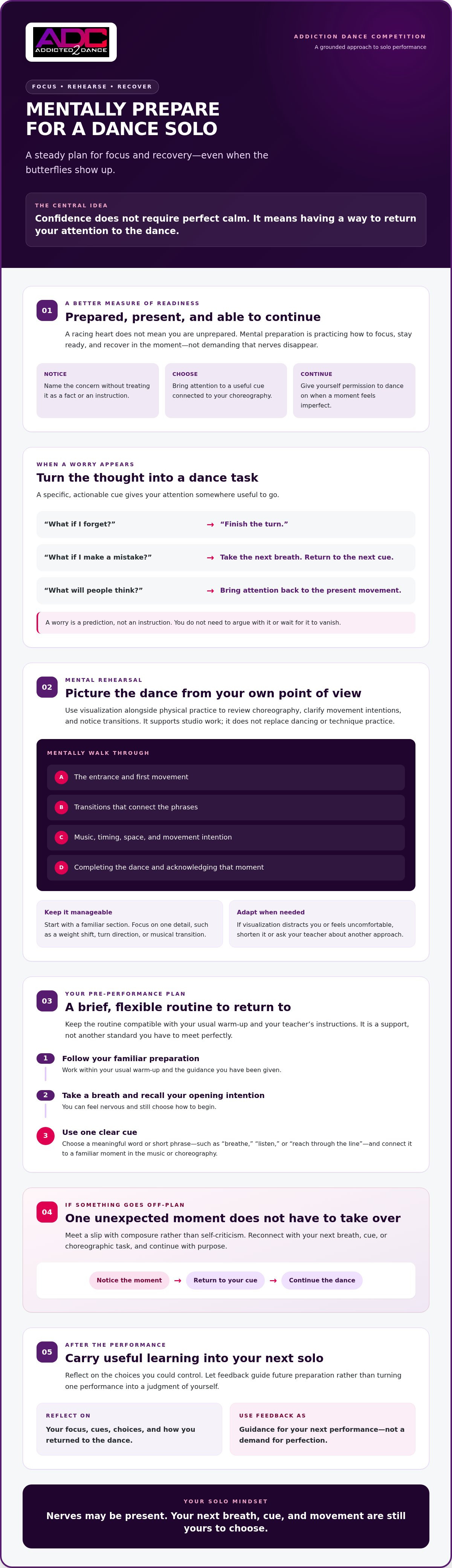
Separate the worry from the task. “What if I forget?” is a prediction, not an instruction. Replace it with a specific, actionable cue connected to your choreography, such as “finish the turn” or “breathe into the next phrase.” A clear cue gives you something useful to do without requiring you to feel fearless.
What does it mean to feel mentally ready to perform?
Readiness isn’t certainty that every movement will be flawless. It means knowing what you’ve prepared, bringing your attention to the present, and having a way to return to the dance if your focus wavers. That’s a more dependable foundation than waiting for confidence to arrive as a perfect, untroubled feeling.
As you consider how to mentally prepare for a dance solo, focus on what you can influence: recall your opening intention, settle your attention on a familiar cue, and give yourself permission to continue if a moment feels imperfect. Nerves may remain, but they don’t have to make your choices for you. You can feel them and still dance with purpose, musicality, and control.
Build Dance-Solo Confidence Through Focused Mental Rehearsal
Mental rehearsal gives your attention another way to work with choreography you’ve already practiced physically. It can help you review the sequence, notice transitions, and clarify the intention behind a movement. It doesn’t replace studio practice or correct technique; it supports the preparation you and your teacher have already built.
Visualization can sharpen your rehearsal, but it can’t substitute for dancing the choreography and developing its technique in practice. Keep the mental work focused and manageable. During a familiar pause in your studio routine, briefly review one passage, then return to the physical task in front of you. If imagining the dance starts to feel distracting, shorten the exercise or ask your teacher to help you adapt it.
How can you use visualization before a dance solo?
Picture the solo from your own point of view, moving through familiar choreography in order. Include the entrance, the first movement, and the transitions that connect phrases, rather than jumping straight to a triumphant ending. Notice how the music guides your timing, where you are in the space, and what intention you want to carry through each section. Finish by imagining yourself completing the dance and acknowledging that moment.
Start with a section you know well instead of trying to create a flawless mental movie of the entire piece. The details don’t need to look perfectly vivid. You might focus on shifting your weight, the direction of a turn, or the musical phrase that signals a transition. If visualization feels uncomfortable or pulls your attention away from useful preparation, speak with your teacher about another approach.
How can a performance cue strengthen focus?
A brief cue gives your attention a clear place to land at the opening of the solo. Choose a word or short phrase that feels meaningful and connects directly to the dance. It could be “breathe,” “listen,” or a movement intention such as “reach through the line.” There isn’t one correct cue; choose something you can remember and use without adding pressure.
Pair your cue with a familiar moment in the music or choreography. If thoughts about judgment or memory surface, you don’t have to argue with them or wait for them to disappear. Return to the cue, then direct your attention toward the next action: hearing the phrase, completing the movement, or moving into the transition. That small reset can help you stay engaged with the dance, one moment at a time.
As you consider how to mentally prepare for a dance solo, treat imagery and cues as skills to explore in practice, not tests you must pass. A supportive performance setting can also give you room to share prepared work and continue learning. Addiction Dance Competition hosts professionally judged competitions with solo categories across dance styles. You can learn about its dance competitions as one possible setting for that experience.
Manage Mistakes and Perfectionism Without Letting Them Take Over
Feeling nervous doesn’t automatically mean you’re unprepared. It may simply mean the solo matters to you. Preparation can make choreography more familiar, but no dancer can control every detail of a live performance. A missed accent or imperfect transition may happen; it doesn’t have to define what comes next.
Perfectionism can make a small slip feel larger than it is. Your mind may rush to judge the mistake while the music keeps moving. In that moment, the most useful response isn’t to demand a flawless recovery. Bring your attention back to the dance and continue as fully as you can. This won’t prevent mistakes, but it can help keep one moment from taking over the rest of your solo.
What should you do if you forget a step during your solo?
Return your attention to the next familiar movement, musical cue, or transition. If a detail slips in one phrase, listen for the next clear beat or recognize the pathway into a movement you know. Try not to replay the error or visibly scold yourself; those reactions can pull focus from the choreography still unfolding. During rehearsal, ask your teacher which recovery options fit your solo, so you can practice continuing with composure.
How can dancers ease perfectionist pressure before performing?
Before you begin, define success through choices you can influence: staying connected to the music, committing to your movement intention, or returning your focus after a distraction. Replace absolute self-talk such as “I can’t make one mistake” with language that feels believable in your own voice, such as “I’ve prepared, and I can keep going if something feels off.”
Scores, awards, and audience reactions may matter to you, but they aren’t a measure of your worth as a dancer. Hold high standards while leaving room for humanity. You can care about quality, work carefully, and still accept that a live solo won’t be perfectly controllable. That balance is central to how to mentally prepare for a dance solo: value your preparation, then focus on the next choice you can make.
Create a Simple Pre-Performance Mental Routine for Your Solo
A repeatable routine can give your attention a familiar path when the event setting feels busy or the schedule shifts. Keep it flexible, and fit it around your established warm-up and your teacher’s or event-day instructions. The aim isn’t to add pressure or rehearse every detail backstage. It’s to make a few steady choices that help you feel ready to begin.
Use this sequence as a starting point, then adjust it with your teacher:
- Check what you can control. Notice what’s ready, such as your costume and agreed-upon performance cues. Set aside what you can’t control right now, including the schedule, other dancers, or how you’ll be judged.
- Review one or two familiar cues. Recall the opening intention or a key transition you and your teacher have chosen. Resist repeatedly testing every step; last-minute checking can make preparation feel less settled.
- Use a familiar grounding practice. If a breathing or grounding practice already feels comfortable, use it briefly. Don’t feel obliged to try a new technique just before performing.
- Bring your attention to the dance. Notice where you are, recall your opening cue, and direct your focus toward the music and the first movement.
What can you do before your solo is called?
Stay with the plan you’ve practiced instead of collecting last-minute advice or comparing your preparation with another dancer’s. Follow the instructions from your studio, teacher, and event. If you’re unsure what to do next or feel overwhelmed, check in calmly with a trusted teacher or adult. That can help you return to your routine without adding extra steps.
How can you focus in the final moments before going onstage?
Keep the last moments simple: notice the present moment, recall your opening cue, then turn your attention toward the performance. You might feel your feet on the floor, think “listen,” and focus on the first musical phrase. Choose actions that are already familiar, and leave unfamiliar advice or comparisons outside your preparation.
Backstage reminder: Check what you can control. Recall your cue. Notice this moment. Begin. That compact sequence captures how to mentally prepare for a dance solo without needing to feel perfectly calm first.
A supportive competition setting can give you space to share prepared work and continue learning. Explore Addiction Dance Competition events and consider how a solo performance could fit into your broader dance experience.
Carry Your Solo Mindset From the Stage Into Your Next Performance
Your solo doesn’t end the moment you leave the stage. How you reflect on it can shape what you carry into the next performance. Scores, awards, and audience reactions may be part of the experience, but they’re only one piece of the picture. Give yourself space to feel whatever comes up before turning the performance into a lesson.
How can you reflect on your solo after performing?
Start with something you controlled. Name one moment when you felt focused, expressive, musical, or well prepared. It could be a transition you handled with care or a phrase where you stayed connected to your intention. This isn’t about overlooking areas to improve. It’s a way to recognize the work and choices that deserve to be remembered, too.
When you’re ready, choose one useful question to discuss with your teacher. For example: “How can I make that transition clearer next time?” A focused question is more constructive than replaying every perceived flaw. Feedback can show you what to practice or explore; it isn’t a verdict on your talent or potential. If you feel disappointed or excited, let those feelings settle before deciding what the performance means to you.
How can competition experience support future confidence?
Each performance offers a chance to learn more about your own preparation. You may notice that reviewing a particular cue helps, or that you feel more present when you give yourself quiet space before going onstage. Carry forward what was useful and discuss any changes with your teacher. Confidence can grow through experience, but taking part can’t guarantee a particular feeling, score, or result.
Addiction Dance Competition hosts regional and national events with solo categories across dance styles, professional judging, and a positive, family-friendly atmosphere. A supportive setting can give dancers a place to share prepared work and keep learning. As you continue thinking about how to mentally prepare for a dance solo, let each performance inform your next steps without making one result the measure of your growth.
If you’re considering a future opportunity to perform, explore Addiction Dance Competition events and see whether one feels like a good fit for your dance journey.
Take Your Confidence Into Your Next Solo
Learning how to mentally prepare for a dance solo isn’t about waiting for nerves to disappear. It’s about practicing a simple routine, focusing on the movement in front of you, and knowing how you’ll return to the dance if a moment goes differently than planned. Mental rehearsal can support your physical preparation, while reflection afterward helps you notice what worked and choose one useful next step.
Let confidence come from the choices you can control: your preparation, your focus, and the care you bring to performing. Scores and audience reactions may matter, but they don’t define your value or potential as a dancer.
Addiction Dance Competition hosts regional and national events with solo categories across various dance styles, professional judging, and a family-friendly atmosphere. For dancers and families in Chicago, Akron, Omaha, Richmond, Las Vegas, Minneapolis, Miami, Houston, Grand Rapids, Memphins, Detroit, Bloomington, Philadelphia, Pittsburgh, Boston, Nashville, St. Louis, Davenport, Milwaukee, and Birmingham, regional and national events can offer opportunities to share prepared work and keep learning.
You don’t need a perfect performance to take the stage with purpose. Trust your preparation, stay with the music, and give yourself room to grow. Explore Addiction Dance Competition events to find a competition or convention opportunity that fits your dance goals.
Frequently Asked Questions
How do I calm my nerves before a dance solo?
Use a familiar pre-performance routine rather than trying to force your nerves away. Follow your usual warm-up and your teacher’s instructions, then review one or two agreed-upon cues, such as your opening intention or a key transition. If a breathing or grounding practice already feels comfortable, use it briefly. Keep your attention on what you can control, like listening for the opening music and beginning with purpose.
Is it normal to feel nervous before performing a dance solo?
Yes, feeling nervous before a solo can be part of caring about the performance, and it doesn’t automatically mean you’re unprepared. Dancers experience nerves differently, so there’s no single “right” way to feel before going onstage. Rather than judging the feeling, notice it and redirect your attention to a familiar cue or the next action. You can feel nervous and still perform with intention and control.
What should I do if I forget choreography during my solo?
Bring your attention to the next familiar movement, musical cue, or transition, and continue as steadily as you can. Try not to replay the missed step or visibly criticize yourself while the dance is still unfolding. Before performing, ask your teacher how you might recover from a missed section in your specific choreography. Practicing an agreed-upon recovery option can help you respond with composure, though it can’t guarantee that mistakes won’t happen.
How can I build confidence for a dance solo?
Build confidence through preparation you can repeat: rehearse the choreography physically, clarify your movement intentions, and choose a simple cue for the opening moment. After performing, recognize one choice you controlled, such as staying connected to the music or refocusing after a distraction. Confidence doesn’t require certainty that every movement will be flawless. It can come from trusting your preparation and knowing you can keep engaging with the dance.
Does visualization help dancers prepare for a solo?
Visualization can complement physical rehearsal by helping you mentally review familiar choreography, transitions, musical phrasing, and spatial pathways. Picture the solo from your own perspective and focus on clear movement intentions rather than only imagining applause or a perfect result. Mental rehearsal isn’t a replacement for practicing technique and choreography in the studio. If visualization feels distracting or uncomfortable, shorten it or ask your teacher to help adapt the approach.
What should I do immediately before going onstage?
Keep the final moments simple: notice where you are, recall your opening cue, and direct your attention toward the performance. Follow your teacher’s and event’s instructions, and avoid last-minute comparisons or unfamiliar advice. If you need support, check in calmly with a trusted teacher or adult. Dancers in Chicago, Miami, Boston, and other communities should also follow the specific event-day directions for the event they’re attending.
How do I stop worrying about making mistakes during a dance performance?
You may not be able to stop every worry, but you can practice giving your attention a more useful direction. Replace “I can’t make a mistake” with a realistic cue in your own voice, such as “listen for the next phrase.” Set an intention you can control, like committing to your expression or movement quality. A mistake doesn’t define the entire performance, and scores or audience reactions don’t define your worth as a dancer.


