
How are dance competitions adjudicated? Judges assess each performance using the event’s criteria, while awards may also compare routines within a category. The process is structured, but there isn’t one universal formula for every competition.
It’s natural for dancers and families to wonder what judges noticed, how feedback connects to a result, and how performances are assessed consistently. Professional adjudication gives routines a considered review, often taking technique, execution, musicality, choreography, and performance quality into account. The event’s published rules explain the specific criteria and how results are organized.
In this guide, I’ll walk you through what typically happens between a performance and its result, how adjudicated awards can differ from rankings, and how to interpret rules and feedback. I’ll also connect these principles to solo, duo/trio, and group categories across styles at Addiction Dance Competition, where professional judging is part of an organized, welcoming experience.
Key Takeaways
- Understand how are dance competitions adjudicated by separating a judge’s assessment of a routine from its placement against other performances.
- Follow the typical path from watching a performance to evaluating it and communicating results, while remembering that event procedures differ.
- Recognize that judging includes artistic interpretation, and that stated criteria guide professional assessments without removing that perspective.
- Use the relevant category and published event criteria to make sense of results, and treat feedback as one perspective for continued growth.
- Learn what professional adjudication looks like at Addiction Dance Competition, where industry-respected professionals judge performances.
How Are Dance Competitions Adjudicated? Start with the Purpose of Judging
So, how are dance competitions adjudicated? Judges make a professional assessment of each performance using the framework set out by the event. The goal is to consider the routine on its own terms, not simply to decide which dancer made the strongest impression in the room. That distinction helps make results easier to understand when several styles and categories share the stage.
What does adjudication mean in a dance competition?
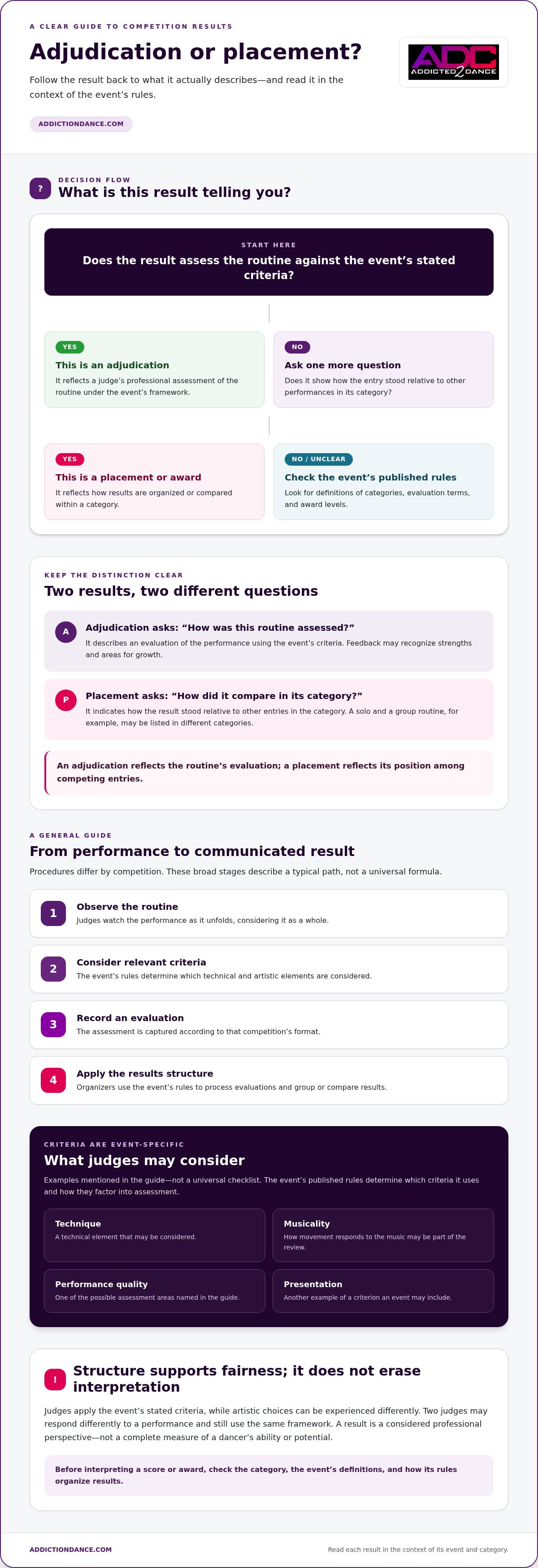
Adjudication is a judge’s evaluation of a dance performance against an event’s stated criteria. Placement, by contrast, compares results among entries in a category, such as solos or group performances. An adjudication reflects how a routine was assessed; a placement shows how that result stood relative to others. An event’s published rules explain how it defines and organizes these results.
For example, a dancer may receive an assessment that recognizes strengths and areas for growth, while a separate award indicates how the performance ranked within its category. These outcomes answer different questions. One speaks to the routine’s evaluation under the event’s framework; the other reflects its position among competing entries. A general overview of the dance competition format can provide useful context, but the event’s own criteria determine how its adjudication and awards are structured.
There isn’t one universal scoring formula. Events can differ in the criteria they publish and the way they organize results. Before interpreting a score or award, look for definitions of the categories, evaluation terms, and award levels. This helps prevent a common misunderstanding: assuming that the same label means precisely the same thing at every competition.
Why do competitions use professional judges?
Dance brings together technique, musical interpretation, movement quality, and artistic choices. Judges with relevant dance knowledge and experience can consider these elements thoughtfully within the event’s framework. Their role is to assess what they see and hear, not to reduce every artistic quality to a perfectly objective measurement.
That human perspective matters. Two judges may respond differently to a performance’s artistic choices while still applying the same stated criteria. Structure keeps an evaluation focused, but it doesn’t erase interpretation. A judge may notice a dancer’s precision while also considering how the movement communicates the choreography. Which elements carry weight depends on the event’s rules.
Professional assessment also gives varied performances a considered review. A solo, a duo/trio, and a group piece present different choreographic and performance demands. The framework helps judges evaluate each entry appropriately, while their experience supports informed attention to the dance itself. I find it helpful for families to view adjudication as a structured professional perspective: meaningful feedback and results, but not a complete measure of a dancer’s ability or potential.
What Happens When Judges Assess a Dance Performance?
From the first movement to the final pose, adjudication is a focused act of observation. Judges watch the routine as a whole, considering how its elements work together under the event’s stated criteria. The exact process varies by competition, so the stages below are a general guide rather than a description of Addiction Dance Competition’s specific procedures.
From the opening moment to the final pose
During a performance, judges may consider areas such as technique, musicality, performance quality, and presentation. These are examples, not a universal checklist. An event’s rules determine which criteria it uses and how they factor into its assessment. A dancer’s control, for instance, may be considered alongside how the movement responds to the music and communicates the choreography.
The performance is what happens onstage; the adjudication is a judge’s professional interpretation of it. This distinction explains why a result isn’t a purely mechanical measurement. Judges interpret what they see and hear through their dance knowledge and the event’s framework. Artistic choices can be experienced differently, even when the same published criteria guide the review.
It’s useful to think of the process in broad stages:
- Observe the routine. Judges watch the performance as it unfolds, rather than relying on a single moment or feature.
- Consider relevant criteria. They assess the elements named by the event, which may include technical and artistic aspects.
- Record an evaluation. The assessment is captured according to that competition’s format.
- Apply the event’s results structure. Organizers use the event’s rules to process evaluations and determine how results are grouped or compared.
From individual assessments to communicated results
A judge’s evaluation and a final placement aren’t identical. The evaluation reflects an assessment of a performance under the event’s criteria. A placement or award reflects how results are organized within the event’s categories. The event’s rules explain how those pieces connect, including which entries are compared.
For example, a solo and a group routine may be listed in different categories, even if both are assessed at the same competition. Read each result in its category context rather than treating it as a universal ranking across every performance. The event’s published descriptions, read alongside the result, can clarify what a label means. Processes vary, so assumptions based on another competition may not apply.
Result communication is when the event shares its outcomes with dancers and families. For dancers curious about an organized performance experience, Addiction Dance Competition events offer a welcoming setting for taking the stage.
Is Dance Judging Subjective? How Fairness is Supported
Dance judging can’t be entirely free of interpretation. A routine is a live, expressive performance, and artistic qualities don’t reduce neatly to a single objective measure. Professional judgment brings expertise to that complexity, while the competition’s stated criteria offer a structure for evaluating what happens onstage.
That balance is reassuring when its limits are understood. Structure can make expectations clearer, but it doesn’t make every judge experience a performance in exactly the same way. Nor does a difference in interpretation automatically mean a result is unfair. The procedures used to support fairness depend on each competition’s published rules.
Why two judges may interpret a performance differently
Even experienced dance observers may notice different details in the same routine. One might focus on musical phrasing, while another attends closely to movement clarity or how the choreography’s mood comes across. Both judges may respond thoughtfully to the criteria while giving different emphasis to what they notice.
That variation is part of judging an art form. On its own, it isn’t proof of inconsistency or unfairness. A more useful question is whether an assessment is grounded in the event’s stated framework, rather than whether every observer reaches an identical impression.
What fairness means in an adjudicated competition
In practical terms, fairness means applying the relevant event criteria consistently to performances eligible for assessment in a category. It doesn’t mean identical scores for routines with different strengths, or identical artistic responses from every judge. As a guiding principle, consistency means applying a clear framework, not making every performance identical.
The framework is the key reference point. Event rules can explain how categories are defined, which criteria guide assessment, and how results are organized. Since procedures and definitions vary, don’t assume that a process used at one competition applies at another. Published rules are the clearest source for understanding what fairness means at a particular event.
If a result feels surprising, take a calm, specific look at the available information:
- Read the category description. Confirm which performances are grouped together for comparison.
- Review the event’s criteria. Focus on the qualities it says judges consider, rather than assumptions from another competition.
- Read comments in context. Feedback may highlight a particular aspect of one performance, not provide a complete verdict on a dancer’s ability.
- Separate interpretation from procedure. A different artistic response isn’t automatically evidence that event rules were applied differently.
So, how are dance competitions adjudicated fairly when artistry involves personal interpretation? The event framework provides a basis for professional assessment, while interpretation remains part of dance. Reviewing the published rules can help dancers and families understand what a result represents, without expecting judging to remove the human perspective that makes performance meaningful.
How Can Dancers and Families Understand Adjudication Results?
Begin with context when reviewing a result. Look at the performance’s category, then compare the outcome with the event’s published criteria and definitions for scores, awards, or placements. This makes a result easier to interpret, especially when comparing performances from different categories or events.
How to read scores, feedback, and placements
Each competition determines its own result format and whether feedback is available. It helps to treat a score, award level, written comments, and placement as distinct pieces of information. A number or label doesn’t carry the same meaning at every event, so use the published rules to understand how that competition presents results.
Category context matters, too. A solo placement compares an entry within the relevant solo category; it isn’t necessarily a ranking against every routine at the event. If a result seems difficult to interpret, check the category name, criteria, and any definitions the event provides. For more detail on judging standards, this professional dance judging guide offers another helpful perspective.
Turning an adjudication into a constructive next step
Feedback is most useful when it points toward one clear learning opportunity. Rather than trying to act on every comment at once, dancers can choose a specific observation to discuss with their studio teacher. A note about musicality, for example, could open a conversation about how movement relates to the music. Their teacher can place that comment in the context of the dancer’s goals and training.
If a result brings up questions, give everyone a moment to take it in before discussing it. Then return to the written criteria and any feedback provided. A calm conversation can help distinguish what the judge observed from how the dancer felt about the performance, keeping the focus on useful learning rather than blame or comparison.
How are dance competitions adjudicated in a way that supports growth? The result is one part of a dancer’s experience, not a complete measure of ability, progress, or potential. An award or placement may feel meaningful, but the chance to share artistry, build confidence, and learn from performing matters as well. That perspective helps keep competition in balance with the dancer’s wider journey.
If your dancer is ready to explore a welcoming competition experience, you can explore Addiction Dance Competition events.
What Professional Adjudication Looks Like at Addiction Dance Competition
Understanding the general principles of judging makes it easier to see how they connect to a real competition setting. Addiction Dance Competition hosts regional and national events, with professional judging by industry-respected professionals. That combination brings structure to the event experience while keeping the focus on the dancers and the performances they’ve worked to share.
Professional judging across dance styles and categories
Performances at Addiction Dance Competition span ballet, jazz, hip hop, and musical theatre, with solo, duo/trio, and group categories. Each style has its own movement vocabulary, and each category has a different performance context. A solo centers on one dancer’s interpretation; a group routine brings multiple performers together in a shared composition. These differences matter when families consider what a performance involves, but they don’t imply a particular rubric or scoring method. The event’s published rules define its criteria and procedures.
A question families often ask is: how are dance competitions adjudicated? The answer depends on the competition’s framework, and understanding the category helps put an evaluation into context. A performance is best considered within the event’s own structure, rather than compared automatically with a different style or category. Addiction Dance Competition’s range of styles and formats creates opportunities for dancers to bring distinct strengths and artistic choices to the stage.
A competition experience built around dancers
Professional judging is one part of an organized competition experience. It gives performances considered attention, while the event environment shapes how dancers and families experience the day. Addiction Dance Competition’s events offer a positive, family-friendly setting for dancers to participate, perform, and share their work.
For families, it can be reassuring to approach results with both curiosity and perspective. The event’s published rules help explain how categories and evaluations are organized, while the performance itself remains a meaningful part of a dancer’s experience. An award or placement is one outcome of competition, not a complete measure of a dancer’s development. Taking the stage, performing alongside peers, and engaging with professional adjudication can all contribute to a rich learning experience.
For dancers exploring competition opportunities, Addiction Dance Competition brings together professional judging, varied dance styles, and solo, duo/trio, and group performances in a welcoming event environment. Explore Addiction Dance Competition and discover an event experience centered on dance.
Step Into the Next Performance with Confidence
Knowing how dance competitions are adjudicated can make the next event feel easier to approach, but understanding the process should support the dancer, not overshadow the joy of performing. Before an event, make space for questions and talk about what the dancer hopes to experience onstage. Afterward, celebrate the effort, courage, and artistry it took to perform, whatever the result may be.
Competition is one part of a dancer’s journey. Each time they step into the spotlight, they have an opportunity to share their work, learn from the experience, and feel the energy of a dance community. That perspective helps keep awards in balance with the growth and connection that make performing special.
Ready to explore a welcoming place for dancers to take the stage? Explore Addiction Dance Competition and find an event experience to inspire the next step in your dance journey. Keep celebrating the work, and let each performance open the door to new possibilities.
Frequently Asked Questions
How are ties handled in a dance competition?
Tie procedures depend on the competition’s rules. An event may define a tie-break method or allow tied results, but there’s no single approach that applies everywhere. If two entries share a result, look for tie language in the rules or awards information, including whether it applies to scores, placements, or both. This helps families understand the outcome without assuming a tie automatically triggers another round or a judge’s review.
Can dance competition judges change a score after a performance?
Whether a score can be changed depends on the event’s procedures. A correction to a recording or entry detail is different from changing a judge’s artistic assessment, and rules may treat these situations differently. If a result appears inconsistent with the information provided, review the event’s published process for score corrections. Don’t assume a change is possible, or that a judge can revise an assessment after results are announced.
Do all judges evaluate every dance routine?
Not necessarily. The way judges are assigned to routines depends on the competition, so families shouldn’t assume every judge sees every performance. The event’s rules or judging information may explain how evaluations are organized. If the published material doesn’t clarify this, keep the interpretation narrow: a result reflects the assessment process the event uses, not necessarily a review by every judge associated with the competition.
Is a dance adjudication score the same as a placement?
No. A score records an evaluation under the event’s system; a placement shows how an entry compares with others in its category. For example, a dancer may receive a score and also place among solo entries, with each result offering different information. For dancers and families in Chicago, Akron, Omaha, Richmond, Las Vegas, Minneapolis, Miami, Houston, Grand Rapids, Memphis, Detroit, Bloomington, Philadelphia, Pittsburgh, Boston, Nashville, St. Louis, Davenport, Milwaukee, or Birmingham, compare each result with that event’s rules.
Can dancers appeal a dance competition result?
It depends on the event’s published policies. Some competitions may describe a process for raising a concern, while others may limit reviews to specific issues, such as an administrative error. An appeal shouldn’t be assumed to mean a judge will reconsider artistic judgment. If a family has a question, identify the exact result or rule involved and follow the procedure stated by the event, rather than relying on another competition’s policy.
Are judges’ comments shared with dancers or studios?
Feedback availability and delivery vary by competition. Some events may provide written or recorded comments, while others may communicate results differently; don’t assume a particular format. Check the event information to see whether comments are offered and who can access them. If feedback is available, a dancer and studio teacher can review it together, clarify unfamiliar wording, and select one practical point to discuss in training.
Does adjudication differ between solo and group performances?
The event’s criteria may account for the category, but the exact approach depends on its rules. A solo highlights one dancer’s choices, while a group routine involves coordination among performers, so the performance context differs. That doesn’t mean every competition uses separate scoring criteria. For dancers and families in Philadelphia, Pittsburgh, Boston, Nashville, St. Louis, Davenport, Milwaukee, Birmingham, or elsewhere, the published category descriptions are the best guide.


