
What if the spotlight could feel welcoming as well as thrilling? When families consider a dance competition Pittsburgh dancers can enter, it helps to know how the event works, which performance categories might suit a routine, and what competition day involves. A polished stage and professional judging can raise the stakes, but they can also be part of an encouraging, family-friendly experience.
Addiction Dance Competition brings Pittsburgh dancers into a broader regional and national event circuit, with opportunities for dancers of all ages and skill levels. Performances include solo, duo/trio, and group categories, with styles such as ballet, jazz, hip-hop, and musical theatre. Dancers can share their strengths onstage while building confidence through preparation and performance.
In this guide, I’ll explain the performance formats, the role of professional adjudication, and practical ways dancers and families can prepare. I’ll also cover how livestream access helps supporters watch from afar. Knowing what to expect can make the first step toward the stage feel more exciting and manageable.
Key Takeaways
- Look for a dance competition Pittsburgh dancers can enjoy in a positive, family-friendly setting.
- Choose a performance format that fits the routine, and coordinate category decisions with the studio.
- Competition can be a meaningful next step for dancers at different ages and skill levels, not only advanced performers.
- Prepare by reviewing event information, aligning the routine and category, rehearsing, and deciding how family will watch.
- Addiction Dance Competition offers a professional event experience, with livestream access for supporters watching from another location.
Why Pittsburgh dancers look for a competition that feels both exciting and welcoming
A competition day should feel like a meaningful performance, not a test of whether a dancer belongs. Dancers want the energy of a real stage and the chance to present work they’ve prepared with care. Families want an encouraging atmosphere and clear event information so they can understand what to expect. Keeping both priorities in view makes it easier to decide whether an event suits your dancer.
For Pittsburgh-area studios, a regional competition brings dancers, teachers, and supporters together around a shared performance experience. Addiction Dance Competition hosts regional and national events across the United States, connecting Pittsburgh-area participants with a broader circuit that also serves dancers in places such as Chicago, Akron, Omaha, Richmond, Las Vegas, Minneapolis, Miami, Houston, Grand Rapids, Memphis, Detroit, Bloomington, Philadelphia, Boston, Nashville, St. Louis, Davenport, Milwaukee, and Birmingham.
A regional dance competition is an event where dancers perform for an audience and receive professional adjudication. The day combines the excitement of presenting choreography with an expert assessment of the performance. The broader context of Competitive dance includes varied styles and formats, while each event’s organization and atmosphere shape the experience for its participants.
What dancers and families hope to find in Pittsburgh
A professionally organized setting lets dancers focus on the details that matter onstage: musicality, expression, timing, and connection with fellow performers. Families benefit from understanding the event structure and how they can support their dancer, whether they attend in person or watch remotely. An encouraging atmosphere also helps the occasion feel exciting without making participation feel intimidating.
How a competition can support growth onstage
Performing in front of an audience gives dancers a chance to practice confidence and pursue artistic excellence. Each routine calls for focus, preparation, and a willingness to share an interpretation of the music. That experience is meaningful whether a dancer performs alone or with others. It doesn’t promise a particular result; it offers a purposeful opportunity to present prepared work and receive professional feedback.
A dance competition Pittsburgh families choose can be about more than a ranking. High-energy production, industry-respected judging, and a positive, family-friendly atmosphere can make an event feel polished and approachable. For studios, a shared competition experience gives dancers a common goal and families a chance to celebrate the effort behind each routine.
As you consider an event, ask what would help your dancer feel ready to take the stage: a suitable performance format, a supportive audience, and clear expectations for the day. Those details can turn uncertainty into anticipation. With professional standards and a welcoming atmosphere, Pittsburgh-area dancers can approach competition as an opportunity to perform with purpose and enjoy the moment under the lights.
What a Pittsburgh dance competition experience can include
A competition experience takes shape through the routines dancers bring to the stage, the styles they perform, and the way the event presents their work. If you’re comparing a dance competition Pittsburgh opportunity, these details help turn a broad idea into a clearer picture. Addiction Dance Competition features solo, duo/trio, and group performances in styles including ballet, jazz, hip-hop, and musical theatre.
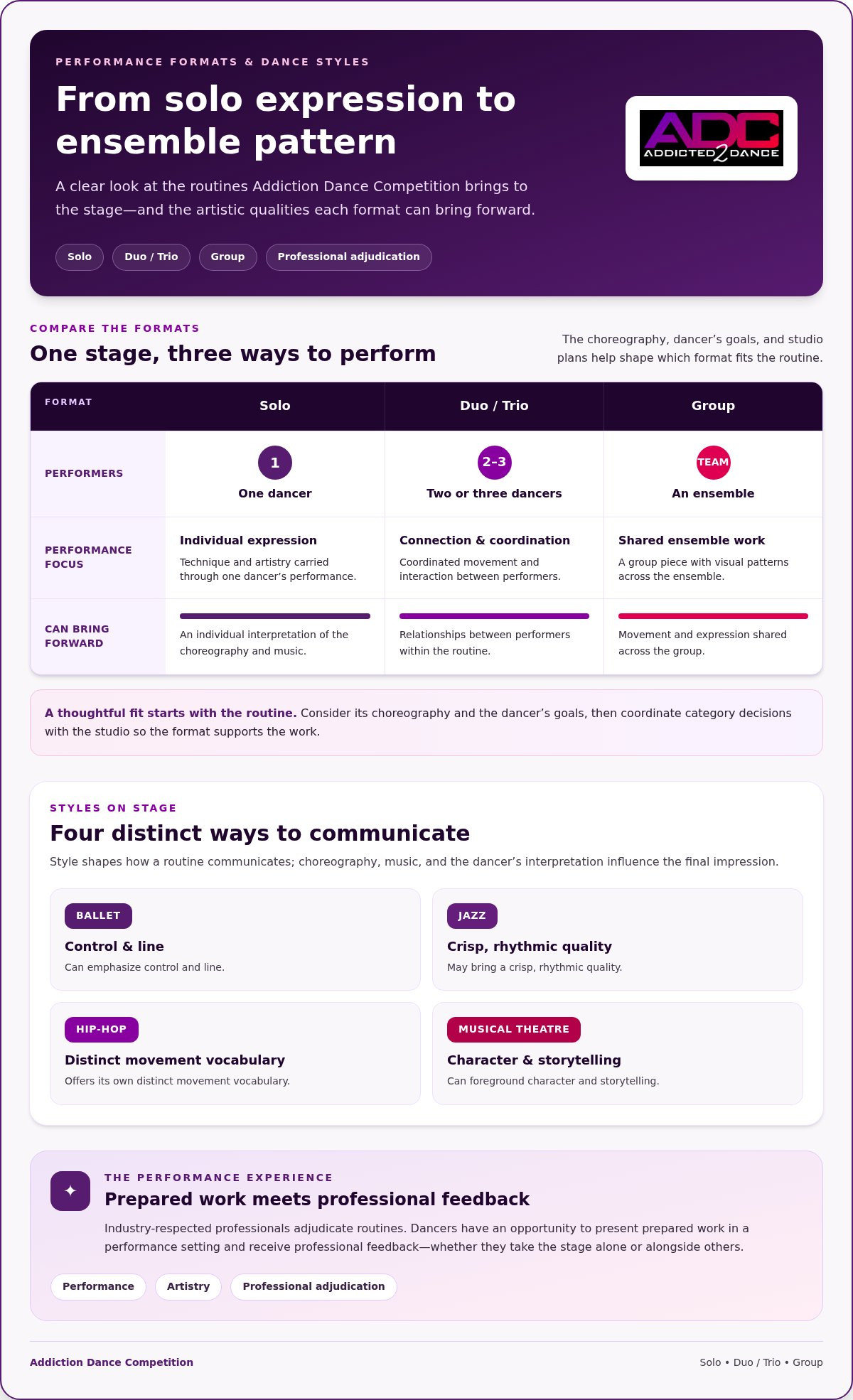
From an individual solo to a shared group routine, the event brings together different performance formats and dance styles. Each format creates a distinct way to approach the stage. A solo lets one dancer present an individual interpretation, a duo or trio builds on close collaboration, and a group performance brings together movement and expression across an ensemble.
Solo, duo/trio, and group performances
A solo places one dancer at the center of the routine, with the performance carried through individual technique and artistry. Duo/trio routines involve two or three dancers, creating room for coordinated movement and interaction. Group performances bring dancers together in a shared piece. The best fit depends on the choreography, the dancer’s goals, and the studio’s plans for the routine.
When considering a format, think beyond how many people will be onstage. A solo may suit choreography built around individual expression; a duet or trio can highlight relationships between performers; and a group piece can create visual patterns across the ensemble. Studios guide routine and category choices so the format supports the choreography rather than feeling like an afterthought.
Styles represented on the competition stage
Style shapes how a routine communicates. Ballet can emphasize control and line, while jazz may bring a crisp, rhythmic quality. Hip-hop offers a distinct movement vocabulary, and musical theatre can foreground character and storytelling. These are broad artistic possibilities, not fixed descriptions of every routine. The choreography, music, and dancer’s interpretation all influence the final impression.
Professional judging adds an expert perspective to the performance experience. Industry-respected professionals adjudicate routines, connecting the event to performance standards without reducing the experience to a single result. Dancers have the opportunity to present prepared work in a setting designed around performance and professional evaluation. Families can follow along in person or use livestream access to watch from another location.
Production adds another layer. High-energy staging gives routines a shared event setting, while the mix of formats and styles keeps the program varied for dancers and spectators. Before choosing a routine category, dancers can discuss the choreography and their goals with their studio, then consider whether an individual or collaborative performance best expresses the piece.
To see how these elements come together across regional and national events, explore Addiction Dance Competition and consider a stage that feels both polished and welcoming.
Is a Pittsburgh dance competition only for advanced dancers?
No. Addiction Dance Competition welcomes dancers of all ages and skill levels. A polished event and professional adjudication don’t mean that only advanced performers belong onstage. A professional event standard describes the quality of the performance experience, not an advanced-only audience. For dancers and families considering a first competition, that distinction can make the opportunity feel more approachable.
Competition is a focused performance setting: dancers prepare choreography, appear before an audience, and take part in an organized event. The experience can be meaningful at different points in a dancer’s journey. It isn’t a promise of a title or a particular result. It’s a chance to bring prepared work to the stage and participate in a structured artistic event.
How age and experience shape the competition experience
Dancers arrive with different backgrounds, performance histories, and goals. One may be getting comfortable onstage, while another is ready to refine an established performance. Neither story defines a single readiness threshold. Preparation is best approached as a conversation between the dancer and their studio, grounded in the routine, the format, and what feels like an appropriate next step.
Families can help by making space for honest, low-pressure conversations: Is the dancer curious about performing? Do they understand what their routine asks of them? What support would help them feel prepared? These questions can guide a thoughtful decision without turning experience into a measure of who belongs. Use the event’s participation information to understand the applicable entry requirements.
What professional judging means for participants
Professional adjudication gives the event an organized competitive framework, with performances evaluated by industry-respected professionals. That adds focus to the occasion while leaving room for each dancer’s artistic voice. Judging is one part of the event, not a guarantee of a specific score, award, or future opportunity. Families can also consult a dedicated adjudication guide for more context about how judging works.
For a first-time participant, it may help to separate preparation from prediction. Rehearsing with care, understanding the chosen routine, and arriving ready to perform are constructive goals; anticipating a particular placement isn’t. Studios can help dancers approach the event with clear expectations and a steady focus on presenting their work.
A dance competition Pittsburgh families consider can offer professional standards alongside a positive, family-friendly atmosphere. The two qualities aren’t opposites. In a supportive setting, dancers can take the stage at their own experience level, share the work they’ve prepared, and experience the event without needing to arrive as an expert. That balance makes competition a possible next step for a wider range of dancers.
How Pittsburgh dancers and families can prepare for competition day
A thoughtful plan can make competition day feel more manageable for dancers and families. The goal isn’t to control every moment; it’s to understand the event, prepare for the routine, and make a viewing plan that works for your family. For a dance competition Pittsburgh participants are preparing for, use the official event information to plan around the schedule, venue, and other practical details.
A simple preparation sequence for dancers
Keep preparation focused and coordinated with the studio. Start by reviewing the event details, confirm the routine’s performance category with the studio, then use rehearsals to build familiarity and confidence. Finally, decide how family and supporters will watch. Taking these steps in order can help everyone focus on what’s ahead without adding pressure or relying on assumptions.
- Review the event information. Read the applicable event details with your dancer so you both understand the schedule and venue information. Keep those details handy as competition day approaches.
- Align the routine and category. Talk with the studio about whether the choreography is entered as a solo, duo/trio, or group performance. The studio can help ensure the category reflects the routine and the dancers performing it.
- Rehearse with a steady focus. Follow the studio’s preparation plan and give the dancer room to become comfortable with the choreography. A calm, encouraging approach can help keep attention on musicality, expression, and the pleasure of sharing the work onstage.
- Plan how supporters will watch. Decide who expects to attend in person and whether livestream access would help family or friends watch from another location.
Planning how family and supporters will watch
Watching in person lets supporters share the atmosphere of a live performance, while livestream access offers another way to follow along from a different location. Make your plan around the event details and your family’s travel considerations. Use the schedule and location information for the specific event to shape the day.
It can also help to agree on a simple plan with the dancer: who will be watching, how supporters will follow the performance, and what the dancer would find reassuring beforehand. Keep the focus warm and practical. A supportive message and a clear plan can leave more room for the dancer to enjoy performing instead of carrying the logistics alone.
Preparation doesn’t need to become a second performance. The studio helps guide routine and category choices, while the official event information grounds family plans in the details that apply. With those pieces in place, dancers can focus on presenting their work, and supporters can be ready to share the moment, whether they’re in the audience or watching remotely.
Explore Addiction Dance Competition event information as you plan the performance and family viewing experience.
Explore Addiction Dance Competition events for Pittsburgh dancers
Choosing an event becomes easier when you look at the full experience, not just the moment a dancer steps onstage. Consider which performance format suits the routine, what the event atmosphere offers participants and families, how professional judging fits into the experience, and how supporters will watch. Addiction Dance Competition brings Pittsburgh dancers into a regional and national competition circuit with an organized setting and a positive, family-friendly atmosphere.
That combination matters. Strong production gives performances a polished setting, while professional adjudication brings expert attention to the work dancers have prepared. A high-energy event can feel exciting without losing sight of encouragement, confidence, and fair evaluation. For dancers, families, and studios, the aim is a well-structured stage experience where artistic effort can take focus.
Why dancers choose an organized, high-energy event
A clear event structure helps participants and supporters understand what happens around each performance. Dancers can focus on presenting their routine; families can cheer in person or follow through livestream access. Industry-respected professionals bring an informed perspective to adjudication, while a welcoming environment helps the day feel approachable. Professional standards don’t require an intimidating atmosphere.
As you weigh a dance competition Pittsburgh opportunity, start with the dancer’s goals and the studio’s plans. A solo may suit one routine, while a shared performance may better express another. Then consider whether the event atmosphere and family-viewing options fit what your group values. This simple decision path keeps the focus on a good match rather than pressure to pursue a particular result.
Competitive dance can involve recognition and ambitious next steps, including titles, scholarships, or national championship opportunities. Those are possibilities, not promised outcomes. A dancer’s experience is also worth valuing for the preparation, performance, and professional feedback involved, regardless of placement. It’s natural to aspire, and the stage experience itself has meaning.
Take the next step toward the spotlight
Before deciding, dancers can talk with their studio about the routine and participation format, while families consider how they’d like to experience the event. Studio representatives can review the relevant participation information alongside their dancers’ plans. Use the event information for the details that apply, including the schedule, venue, fees, and registration process.
Addiction Dance Competition’s regional and national circuit offers Pittsburgh dancers a chance to take part in a professionally judged, high-energy event with a family-friendly spirit. The next step might be exploring participation, learning how the event works, or planning to support a dancer. Clarity around format, atmosphere, judging, and family viewing makes the decision more confident.
Explore Addiction Dance Competition events and participation information to find the next step that feels right for your dancer, family, or studio.
Take Your Next Step Toward the Stage
The right next step doesn’t have to be a grand leap. It can begin with a conversation between a dancer, family, and studio about what feels exciting and achievable now. If you’re considering a dance competition Pittsburgh opportunity, explore the event details, discuss participation with the studio, and picture what sharing a prepared routine could mean for your dancer.
Every performer arrives with a different story and a different reason for stepping into the spotlight. Choosing to take part can be a meaningful goal, whether the dancer is exploring competition for the first time or ready for a new challenge. Give that possibility room to grow at a pace that feels right.
Explore Addiction Dance Competition events and find the information to help your dancer take the next step. The stage is waiting, and a little preparation can make that first step feel within reach.
Frequently Asked Questions
Can dancers of different ages and skill levels participate in Addiction Dance Competition events?
Yes. Addiction Dance Competition welcomes dancers of all ages and skill levels. Families considering a dance competition Pittsburgh event can think about whether performing feels like a suitable next step for their dancer, rather than assuming they need years of competition experience. A studio can help the dancer prepare at an appropriate pace and talk through participation, while the event information provides applicable entry details.
What dance styles can dancers perform at an Addiction Dance Competition event?
Styles include ballet, jazz, hip-hop, and musical theatre. The right style depends on the choreography and how the dancer or group wants to interpret the music. For instance, a studio might shape one routine around ballet technique and another around musical theatre storytelling. Dancers can coordinate the routine’s style and category with their studio so the entry reflects the performance they’ve prepared.
Can a dancer compete in a solo and a group category?
A dancer may participate in both solo and group routines when the event entry plan and the studio’s choreography include both. These formats ask dancers to prepare in different ways: a solo centers on one performer, while a group routine depends on shared timing and coordination. The studio can help manage the dancer’s routine choices and participation plan, and the event’s official information outlines the applicable entry structure.
Is livestream access available for families who cannot attend in person?
Yes. Livestream access gives families and supporters a way to watch competition performances from another location. It can help relatives who live outside the Pittsburgh area share the performance moment, even if travel isn’t possible. Families can use the relevant event information to follow the livestream and plan their viewing around the dancer’s performance schedule.
What can dancers earn at a dance competition besides a title?
Participants may have opportunities to earn scholarships and national championships, as well as titles. These are possible outcomes, not guaranteed results, and opportunities can vary by event. Dancers can also value the chance to present their work and receive professional adjudication, regardless of placement. A studio can help families consider which opportunities are relevant to the dancer’s goals and the event.
How can Pittsburgh families follow a dancer’s performance if they are watching remotely?
Families watching from another location can use livestream access to follow the performance. Keep the event schedule and livestream information together, then use the performance timing provided for that event to plan when to tune in. If relatives are watching from different places, sharing those details ahead of time can help everyone be ready for the dancer’s moment onstage.


