
What makes a dance competition Birmingham option right for your dancer? Look beyond the size of the stage and compare the performance format, learning opportunities, and practical plans for your studio and family. A good fit starts with what your dancer hopes to gain.
It’s understandable to feel unsure when you’re weighing solo, duo/trio, or group performances alongside travel and family plans. I recommend starting with the experience you want your dancer to have, then matching the event to that goal.
Addiction Dance Competition brings Birmingham-area dancers and studios into professionally judged regional and national competitions, with solo, duo/trio, and group categories. Convention masterclasses with industry-respected teachers and choreographers add a learning dimension, while livestream access gives family and supporters a way to watch remotely. This guide explains how to compare event formats, plan ahead, and choose a competition experience that suits your dancer.
Key Takeaways
- Choose a dance competition Birmingham option by matching its format and experience to your dancer’s goals.
- Compare solo, duo/trio, and group categories to find a setting that suits the dancer or studio.
- Consider how professional judging, production, and convention masterclasses shape the experience.
- Plan with your studio by clarifying the performance format, dance style, event details, and travel arrangements.
- Explore Addiction’s regional and national competitions, conventions, and livestream access for families.
What Birmingham-Area Dancers Should Look for in a Dance Competition
Birmingham dancers and studios bring different goals to a competition. One performer may be ready to take the stage for the first time; another may be working toward a title, scholarship, or national championship. Start by identifying the dancer’s priorities, then consider experience, performance category, learning opportunities, and the practical details of taking part.
A good competition fit gives dancers a meaningful stage, a suitable performance format, and an experience that supports their next step. That might mean presenting prepared work for professional adjudication, building confidence in a live event setting, or combining performance with learning. The broader history of dance competitions includes dance marathons, a distinct endurance-based format. Studio competitions today have their own focus on performance and adjudication.
Which Birmingham dancers can benefit from a competition experience?
Competition can serve dancers at different ages, skill levels, and stages of development. For one dancer, success might mean performing with poise and taking in adjudicator feedback. For another, it might mean pursuing a title, scholarship, or championship. These goals can coexist, but naming the priority helps a dancer and studio choose an experience that feels motivating rather than mismatched.
Addiction’s regional and national competitions welcome dancers of all ages and skill levels. A performance gives dancers a chance to share prepared work before an audience and receive professional adjudication. It also lets them practise composure in a live event setting. Confidence can grow through preparation and personal progress, not only through results. A competition does not need to be a first step toward winning to be worthwhile.
What should Birmingham studios consider before choosing an event?
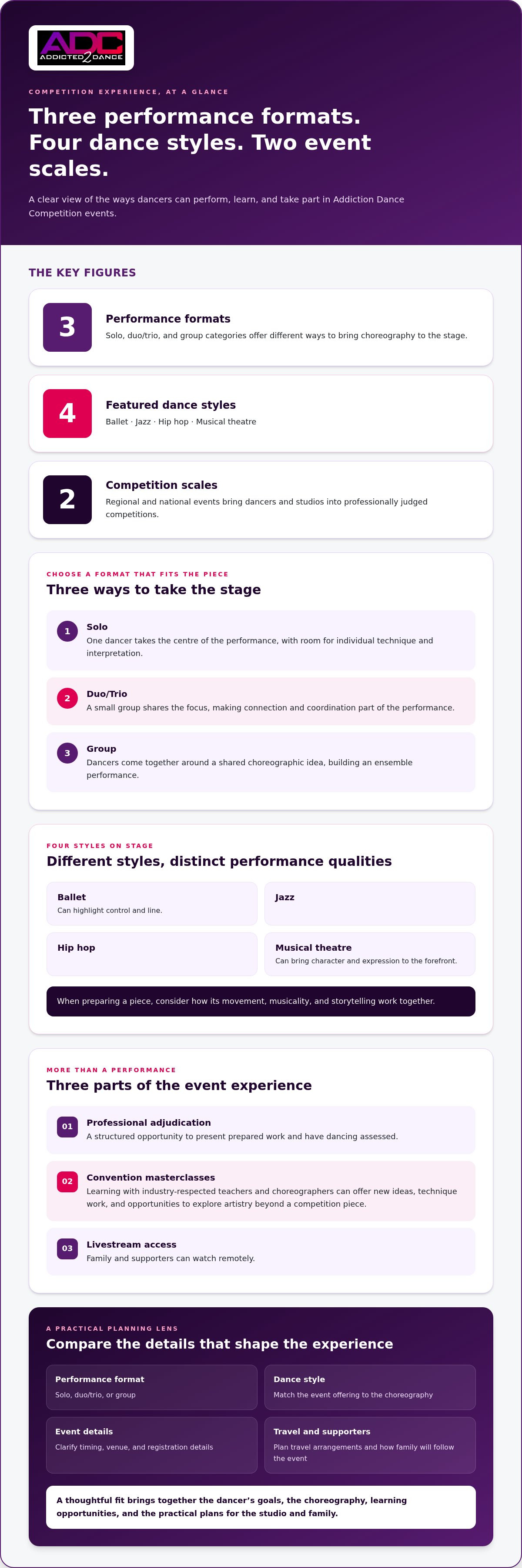
Start with the studio’s artistic and development priorities. Is the aim to spotlight individual performers, build partnerships, or bring an ensemble to the stage? Addiction offers solo, duo/trio, and group categories, giving studios different ways to present dancers. Match the format to the choreography and the experience the studio wants dancers to gain.
Next, consider what surrounds the performance. Professional judging and production create a polished, high-energy stage experience. Convention learning can complement performance development through masterclasses with industry-respected teachers and choreographers. Decide which outcomes matter most before comparing event details, so the choice reflects dancer growth as well as the performance itself.
Practical planning matters, too. Studios and families can consider travel, event timing, and how supporters will follow the experience. Livestream access gives family and friends a way to watch remotely. Addiction hosts regional and national events across the United States, with opportunities for studios and dancers in Birmingham and communities including Chicago, Akron, Omaha, Richmond, Las Vegas, Minneapolis, Miami, Houston, Grand Rapids, Memphis, Detroit, Bloomington, Philadelphia, Pittsburgh, Boston, Nashville, St. Louis, Davenport, Milwaukee, and Birmingham. Use the current event schedule to plan around dates, venues, and registration details.
What to Expect at an Addiction Dance Competition
An Addiction competition brings dancers into a professionally judged performance experience supported by high-energy production. Adjudication gives performers a structured opportunity to have their dancing assessed, while the event creates a lively stage for sharing prepared work. For Birmingham-area studios, it’s a chance to bring dancers together for a larger event experience.
Addiction competitions feature dance styles including ballet, jazz, hip hop, and musical theatre. Each style can bring different qualities to the stage. A ballet solo may highlight control and line, while a musical theatre performance can put character and expression at the forefront. Consider how the choreography’s movement, musicality, and storytelling work together when preparing a piece.
How do performance categories shape the competition experience?
A solo places one dancer at the centre of the performance, giving the choreography room to reflect individual technique and interpretation. A duo or trio shares the focus among a small group, making connection and coordination part of the performance. Group work brings dancers together around a shared choreographic idea. The right format depends on the piece and the experience the dancers hope to gain.
For a studio, choosing a format is an artistic decision as well as a practical one. A solo may suit a dancer working toward an individual performance goal; a group piece can help an ensemble build cohesion and stage presence together. Addiction’s solo, duo/trio, and group categories let studios choose among these performance settings.
How can convention learning add value for dancers?
Competition gives dancers a stage for prepared choreography; convention learning offers a different kind of challenge. Addiction’s conventions feature masterclasses led by industry-respected teachers and choreographers. Dancers can encounter new ideas, work on technique, and explore artistry beyond their competition piece. Instruction can also encourage them to approach movement with fresh attention and curiosity.
Competition gives dancers a stage to present their work, while convention learning can deepen the technique and artistry they bring to future performances. That distinction can help studios decide how educational opportunities fit their dancers’ priorities. Scholarship opportunities may also be part of the experience, offering another avenue for recognition without making an award the measure of a dancer’s progress.
As you explore a dance competition Birmingham option, consider what your dancer or studio hopes to take away: a focused solo performance, the energy of a group piece, professional adjudication, or new learning through masterclasses. Explore Addiction Dance Competition opportunities and compare the formats with those goals in mind.
How Birmingham Studios Can Compare Dance Competition Options
A useful comparison starts with the dancers, not the trophy table. For Birmingham studios, the best dance competition Birmingham option supports current priorities through its performance experience and learning opportunities. Use the framework below to compare event features with what your dancers need.
| Criterion | What to compare | Addiction context |
|---|---|---|
| Performance format | Consider whether solo, duo/trio, or group work best suits the choreography and studio’s goals. | Addiction competitions include solo, duo/trio, and group categories. |
| Judging and production | Consider how adjudication and the event environment support the performance experience. | Addiction offers professional judging and high-energy production. |
| Educational opportunities | Decide whether dancers would benefit from learning beyond their prepared pieces. | Addiction conventions feature masterclasses with industry-respected teachers and choreographers. |
| Family access | Consider how relatives and supporters can share in the event. | Livestream access lets families and supporters watch remotely. |
| Logistics | Compare travel, timing, and the practical needs of your dancers and families. | Use the current event schedule for dates, venues, and registration details when planning. |
Which evaluation criteria matter most to Birmingham studios?
Set priorities instead of treating every feature as equally important. A studio focused on ensemble development may rank group participation and a professionally produced stage highly. A studio looking to extend dancers’ training may place greater weight on convention masterclasses. Family access can also shape the experience, especially when supporters cannot attend in person.
Professional judging is another useful point of comparison. Consider how adjudication fits the studio’s goals and the dancers’ experience. The article “Professional Judged Dance Competition: The Ultimate Guide to Adjudication” can provide a useful subject for further reading. When planning, distinguish between the event experience and the details for a particular event: Addiction offers competition formats, professional judging, production, masterclasses, and livestream access, while the current schedule provides dates, venues, and registration information.
How should dancers weigh titles, scholarships, and learning?
Recognition can be motivating, but it does not need to be the only measure of a successful event. Help dancers set goals they can act on, such as performing with greater confidence, applying feedback, or exploring a new artistic choice. If a title or scholarship is an ambition, treat it as one possible outcome rather than a promise or a measure of personal progress.
Scholarship opportunities can add another dimension to competition, while convention learning supports continued technique and artistic growth. Studios can discuss which matters most to each dancer before choosing an event. “Unlocking Artistic Potential: The 2026-2027 Guide to Dance Competition Scholarships” is a relevant next read for studios considering scholarship goals alongside development priorities.
How Birmingham Dancers and Families Can Prepare for Competition
Good preparation begins with clear information and a shared plan. For families considering a dance competition Birmingham opportunity, the studio is a helpful starting point for understanding the performance, setting a useful goal, and keeping the experience supportive. Early coordination gives dancers more room to prepare with confidence and arrive focused on performing.
What should dancers align with their studio before the event?
Before rehearsals and travel plans take over, make sure the dancer and studio share expectations. A solo, duo/trio, or group performance can call for different rehearsal priorities, and the dance style influences how a performer approaches the work. Agreeing on a personal focus keeps preparation grounded in the dancer’s development, not just the result.
- Review the event information. Read the current published details with the studio, including dates, venue, schedule, and registration information. Note what the family needs to plan around, and use current event details rather than an older page or message.
- Clarify the performance. Confirm whether the dancer is preparing a solo, duo/trio, or group piece, and identify its dance style. Knowing the dancer’s role helps families understand what the event experience will involve.
- Choose a realistic goal. A dancer might focus on performing with greater confidence, applying feedback, or exploring artistry in a convention masterclass. Keep the aim specific and encouraging. A personal growth goal makes preparation meaningful regardless of the competition outcome.
- Coordinate the family plan. Use the event’s published information to plan travel, timing, and attendance with the studio. If family members cannot be there in person, review the livestream information as part of your viewing plans.
- Keep preparation steady. Follow the studio’s rehearsal guidance and give the dancer room to stay focused without adding unnecessary pressure. Consistent support helps them feel prepared to take the stage.
How can Birmingham families stay connected to performances?
Livestream access gives family and supporters a way to watch remotely, making it easier to share in a performance from a distance. Use the event’s published information to plan when and how to view. Families attending in person can coordinate with the studio so the dancer knows where their support will be.
Preparation should feel organized, not overwhelming. A clear conversation with the studio can resolve practical questions early and help each dancer understand their format, style, and personal focus. Explore Addiction competition and convention opportunities as you plan the next stage of your dancer’s experience.
Explore Addiction Dance Competition Opportunities Near Birmingham
Once you’ve identified what matters most to your dancer or studio, explore Addiction’s regional and national competition opportunities. Birmingham-area dancers can compare event information with their goals, preferred performance format, and practical plans. Studios across the circuit, including those in Chicago, Akron, Omaha, Richmond, Las Vegas, Minneapolis, Miami, Houston, Grand Rapids, Memphis, Detroit, Bloomington, Philadelphia, Pittsburgh, Boston, Nashville, St. Louis, Davenport, Milwaukee, and Birmingham, can use the same approach to plan their competition experience.
What makes Addiction a compelling choice for Birmingham-area dancers?
Addiction brings together professional judging, high-energy production, and solo, duo/trio, and group participation formats. Dancers can share their work in a polished performance setting, while studios can bring performers together onstage. The family-friendly atmosphere makes the event welcoming for dancers and the people supporting them.
Performance is one part of the experience. Convention events feature masterclasses with industry-respected teachers and choreographers, giving dancers an opportunity to explore technique and artistry beyond their prepared routines. Competition and learning can sit side by side: one lets dancers present their work, while the other can inspire fresh ideas for future performance.
Scholarships may also be part of the competition and convention experience. They offer a possibility for recognition and development, but no particular outcome is assured. A dancer’s growth, confidence, and willingness to learn remain valuable measures of the experience in their own right.
What is the next step for interested dancers and studios?
Start with Addiction’s current event schedule and participation information. Review the dates, locations, and registration details for each opportunity, then discuss the options with the studio. Use the current event details when making plans.
From there, match the event to the dancer’s priorities. A studio may be planning around a group performance, while an individual dancer may be focused on a solo or the added learning available through convention masterclasses. Families can include travel and viewing plans in the conversation, guided by the event information.
For studios considering a larger national experience, The Ultimate Stage: Your 2027 National Tour Guide can be a helpful next point of exploration. Start with a clear sense of what your dancers hope to gain, then explore Addiction Dance Competition opportunities and choose an event path that brings those ambitions to the stage.
Choose the Stage That Moves You Forward
You don’t need to plan every detail at once. Begin by deciding what would make the experience worthwhile for your dancer: a new performance challenge, a meaningful goal, or learning that carries into future routines. For Birmingham-area dancers, the right dance competition Birmingham opportunity gives those ambitions room to grow.
Addiction brings together professional judging, exciting production, solo, duo/trio, and group formats, along with convention masterclasses and livestream access. Use these features to guide your conversation with the studio, then plan with the current event information. A considered choice can turn competition anticipation into a stage experience your dancer feels ready to embrace.
Your next performance chapter can start with one clear decision. Explore Addiction Dance Competition opportunities and take the next step with confidence.
Frequently Asked Questions
Is Addiction Dance Competition suitable for first-time competitors?
Yes. Addiction events serve dancers of all ages and skill levels, so a first competition can be a meaningful opportunity to perform and gain experience. A dancer and studio can make the experience feel manageable by agreeing on one personal goal, such as building confidence in front of an audience or remembering performance details under stage lights. Reviewing event information together also helps the dancer know what to expect.
Can dancers compete as soloists, duos, trios, or groups?
Yes. Addiction offers solo, duo/trio, and group participation formats. A studio can consider which format suits the choreography and the dancer’s experience, then plan accordingly. A performer preparing an individual piece may choose a solo, while dancers working together may present a shared routine. The studio can guide the entry into the appropriate category.
What dance styles can participants perform?
Participants can perform styles including ballet, jazz, hip hop, and musical theatre. A studio preparing a routine can use the event’s published participation information to identify the style and plan accordingly. A piece built around character and storytelling, for example, calls for a different performance approach than a technique-focused ballet variation. Let the choreography guide the conversation with the studio.
Can dancers earn scholarships at a dance competition?
Scholarship opportunities may be part of Addiction’s competition and convention experiences, but receiving one is not guaranteed. Dancers can view a scholarship as a possible recognition opportunity while keeping their focus on growth, artistry, and taking in feedback. Studios and families can review the event information and help dancers set balanced expectations.
Can family members watch a dance competition online?
Yes. Livestream access gives families and supporters a way to watch competition performances remotely. Relatives who cannot travel can still share in a dancer’s moment onstage. Families can use the event’s published information to plan how to access the stream and when to watch.
How can Birmingham studios find current dance competition dates?
Review Addiction’s current official event schedule and the information published for each event. Dates, locations, and registration details are listed for individual opportunities, giving Birmingham studios the information they need to plan with dancers and families.


