
Last Sunday evening, Sarah sat in a quiet studio office, staring at a score sheet that felt like a foreign language. Her lead soloist had delivered a breathtaking performance, yet the "Double Platinum" designation and the judge's hurried comments about "grounding" left her feeling more confused than celebrated. It's a common struggle for those of us dedicated to the craft; the gap between a dancer's effort and a judge's final tally often feels shrouded in mystery.
I know how frustrating it is to face a disappointed child when you can't quite explain the point discrepancies between a Diamond and a High Gold award. This guide is your definitive resource on how to understand dance competition score sheets with professional precision. You'll master the art of decoding elite feedback to transform every critique into a powerful stepping stone for your next performance. We'll break down the standard 300-point rubric, translate technical judge vernacular into actionable studio goals, and show you exactly how to use these insights to prepare for the prestigious 2027 National Tour. It's time to turn those audio notes into your roadmap for excellence.
Key Takeaways
- Master the elite 300-point rubric to pinpoint exactly where technical precision meets artistic excellence.
- Discover how to understand dance competition score sheets by translating complex judge shorthand into a clear, actionable training plan.
- Distinguish between benchmark adjudication levels and competitive rankings to keep your team focused on their personal journey toward the pinnacle of the sport.
- Apply the "24-hour rule" to filter emotional responses and extract pure, professional data that fuels growth for the 2027 National Tour.
- Leverage expert critiques from the upcoming season to prepare your dancers for the ultimate stage at Nationals Branson 2027.
The Anatomy of a Dance Competition Score Sheet
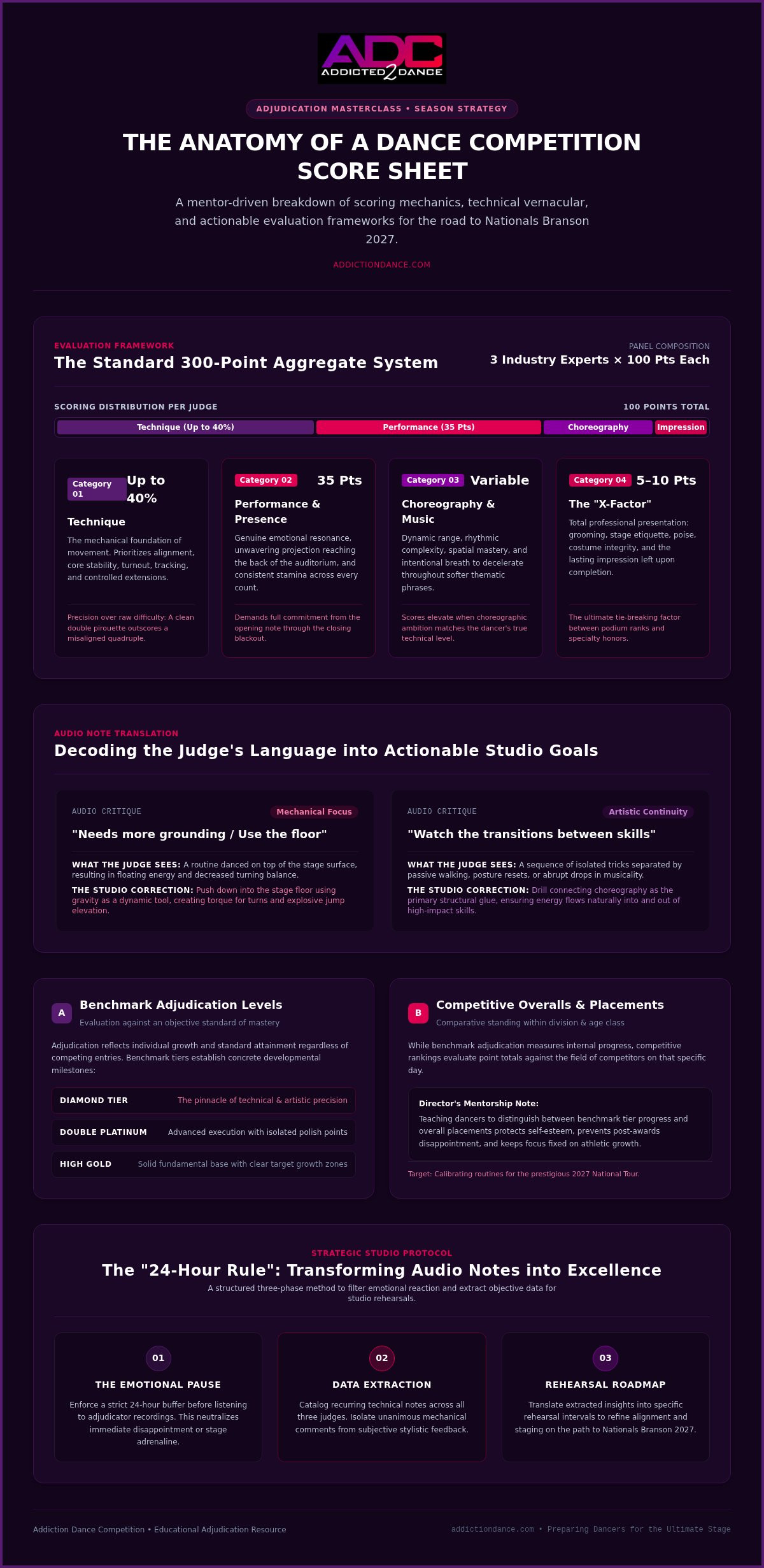
Every high-stakes performance begins long before the music starts. It lives in the preparation, the sweat, and the meticulous precision of the studio. When you step onto the stage at our 2027 National Tour, the judges aren't just watching; they're dissecting every second through a professional, mentor-driven lens. Learning how to understand dance competition score sheets is the first step in bridging the gap between a strong routine and a title-winning masterpiece. Most elite panels utilize a 300-point aggregate system, where three industry experts evaluate your artistry and athleticism with surgical focus. Understanding this breakdown allows you to train with intention rather than guesswork.
Technique: Beyond the Pointed Toe
Technique is the mechanical integrity of the movement. While you are mastering how to understand dance competition score sheets, you will quickly see that technique is the silent language of excellence. Judges prioritize alignment, core stability, and tracking because these are the markers of a safe, high-performance artist. A common pitfall is prioritizing difficulty over execution. A clean, controlled double pirouette will outscore a misaligned quadruple every time. Within the broader competitive dance structure and scoring models, technique usually accounts for up to 40 percent of your total score. This category evaluates everything from your turnout to the control of your extensions. It is the non-negotiable foundation that allows your artistry to feel effortless.
Performance and Stage Presence
Performance is more than just a bright smile or a rehearsed facial expression. It's about genuine emotional connection and the ability to command the entire room with your energy. Judges look for projection that reaches the back of the house and a focus that never wavers, regardless of the choreography's difficulty. If your energy drops after the first big power move, your score will reflect that lack of stamina and commitment. We want to see you live in the moment from the first note to the final bow. This category, often worth 35 points per judge, rewards the dancer who breathes life into the steps and makes the audience feel something profound.
Choreography and Musicality
Choreography isn't just about the sequence of steps; it's about how those steps utilize the score to tell a story or explore a concept. Judges evaluate dynamic range, rhythmic complexity, and the intelligent use of the stage space. They look for musicality that feels intentional rather than coincidental. This means hitting the "pocket" of the music and using breath to decelerate during soft phrases. A well-constructed routine highlights the dancer's strengths while pushing their artistic boundaries. When the choreography matches the dancer's skill level perfectly, the score naturally rises.
Overall Impression and The X-Factor
Finally, the overall impression serves as the "X-factor" that separates titles from placements. This is where your costume, grooming, and professional poise culminate into a single, lasting image. It's the feeling the judge is left with when the lights go down. While it may only account for 5 to 10 points, it's often the deciding factor in a tie-break or a specialty award. It represents your total package as a competitive artist. This category reflects your professionalism, your confidence, and the unique spark you bring to the stage.
Decoding the Judge’s Language: What They Really Mean
Judge feedback often arrives as a whirlwind of technical shorthand and rapid-fire audio notes. To the untrained ear, these critiques can feel like a riddle. However, once you learn how to understand dance competition score sheets, you realize these experts are providing a masterclass in technical refinement. They aren't just looking for mistakes; they're looking for the potential to reach the pinnacle of performance. Deciphering this language allows you to move past the "what" and focus on the "how" of your training.
One term you'll hear frequently is "grounded." When a judge asks you to be more grounded, they're looking for a deep connection to the floor. Elite performers don't just dance on top of the stage; they use gravity as a tool. By pushing into the floor, you create more power in your jumps and more stability in your turns. It's the difference between a movement that looks floaty and one that feels intentional and authoritative. This weighted quality is a hallmark of professional excellence.
Transitions are the "glue" that holds your choreography together. If your routine feels like a series of disconnected tricks, your score will suffer. Judges want to see seamless shifts where one movement flows logically and beautifully into the next. Every step between the "big moments" is an opportunity to showcase your artistry. Similarly, creating long lines and extensions is vital. You must finish every movement through your fingertips and toes. A soft knee or a lazy foot breaks the aesthetic line, instantly lowering the visual impact of your performance.
The Nuance of 'Musicality'
Musicality is often misunderstood as simply dancing on the beat. In reality, it’s about dancing within the layers of the track. Judges look for visual representations of the score through your physical movement. This means identifying the subtle violin pluck or the deep bass drop and reflecting those sounds in your body. When you master phrasing and accents, you elevate a standard score into the elite tier. For more insight into this professional standard, consider interpreting judges' critiques to see how world-class adjudicators prioritize these artistic choices.
Understanding 'Spacing' and 'Spatial Awareness'
Clean formations are the backbone of high-scoring group routines. Spatial awareness isn't just about knowing your spot; it's about maintaining the integrity of the formation as it moves. For soloists, spacing means owning the entire stage. If you stay confined to the center, you appear hesitant. Use the wings. Command the corners. This level of confidence is exactly what we look for in a professional judged dance competition. As you prepare for our 2027 National Tour, remember that every inch of the stage is yours to conquer. Mastery of space is mastery of the performance itself.
Adjudicated vs. Competitive Scoring Systems
One of the most vital lessons in how to understand dance competition score sheets is recognizing that your performance is being measured on two distinct, parallel tracks. The first is the adjudicated score. This is a purely objective measurement of your routine against a set standard of excellence. At our events, this benchmark is high. We use a 300-point system where three industry experts provide a composite score that places you into a medal tier, such as Double Platinum or the elite Flawless Diamond. This score reflects your technical growth and artistic maturity regardless of who else is in the building. It's your personal progress report from the pros.
The second track is the competitive ranking, or the "overalls." This is where your score is compared to every other routine in your specific age division and category. While the adjudication remains constant, the overall placement shifts based on the talent in the room. This distinction is why a routine might earn a prestigious Diamond adjudication but still miss a Top 5 placement in a particularly deep category. Understanding these layers helps dancers value their technical achievements while maintaining a healthy, professional perspective on rankings. For a deeper look at the industry's move toward these benchmarks, you can explore the standardized dance scoring rubrics used to maintain elite adjudication quality across the country.
The 'Platinum' Paradox
Dancers often face the "Platinum Paradox," where a high adjudication score doesn't result in a trophy. This happens when the depth of the category is exceptionally strong. If ten soloists all score within the Double Diamond range, the difference between first and tenth place might be less than half a point. These razor-thin margins are what make the competitive circuit so exhilarating. It's about finding that extra one percent of effort to stand out. As you prepare for The Ultimate Stage: Your 2027 National Tour Guide, remember that a high adjudication is a victory in itself. It proves you are meeting the elite standards set by the industry's best mentors.
Deductions and Penalties
Precision extends beyond the choreography to the technical rules of the event. A deduction is a preventable loss of points that can easily be avoided with careful planning. Common infractions include exceeding time limits, such as the 2:45 maximum for solos or 3:00 for small groups. Judges also closely monitor music and costume appropriateness to ensure a family-friendly atmosphere. These penalties are often applied by the tabulator rather than the judges, but they can be the difference between a title and a runner-up spot. Professionalism means respecting the clock as much as the craft.
Title eligibility adds another layer to the weekend. While high-score awards are based purely on the numbers, "Title" categories often involve additional criteria like an interview or a separate audition class. It's the search for the "Total Package" artist who embodies the spirit of the 2027 National Tour. By mastering every aspect of the score sheet, you position yourself to reach the pinnacle of the competitive journey at Nationals Branson 2027.
Turning Critiques into a Roadmap for Excellence
The adrenaline of a high-stakes performance often clouds our immediate judgment. I always recommend the 24-hour rule. Step away from the score sheets and let the excitement or disappointment settle before you attempt any deep analysis. Once the emotional fog lifts, you can approach the data with the clarity of a professional artist. Mastery of how to understand dance competition score sheets requires looking for the "Common Thread" across your feedback. If multiple judges highlight the same technical misalignment or a specific lack of breath in a transition, you've found your primary focus for growth. These consistent notes are the most reliable indicators of where your routine can be elevated from great to exceptional.
Transform these observations into a "Critique Action Plan" for your very next studio session. Don't just read the notes; apply them. If the judges noted a lack of dynamic range, spend your rehearsal time exploring the contrast between sharp hits and soft deceleration. This proactive approach turns a piece of paper into a powerful training tool that drives real results. To truly accelerate this growth, our Elite Masterclasses offer a high-energy environment where dancers can work directly with industry leaders to fix these technical gaps in real-time. Bridging the gap between a critique and a correction is what defines a champion.
A Gentle Approach for Parents
Speaking to a disappointed child requires a delicate balance of empathy and authority. Shift the conversation away from the trophy and toward the "wins" buried in the judge's comments. Perhaps a judge praised their storytelling or their improved footwork in a difficult sequence. Highlighting these specific technical victories helps them see the value in the process rather than just the outcome. This mindset is crucial for long-term development, especially when aiming for advanced goals and growth opportunities like those found in our Unlocking Artistic Potential: The 2026-2027 Guide to Dance Competition Scholarships. Celebrate the progress, and the placements will eventually follow.
The Studio Owner’s Strategic Review
For studio owners, score sheets are a high-level diagnostic tool for your entire program. Use them to evaluate if your choreography is effectively showcasing your dancers' current strengths across the season. If you see consistent feedback about spacing or musicality, it might be time to refine the routine's structure before your next event. This data is invaluable when finalizing your National Tour strategy. Knowing exactly where your team stands allows you to lead with confidence as you head toward the pinnacle of the season at Nationals Branson 2027. Professional adjudication isn't a critique of your talent; it's a mentor's guide to your studio's evolution.
The Addiction Difference: Elite Adjudication for 2027
At Addiction Dance Competition, we curate an experience that feels exclusive, superior, and intensely focused on your success. Our 2027 National Tour represents the pinnacle of competitive dance, blending high-energy production with a commitment to fair, professional adjudication. We don't just hand out scores; we provide a blueprint for your artistic future. Mastering how to understand dance competition score sheets becomes a transformative experience when you realize our judges are mentors first. They are here to help you bridge the gap between where you are and where you want to be. Our 300-point rubric is designed to be transparent and sophisticated, ensuring that every Double Diamond or elite Flawless Diamond award is earned through genuine technical merit and artistic maturity.
Expert Judges, Personal Growth
Our panel consists of industry-respected professionals who bring decades of experience from the world’s most prestigious stages and top-tier choreography circles. These aren't just adjudicators; they are working artists who understand the current demands of the professional industry. The Addiction Dance Competition atmosphere is positive, professional, and vibrantly confident. We pride ourselves on creating a supportive yet high-stakes environment that encourages dancers to take risks and reach for excellence. This isn't just about technical checkboxes; it is about the heart and soul of the performance. We want to see your growth, your passion, and your unique artistic voice reflected in every tally on that sheet.
Your Path to Branson 2027
Your journey through the 2027 National Tour is the ultimate preparation for the grand stage at Nationals Branson 2027. Every regional score sheet you receive acts as a refined roadmap, guiding you toward the prestige of our national championship. In Branson, the stakes are higher, the lights are brighter, and the rewards are even more significant. Competing for titles and elite scholarships in such a vibrant, high-production setting is a life-changing event for any young artist. By learning how to understand dance competition score sheets during the regional season, you arrive at Nationals with the technical clarity and confidence needed to capture the ultimate impact. The momentum is building, and the spotlight is waiting for your team. Secure your spot on the 2027 National Tour and let us help you reach the pinnacle of your potential.
Elevate Your Artistry to the National Stage
Mastering your craft is a journey of constant evolution. You've now unlocked a professional blueprint for elite performance by learning how to understand dance competition score sheets with precision. You possess the tools to translate technical shorthand into studio breakthroughs. Every adjudicated medal is a stepping stone toward excellence. Our industry-respected professional judges are dedicated to this growth, providing the mentorship you need to refine your technique and command the stage with confidence.
We are redefining the standard for high-energy dance events. This season is your opportunity to join a community that values excellence as much as you do. Everything leads to the ultimate destination for elite talent: Nationals Branson 2027. The momentum is building, and your place among the elite is waiting. It's time to take the feedback you've received and transform it into a breathtaking performance that leaves a lasting impression.
Register for the Addiction Dance 2027 National Tour today to secure your spot in this prestigious experience. Your journey to the pinnacle of competitive dance begins with a single, confident step. We can't wait to see you shine.
Frequently Asked Questions
Why did one judge give me a much lower score than the others?
Adjudication is subjective, and different judges prioritize different elements like technique versus performance quality. While one judge might focus on your alignment, another might be captivated by your storytelling. This variance is precisely why we use a multi-judge panel; it ensures a balanced final score. At Addiction Dance Competition events in cities like Chicago and Nashville, our judges are trained to provide consistent feedback even when their individual numerical tallies vary slightly.
What is the difference between a Gold, High Gold, and Platinum award?
These medals represent specific point ranges on the 300-point rubric used during our 2027 National Tour. A Platinum award usually signifies a score in the 270 to 279 range, while a High Gold sits just below that elite threshold. These tiers allow you to measure your growth against a professional standard of excellence rather than just your peers. Achieving a Double Platinum or a Diamond requires hitting specific technical and artistic benchmarks across all three judges.
How can I improve my 'Performance' score if I’m naturally shy?
Performance quality is about genuine connection rather than just being loud on stage. Focus on your eye contact and the intention behind your movement to project confidence without feeling forced. Our judges look for authenticity, so try to live in the character of your choreography. Practicing your routine in front of small groups in your local studio can help bridge the gap before you hit the big stage in Las Vegas or Boston.
Do judges actually listen to the music or just watch the dancing?
Judges are deeply attuned to the music because musicality accounts for a significant portion of your total score. They are listening for how you hit specific accents, use phrasing, and decelerate during melodic shifts. It's not just about the beat; it's about the visual representation of the track. When you master how to understand dance competition score sheets, you'll see that your ability to dance inside the music is a key technical requirement.
What should I do if a judge’s comment is confusing or contradictory?
Take a breath and look for the technical root of the comment during your next studio session. If one judge says "more energy" and another says "too much face," they might both be reacting to a lack of genuine emotional connection. Discuss these notes with your teacher or director. They can help you filter the feedback into a single, actionable correction that improves your performance for the next stop on our 2027 National Tour.
How much do deductions for 'out of bounds' or 'over time' affect my placement?
Deductions are preventable losses of points that can significantly impact your final ranking in a tight category. While a single-point penalty for going over time might seem small, it can be the difference between first place and missing the Top 5 entirely. At our events in St. Louis and Detroit, we strictly adhere to time limits like 2:45 for solos. Professionalism requires respecting these boundaries to ensure a fair experience for every participating dancer.
Can I request more detailed feedback if the score sheet is empty?
Our industry-respected professionals are committed to providing constructive, detailed feedback for every routine. If you find a score sheet lacks specific notes, we encourage you to attend our Elite Masterclasses held during the weekend. These sessions offer a unique opportunity to ask questions and receive real-time corrections. This direct interaction helps you understand the why behind your scores as you prepare for the pinnacle of the season at Nationals in Memphis 2027.
How do Addiction Dance Competition judges handle different styles like Hip Hop vs. Ballet?
Judges use style-specific criteria to ensure fair adjudication across various genres. When evaluating how to understand dance competition score sheets for ballet, judges look for turnout and extension, while hip hop scores focus on grounding and rhythmic hits. Our panel consists of versatile experts who understand the unique technical demands of each style. This expertise ensures that whether you are competing in Miami or Philadelphia, your routine is judged with professional integrity.


