
A packed convention schedule can look impressive, but spectacle alone won’t sharpen a dancer’s craft. When I consider elite dance training workshops in Las Vegas, I look for a thoughtful connection between expert instruction and a dancer’s next stage of growth. What fits best: a focused masterclass, a broader convention experience, or the steady rhythm of weekly studio classes?
Each format offers a different kind of learning, and the right choice depends on the dancer’s goals, experience, and the instruction itself. A valuable event should offer more than high energy. It should help dancers develop technique, artistry, and confidence in a supportive setting.
This guide compares workshops, conventions, and weekly classes, then explains what makes an opportunity useful for a dancer’s training. Addiction Dance Competition brings focused masterclasses into a broader convention experience, with industry-respected teachers and choreographers in a positive, family-friendly environment. The goal is to choose a dance experience that inspires you and supports meaningful progress.
Key Takeaways
- Choose elite dance training workshops in Las Vegas by matching the event’s learning focus and format to your goals.
- Look beyond promotional language to understand the teaching, style, and instruction on offer.
- Use focused corrections as a chance to observe, absorb, and apply new ideas in your dancing.
- Prepare with a clear goal, follow the event’s guidance, and reflect afterward to carry your learning forward.
- Explore Addiction Dance conventions and masterclasses for instruction from industry-respected teachers and choreographers.
What Makes Elite Dance Training Workshops in Las Vegas Different?
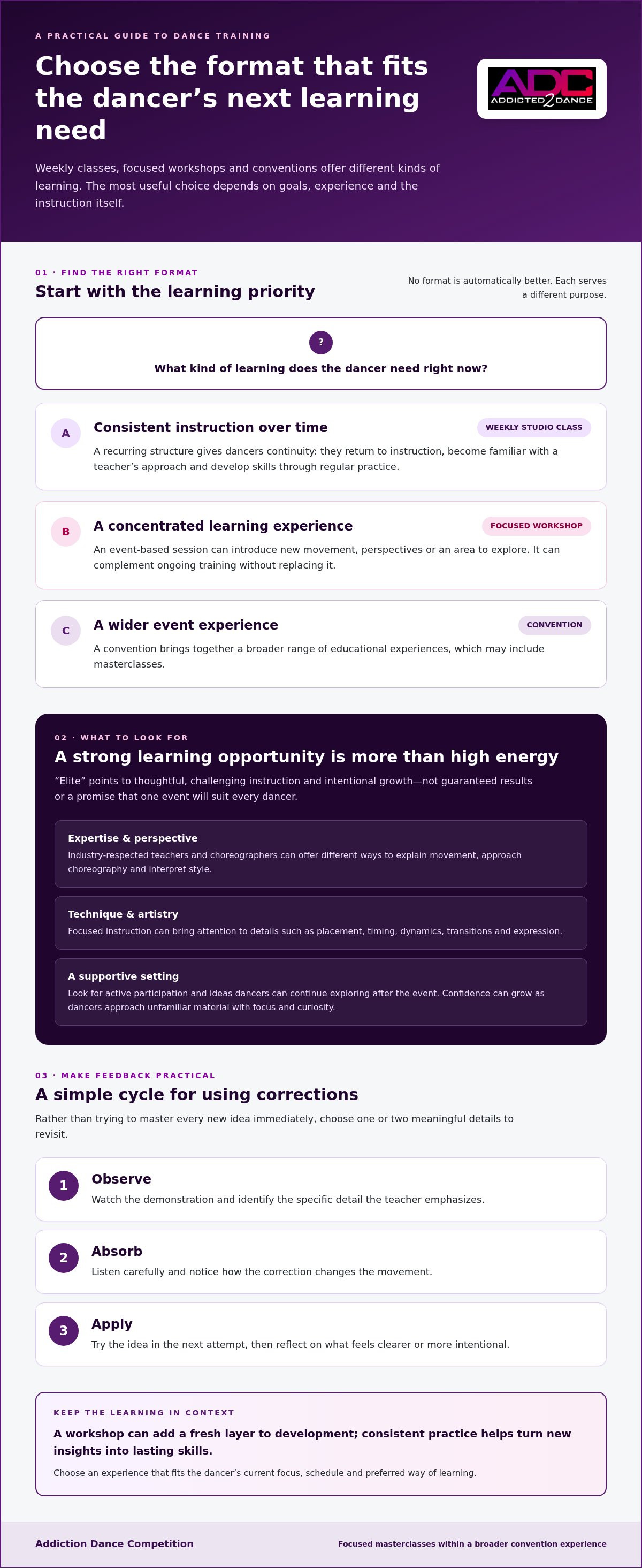
A dance workshop offers a concentrated learning experience. Instead of the ongoing rhythm of regular studio instruction, dancers gather for focused, event-based teaching that introduces new movement, perspectives, or areas to explore. The format has a clear purpose: engage with the material, then carry useful ideas into continued training.
A focused dance workshop brings expert teaching and purposeful instruction together to help dancers develop technique, explore artistry, and approach training with fresh curiosity. That’s a useful definition to keep in mind when comparing elite dance training workshops in Las Vegas. “Elite” signals an emphasis on high-level instruction and intentional growth, not guaranteed results or a promise that one event will suit every dancer.
Workshop, convention, or weekly class: what is the difference?
A weekly studio class provides continuity. Dancers return to instruction over time, build familiarity with a teacher’s approach, and develop skills through regular practice. A workshop is a focused event, giving dancers a concentrated opportunity to work with a teacher or explore a particular area of dance. It can complement ongoing training without replacing it.
A convention brings together a broader range of educational experiences, which may include masterclasses. When comparing formats, consider whether the priority is consistent instruction, a focused session, or a wider event experience. None is automatically better; each serves a different purpose.
What does elite training mean for a dancer?
Elite training is best understood as a commitment to thoughtful, challenging instruction. Learning from industry-respected teachers and choreographers can expose dancers to different ways of explaining movement, approaching choreography, and interpreting style. The value comes from paying close attention, staying open to corrections, and considering how new ideas connect with existing training.
Technique and artistry develop together. A correction may invite a dancer to refine alignment or timing, while a new choreographic perspective can encourage more expressive choices. Confidence can grow through that process, not because every step feels easy, but because dancers learn to approach unfamiliar material with focus and curiosity.
Dance education encompasses more than learning steps. Its wider foundations include curriculum, genres, and the role of specialized dancers in teaching, as described in Dance Education. This broader view helps put event-based instruction in context. A workshop can add a fresh layer to a dancer’s development, while consistent practice helps turn new insights into lasting skills.
Las Vegas dancers may weigh local instruction against traveling conventions and masterclasses because each format offers a different learning setting. A traveling event can bring visiting teachers and choreographers into a convention experience, while local classes offer a recurring structure. For families, the practical question is how each opportunity fits the dancer’s current focus, schedule, and preferred way of learning. Look for an experience that encourages active participation and gives the dancer ideas to explore after the event.
What Dancers Can Gain from Las Vegas Dance Workshops
A focused workshop can give dancers a fresh lens on familiar movement. Its value isn’t simply learning choreography. Dancers can notice how a teacher approaches placement, timing, dynamics, and expression, then decide what to carry into future practice. Expert-led dance training can strengthen attention to technique while opening new possibilities for artistry.
For dancers considering elite dance training workshops in Las Vegas, the most useful gains often come from active learning. Watch closely, listen for the intention behind a correction, and try applying it thoughtfully. A note about a grounded landing, for example, can prompt a dancer to pay closer attention to control and musical timing in the next phrase.
Technique and artistry through focused instruction
Concentrated instruction can help dancers examine details that move quickly during choreography: the clarity of a transition, the coordination of the upper body, or the connection between movement and music. Technique gives a dancer tools for control and precision. Artistry shapes how those tools communicate a mood, character, or musical idea.
Corrections become more useful when dancers work through them in a simple cycle:
- Observe the demonstration and identify the specific detail the teacher emphasizes.
- Absorb the correction by listening carefully and noticing how it changes the movement.
- Apply the idea in the next attempt, then reflect on what feels clearer or more intentional.
This approach keeps feedback practical rather than overwhelming. Dancers don’t need to master every new idea immediately. Staying curious and selecting one or two meaningful details to revisit can make the experience more manageable and encourage steady development.
Learning across styles and teaching perspectives
Different teachers may describe movement through distinct images, rhythms, or technical cues. Hearing more than one perspective can help dancers become adaptable. They learn to interpret instruction, consider what a correction means in their own movement, and explore different routes toward a particular quality.
Ballet, jazz, hip hop, and musical theatre each invite different questions about technique and performance. A ballet-focused exercise might draw attention to balance and line; a jazz or hip hop phrase may ask for a different relationship with rhythm, energy, and grounded movement. Musical theatre can prompt attention to character and storytelling. These examples illustrate the range of learning perspectives dancers may encounter, not a promise that every style appears in every workshop.
That openness matters beyond a single event. Berklee College of Music’s overview of Careers in Dance reflects the breadth of skills and working contexts associated with dance. Exploring new teaching perspectives can renew motivation, too. A fresh challenge may remind dancers why they love training and give them a new question to pursue in class.
For dancers drawn to focused instruction within a broader convention experience, Addiction Dance conventions and masterclasses bring learning together with opportunities to develop technique and artistry in a positive, professional environment.
How to Compare Elite Dance Workshops in Las Vegas
An appealing event description can create excitement, but useful details show whether the learning experience fits the dancer. Before comparing elite dance training workshops in Las Vegas, identify one or two priorities, such as musicality, cleaner technique, or stronger performance quality. Then look for information that connects the teaching and event format to those goals.
Match the learning experience to the dancer’s goals
Start with the dancer, not the promotional language. A student hoping to refine musicality may value instruction that explores rhythm, phrasing, and movement quality. Someone focused on technique may look for clear teaching around execution and detail. A dancer working on performance quality may be drawn to opportunities to consider expression and intention alongside choreography.
Experience matters, too. Consider whether the dancer feels ready to learn in an event setting and engage with instruction at the stated level. A good fit should feel purposeful and appropriately challenging, not like a test of worth. For a broader view of how events combine learning and competition, explore this dance competition and convention guide.
Assess teaching quality and event environment
Look for specifics about what dancers will learn, how instruction relates to dance development, and who is teaching. Industry-respected teachers and choreographers bring valuable perspectives, but a name or an exciting event promise alone doesn’t explain the educational experience. Clear descriptions of focus, style, and format help families make an informed comparison.
It’s understandable to wonder whether an organization connected with competition can also support learning. Competition and education aren’t mutually exclusive. Addiction Dance creates a professional, positive, and family-friendly environment, and its conventions and masterclasses focus on technique and artistry. A welcoming atmosphere can help dancers stay engaged, receive instruction, and approach challenging material with confidence.
Teaching: Does the event identify its teachers or choreographers and explain their role in the learning experience?
Learning focus: Is the educational purpose clear, such as developing technique, musicality, or performance quality?
Style relevance: Does the described style connect with what the dancer wants to explore?
Event format: Is it a focused masterclass or part of a broader convention experience?
Dancer goals: Can the dancer name a skill or perspective they hope to take away?
This framework helps separate substance from spectacle. Broad phrases such as “unforgettable” or “next-level” may set a mood, but they don’t tell you what a dancer will study. Educational details do. AMDA’s resource on Becoming a Professional Dancer also highlights the value of technical foundations and continued learning, useful ideas for dancers at different stages of development.
How to Prepare for a Dance Training Workshop
A little preparation helps dancers arrive ready to learn, rather than spending the opening moments wondering what to expect. For elite dance training workshops in Las Vegas, keep the plan simple: set an intention, read the event information, prepare according to its guidance, participate attentively, and reflect afterward. The aim isn’t to control every detail. It’s to make room for focused, confident learning.
Before the event: set a clear learning intention
Choose one specific skill or artistic quality to notice. A dancer might focus on musicality, clearer transitions, or expressing character through movement. One or two priorities are enough to give the experience direction while leaving room to learn something unexpected. Families can review event information together and plan logistics in advance, helping the dancer feel settled and ready to engage.
- Set a goal. Name a useful focus, such as responding more clearly to musical accents or paying closer attention to movement detail.
- Review the event information. Read the organizer’s instructions for attire, arrival, and any materials to bring. Follow those directions rather than relying on assumptions from another event.
- Prepare thoughtfully. Plan the journey and give the dancer time to arrive without unnecessary rush. Prioritize rest and hydration so they can approach active learning feeling cared for.
- Participate with attention. Listen closely, follow the teacher’s guidance, and take part respectfully. Stay open to corrections, even when a new approach feels unfamiliar at first.
- Reflect afterward. Capture useful feedback while it’s fresh, then choose one practical idea to explore in future training.
During and after the workshop: turn learning into progress
Curiosity makes a strong companion in class. Dancers can arrive with a question or two, such as how to make a transition feel more connected or how to bring greater intention to a phrase. They don’t need to ask every question aloud; listening for answers in demonstrations and corrections can also deepen engagement.
Focused events can be energizing, so it’s wise to respect the dancer’s pace. Pay attention to how they’re feeling, take appropriate opportunities to rest, and drink water as needed. Follow the teacher’s guidance and the event’s instructions throughout the session. There’s no need to measure success by how much choreography a dancer remembers or whether every correction feels natural right away.
Afterward, invite the dancer to share one moment that stood out and one idea they want to carry forward. A teacher or guardian can help make that reflection concrete: perhaps the next step is to revisit a note in regular practice or keep noticing a particular performance quality. This connects the workshop with ongoing development without treating a single event as a promise of instant change.
Ready to put that focused-learning mindset into practice? Explore Addiction Dance conventions and masterclasses as an opportunity to learn, participate, and continue developing as a dancer.
Explore Addiction Dance Conventions and Masterclasses in Las Vegas
Addiction Dance Competition hosts regional and national events across the United States, including Las Vegas. For dancers and families, its convention format offers a chance to consider how focused learning and performance participation might fit together. The convention setting gives dancers more than one way to engage, so it helps to decide whether the priority is learning new material, preparing to perform, or experiencing both.
Before choosing an event, consider what the dancer hopes to take away and how they prefer to participate. A convention’s educational and competitive components have different purposes. Thinking about them separately can help families make a considered choice without treating competition results as the only measure of a successful experience. Dancers and families in Chicago, Akron, Omaha, Richmond, Las Vegas, Minneapolis, Miami, Houston, Grand Rapids, Memphis, Detroit, Bloomington, Philadelphia, Pittsburgh, Boston, Nashville, St. Louis, Davenport, Milwaukee, and Birmingham can explore Addiction Dance’s regional and national events.
A convention experience built around learning and performance
Convention education complements competition by giving dancers a learning context alongside performance opportunities. Masterclasses can introduce ideas to carry into future training, while competition gives dancers a chance to present prepared work for adjudication. Keeping those goals distinct can help dancers stay engaged in each part of an event and make the experience more intentional.
Families considering the broader financial and planning questions around competition can use this dance competition scholarship guide as a resource while weighing event participation.
Take the next step with Addiction Dance
For Las Vegas dancers, explore the event information and consider how the format aligns with the dancer’s interests. Reviewing participation details together helps families understand the experience and make a considered plan.
Explore Addiction Dance events to find participation information and decide which opportunity feels right for your dancer’s next step.
Choose a Next Step That Keeps You Growing
Your next dance opportunity doesn’t need to answer every question at once. Let one clear intention guide you: the skill you want to explore, the perspective you hope to gain, or the kind of performance experience that feels right for this stage of development. That focus can turn a single event into a meaningful part of a longer dance journey.
As you consider elite dance training workshops in Las Vegas, trust the goals you’ve identified and give yourself permission to stay curious. Progress isn’t always a dramatic leap. Sometimes it begins with a small discovery that changes how you approach your next rehearsal.
Addiction Dance offers conventions and elite masterclasses for dancers ready to keep exploring their craft. Review current event and participation information, then decide what feels like a thoughtful next step for you or your dancer.
Explore Addiction Dance events and take your next step with confidence. Let your goals lead, and give your growth room to unfold.
Frequently Asked Questions
Are elite dance workshops in Las Vegas suitable for beginners?
Some may suit beginners, but the best fit depends on the event’s stated level and learning focus. Read the workshop information with the dancer’s current experience in mind, then consider whether they’re comfortable learning choreography and responding to instruction in an event setting. Addiction Dance events welcome dancers of different ages and skill levels, while individual workshop details help clarify the learning experience. A beginner can benefit from setting a manageable goal and staying open to new movement.
How are dance workshops different from dance competitions?
A workshop centers on instruction and learning, while a competition centers on presenting a routine for adjudication. Some convention events bring these experiences together, so dancers may encounter educational sessions alongside competitive performances. For example, a dancer could take a masterclass to explore new movement, then perform a prepared routine in a competition setting. Understanding which parts of an event are instructional and which are competitive helps families plan around the dancer’s interests.
Can dancers receive scholarships through dance workshops?
Scholarship opportunities may be available through dance events, but attending a workshop alone doesn’t guarantee one. Addiction Dance events offer opportunities for scholarships and special awards; eligibility and details depend on the event. Families can review the event information to understand how opportunities are presented and what participation involves. Treat scholarships as a possible benefit, while keeping the dancer’s learning and personal goals at the heart of the experience.
What dance styles can dancers study at a Las Vegas workshop?
Styles can vary by event and instruction. Addiction Dance competition programming includes ballet, jazz, hip hop, and musical theatre, but not every workshop covers each style. A dancer interested in one area can review the specific event’s educational details and consider how the style connects with their training. For instance, a jazz dancer might look for a session that complements their current focus while remaining open to a different movement approach.
What should a dancer bring to a dance training workshop?
Follow the organizer’s instructions for attire, arrival, and any required materials, since needs can differ by event. As practical personal items, a dancer may want water and a way to record notes afterward, such as a small notebook. Avoid assuming a particular shoe, costume, or piece of equipment is required. Reviewing the event information with a parent or guardian beforehand helps the dancer arrive prepared without packing unnecessary items.
Do dance workshops guarantee better competition results?
No workshop can guarantee better competition results. Instruction can give a dancer ideas to explore and skills to keep developing, but performance outcomes depend on the routine, preparation, execution, and adjudication. A more useful measure is whether the dancer leaves with a clearer understanding of a correction or a new artistic idea to practise. That kind of learning can support continued growth without promising placements, scores, or awards.


