
What if the secret to a championship title isn't found in your highest jump, but in the quiet moments between the steps? It's a question every elite dancer asks when the lights go down and the scores go up. You've felt that rush of intense adrenaline on stage, followed by the nagging uncertainty of a score that feels just out of reach. Understanding what do dance competition judges look for is the definitive bridge between a beautiful routine and a legendary performance. It's about more than just hitting your marks. It's about capturing a feeling that lingers long after you've walked off the floor.
I know how it feels to pour your heart into a piece and still wonder why the numbers haven't moved. This guide is your exclusive backstage pass to the professional standards of the 2027 National Tour. I'll show you how to transform technical precision into breathtaking artistry that demands a perfect score. We'll break down the essential 2026 judging criteria, from the nuance of your transitions to the sophisticated polish of your stage presence. Get ready to step into the spotlight with a new sense of authority and the clarity you need to win.
Key Takeaways
- Discover how elite adjudicators analyze every movement on their mental scorecard. You'll learn why consistent excellence throughout your routine is the true hallmark of a champion.
- Master the technical non-negotiables that define what do dance competition judges look for, from core engagement to perfectly finished lines. These subtle details separate the good from the truly exceptional.
- Elevate your performance quality by cultivating an authentic emotional connection that goes beyond a standard smile. We'll guide you in creating moments that feel deeply personal and professionally polished.
- Learn to use levels and dynamics to amplify your routine's musicality and choreographic impact. This approach ensures your performance stays vibrant and engaging from the first note to the final pose.
- Prepare for the prestigious atmosphere of the 2027 National Tour and the road to Branson. Use professional feedback as a refined mentorship tool to reach the pinnacle of your competitive journey.
The Adjudicator’s View: Understanding the Judge’s Mental Scorecard
Imagine sitting behind a glowing table for twelve hours. The music is loud, the energy is electric, and the stakes are incredibly high. For a professional adjudicator, the mental transition from simply watching a routine to actively scoring it is instantaneous. They aren't just spectators; they're analysts searching for excellence. While a casual viewer might be dazzled by a single high-flying leap, judges are trained to look for the thread of quality that pulls a whole performance together. They value the seamless flow of a routine over an isolated "wow" moment that isn't supported by solid technique.
Consistency is the ultimate currency at the judging table. A dancer who maintains their turnout and focus throughout a three-minute solo will almost always outscore a dancer who performs one spectacular trick but loses their alignment elsewhere. This holistic view is rooted in the history of competitive dancing (Dancesport), where precision and poise are evaluated as a single, unified package. When scores are neck-and-neck, the "overall impression" category becomes the ultimate tie-breaker. It's the judge's way of rewarding the dancer who commanded the room and left a lasting impact on the panel. Even the physical environment plays a role; judges must maintain intense focus in a dark room with constant sensory input, so clarity and confidence in your movement help your performance stand out in their minds.
The Anatomy of a Professional Score
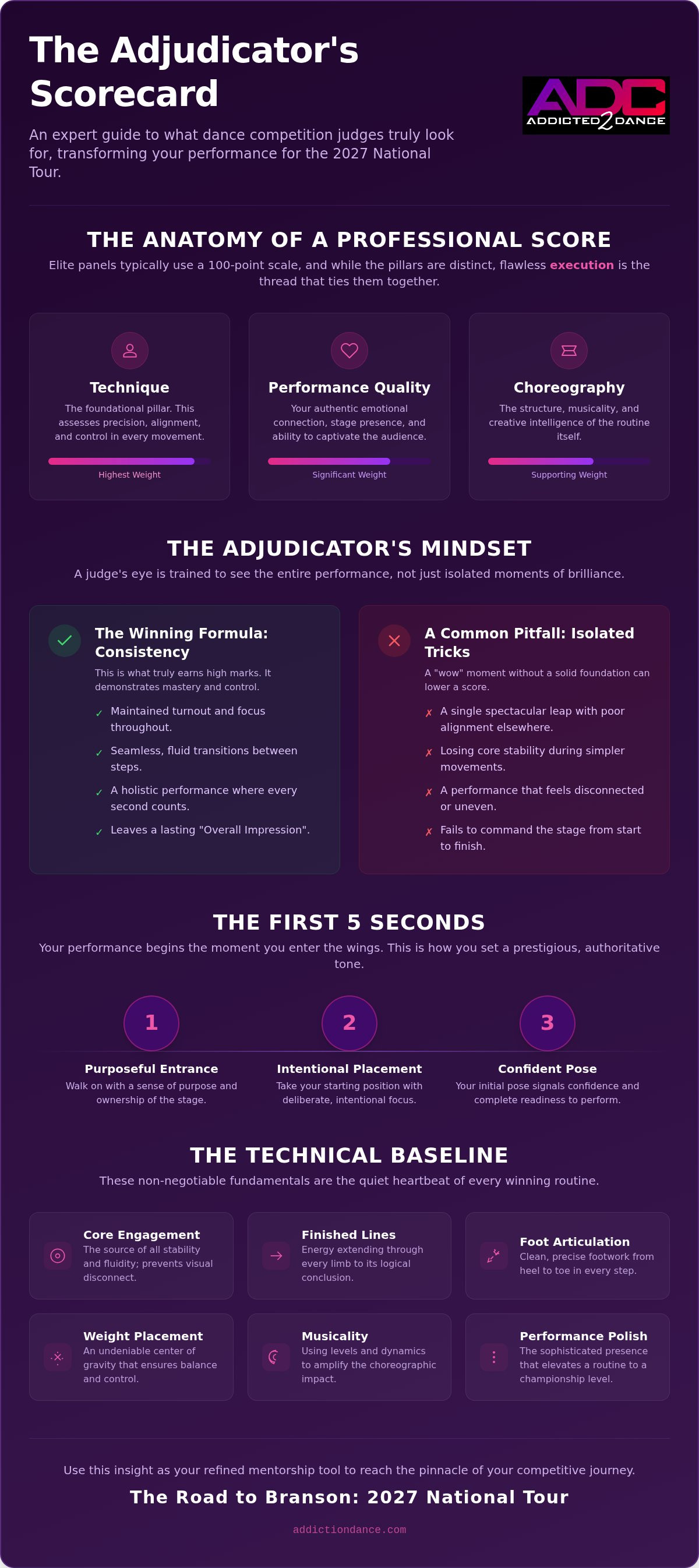
Most elite panels utilize a 100-point scale to quantify your performance. This is typically divided into three major pillars: technique, performance quality, and choreography. Technique often carries the most weight, but the word you'll see most frequently on your critique is "execution." It isn't just about what you can do; it's about how well you do it in the moment. Adjudication is the professional evaluation of both technical skill and the dancer's inner spirit. If your execution is flawless, your score will reflect that elite level of preparation. Knowing what do dance competition judges look for allows you to prioritize these weighted categories during your rehearsals.
First Impressions and the 'Five-Second Rule'
The judging begins the moment you step into the wings. Your entrance and your initial pose tell the panel everything they need to know about your mindset. This "five-second rule" is a psychological reality; judges use those first few moments to gauge your confidence and readiness. When you walk on with a sense of purpose and take your place with intentional focus, you've already won half the battle. This immediate connection with the panel sets a prestigious tone for the entire routine. It signals that you are an authoritative performer who is completely in control of the stage. Understanding what do dance competition judges look for starts with realizing that your performance is a story told from the very first step.
The Technical Baseline: Precision, Alignment, and Finished Lines
In my experience behind the table, I've seen that technical excellence is the quiet heartbeat of every winning routine. While the "wow" moments catch the eye, your non-negotiable fundamentals, such as turnout, foot articulation, and core engagement, keep the judges’ pens moving in the right direction. When considering what do dance competition judges look for, remember that they are trained to see the structure beneath the sequins. A dropped heel or a soft core during a transition can be a significant red flag that signals a lack of control. To truly stand out, you must treat your technical baseline as a living, breathing part of your artistry. It is the foundation that allows your creative spirit to soar without restriction.
Mastering the Mechanics of Movement
Precision starts with weight placement. Whether you are executing a triple pirouette or a simple piqué, your center of gravity must be undeniable. Judges often look for integrity in the "simple" steps, such as chassés or transitions between combinations. If your core stability is compromised, the fluidity of your upper body suffers, creating a visual disconnect. Aligning your training with professional dance program goals ensures that your technical proficiency is as polished as your stage presence. This stability is what allows you to move through high-stakes routines with a sense of effortless grace and authority.
The Power of Articulate Feet and Hands
I often observe that a dancer's extremities are the exclamation points of their movement. High-velocity movements often lead to "dead hands" or "sickled feet," which immediately lower a professional score. Instead, use the floor to create power, rolling through your feet with every step to show depth and strength. Energy must extend through the fingertips and toes to create a complete, breathtaking line. This level of detail is exactly what we emphasize in our Elite Masterclasses, where we bridge the gap between studio practice and championship standards. Every intentional movement of the hand or foot contributes to the sophisticated silhouette that elite panels admire.
Finished lines matter more than the height of an extension. A clean, 90-degree leg with a strong, held core is far more impressive than a 180-degree split that causes your hips to tilt or your shoulders to hunch. Judges watch what happens between the tricks. Your transitions should be as intentional as your grandest leap. If you treat every moment on stage as an opportunity for refinement, you move from being a student to being an artist. A common mistake is relaxing the technique during a walk or a simple weight change. Keep your turnout engaged and your lines finished until the very last second of your performance to ensure you leave a lasting, prestigious impression.
Beyond the Steps: Performance Quality and Authentic Connection
True artistry begins the moment you stop thinking about the steps and start living them. It's the profound difference between a dancer who simply executes a routine and one who invites the audience into a shared experience. When we discuss what do dance competition judges look for, we are often searching for that elusive, magnetic spark of authenticity. The art of dance is fundamentally a medium for expressing ideas and emotions. This means your performance quality is just as vital as your technical foundation. It's the soul of the performance that resonates long after the music stops.
I often see dancers rely on the "competition grin," a fixed smile that rarely reaches the eyes. While energy is essential, elite adjudicators crave nuance. Your facial expressions should reflect the internal journey of the music rather than a rehearsed mask. Use your eyes as a sophisticated tool for both spatial awareness and storytelling. They should project energy to the very back of the house while maintaining an intimate, vulnerable connection with the panel. This balance creates a performance that feels both grand and deeply personal, capturing the attention of every judge in the room.
The Art of Emotional Storytelling
Emotional storytelling requires you to match your performance quality to the specific genre. A sharp jazz routine demands a different energetic signature than a vulnerable lyrical piece. Finding your "breath" within the choreography is essential; it allows the movement to look organic rather than mechanical. Vulnerability is actually a strength on stage. It shows the panel that you aren't just performing for a score. You're truly experiencing the dance. When you understand what do dance competition judges look for, you realize they want to be moved by your story as much as they want to be impressed by your skills.
Stage Presence and Professionalism
Professionalism is often measured in how you handle the unexpected. If a prop slips or a turn falters, your "recovery score" depends on your grace under pressure. Keep your focus, maintain your character, and never let the mistake reach your face. Polished grooming and costume integrity are also non-negotiable for a prestigious, elite look. As you are preparing for the 2027 National Tour, remember that these small details define your national-level presence. High energy and professional standards are what set the championship performers apart from the rest of the field.
Choreography and Musicality: The Framework of Excellence
Choreography is the elegant architecture of your performance. It is the blueprint that allows your talent to shine with clarity and purpose. When we ask what do dance competition judges look for, we are searching for a routine that feels both intentional and unique. It isn't enough to have elite dancers on stage; the framework must be excellent. This starts with a deep understanding of musicality. A judge perceives your rhythm and timing through how you inhabit the music. Are you merely hitting the counts, or are you telling the story of the score? Timing is often objective, but musicality is a sophisticated, artistic choice that defines a professional.
Dynamics are the secret to keeping an adjudicator engaged from the first note to the final pose. A routine that stays at one energy level feels flat and predictable. You need peaks and valleys to create a narrative arc. Soft, quiet moments make the high-energy explosions feel more powerful and prestigious. Age-appropriate choreography is also a major factor in our scoring. We look for movement that challenges the dancer while remaining tasteful and refined. Unique choreographic choices, such as an unexpected change in direction or a subtle rhythmic shift, command our attention. They show that the choreographer understands the high-stakes environment of an elite event.
Beyond the competition stage, the same principles of high-quality production and engagement are essential for any prestigious gathering. To ensure your next celebration has the same professional polish as a winning routine, explore Per-Event Entertainment and Production Service Fees and see how DNA Events and Production can elevate your event with expert DJ and MC services.
Visual Dynamics and Use of Space
The stage is your canvas. It is a space for bold declarations and quiet whispers. Utilizing the entire floor through floorwork, sharp diagonals, and center-stage moments shows a professional level of spatial awareness. Silence and stillness can be just as impactful as a series of complex turns. A moment of absolute quiet in a high-energy routine creates a vacuum that draws the judges in closer. Clever transitions are also vital for a winning routine. They can mask technical weaknesses by keeping the panel focused on the seamless flow rather than a single difficult element.
Musical Nuance and Phrasing
There is a profound difference between dancing "on" the beat and dancing "through" the music. We want to see you highlight subtle accents in the score that a casual listener might miss. Perhaps it is a soft piano trill or a deep, resonant bass thud. Musicality transforms a sequence of steps into a breathtaking piece of art. It is about the breath between the notes and the texture of the movement. To truly master this intersection of technique and timing, I invite you to join our Elite Masterclasses. You will learn how to refine your phrasing under the guidance of industry leaders who know exactly how to catch a judge’s eye.
Stepping into Excellence: Preparing for the Addiction Dance 2027 National Tour
The Addiction Dance Competition stage is a high-octane environment where professional excellence meets electric energy. It is a space designed for those who refuse to settle for anything less than the pinnacle of their potential. When you step onto our floor, you are stepping into a prestigious legacy of championship performance. Understanding what do dance competition judges look for at this elite level is the first step toward the podium. Our adjudicators aren't just scoring your routine; they are looking for the next generation of industry leaders. They seek a blend of technical mastery and an undeniable, magnetic stage presence that commands the entire room.
Success on the road to the National Finals 2027 begins with how you handle your regional feedback. Treat every critique as a refined mentorship opportunity. Our professional panels provide detailed video critiques that are essential for long-term growth. Knowing exactly what do dance competition judges look for allows you to use these insights to polish your transitions and strengthen your emotional connection before you reach the final stage. This methodical approach ensures that your solo, duo, or group performance is ready for the high-stakes atmosphere of a national championship. It is about evolving from a competitor into a true artist.
The Path to the National Title
The journey to a national title is paved with discipline and a positive, family-friendly attitude. Judges look for dancers who carry themselves with grace both on stage and in the wings. This professional demeanor is often what separates scholarship winners from the rest of the field. Special awards are reserved for those who demonstrate exceptional spirit and a commitment to the craft. By attending our Elite Masterclasses, you can refine the specific skills our judges value most. These sessions bridge the gap between education and competition, giving you the edge you need to excel in every category.
Your Journey to the Spotlight
Mental preparation is the final key to peak performance. You must embrace the pressure and turn it into fuel for your artistry. Believe in the work you have put in during those long studio hours. We encourage every dancer to embrace their "Addiction" to excellence and strive for the highest possible standard. The 2027 season is your time to shine, culminating in the spectacular national finals event from July 5-11, 2027. Secure your spot on the 2027 National Tour today and begin your journey to the spotlight. We can't wait to see your championship-winning performance unfold on our stage.
Take the Lead: Your Path to the Podium
You now possess the professional secrets to transforming your artistry into a championship-winning performance. By mastering technical precision and cultivating an authentic connection, you've moved beyond the basics into the elite territory of an industry leader. Understanding what do dance competition judges look for is your ultimate competitive advantage, allowing you to perform with a level of clarity and sophisticated confidence that commands the room. Each transition and every finished line is an opportunity to prove your dedication to the craft.
As a central part of America's fastest-growing dance circuit, we are dedicated to your growth through professional adjudication by industry experts and our exclusive Elite Masterclasses and Conventions. This is your moment to bridge the gap between education and high-stakes competition. Claim your place on the 2027 National Tour and show the judges what you're made of! We are ready to celebrate your excellence and watch you shine on the prestigious road to Branson. Your journey to the spotlight starts with a single, courageous step toward the stage. Believe in your training, trust your artistry, and prepare to leave your mark.
Frequently Asked Questions
Do judges really look at your face the whole time?
Judges scan your entire silhouette to evaluate alignment, but they certainly notice if your expression goes blank during a difficult turn. Your face is the emotional center of the routine. It should reflect the music's story without looking forced. While we don't stare at your eyes for every second, a lack of facial engagement can make a performance feel mechanical. Aim for a natural, nuanced presence that complements your movement.
What is the most common technical mistake judges see?
Sickled feet and a lack of core stability are the most frequent technical red flags we encounter. These issues often appear during transitions or in the middle of complex combinations. When we analyze what do dance competition judges look for, we prioritize a dancer who maintains their lines from the beginning to the end. Focus on articulating through your feet and keeping your center engaged to avoid these common pitfalls.
How much does the costume impact the final score?
Costuming typically accounts for a specific portion of your presentation score, often around five to ten percent of the total. It should be age-appropriate, secure, and professionally polished. A costume that requires constant adjusting or distracts from the movement will negatively impact your overall impression. We look for a look that enhances the choreography rather than overshadowing the dancer's natural talent and technical execution.
Can a great performer beat a better technician?
A captivating performer can absolutely outscore a technician who lacks emotional depth. While technical proficiency is a non-negotiable baseline, the "overall impression" score often acts as the ultimate tie-breaker. If two dancers have similar scores, the one who creates an authentic connection with the panel will take the lead. It's about finding the balance between a perfect triple pirouette and a breathtaking, vulnerable story.
What happens if I make a mistake during my solo?
Your recovery is just as important as the routine itself. If you stumble or miss a step, the best thing you can do is keep moving with confidence. We look for dancers who can handle pressure with grace. Don't let the mistake reach your eyes or break your character. A seamless recovery shows a high level of professionalism and mental toughness that elite panels deeply respect.
Is eye contact with the judges actually necessary?
Direct eye contact isn't always required, but intentional focus is essential for a prestigious performance. In styles like musical theater, looking at the panel builds a necessary bridge. In contemporary, your focus might be more internal or directed toward the space. Understanding what do dance competition judges look for means knowing when to invite us in and when to let us simply witness your artistic journey.
How do judges handle 'over-choreographed' routines for younger dancers?
We prioritize quality over quantity when it comes to choreography for younger performers. Over-choreographed routines often lead to rushed movements and compromised technique. We'd much rather see a mini dancer execute simple steps with perfect alignment and joy. It's important that the movement matches the dancer's physical and emotional maturity. This ensures the performance feels authentic and allows the dancer's natural confidence to shine through.
Why is musicality so heavily weighted in elite competitions?
Musicality is a sign of advanced artistic maturity and professional awareness. It shows that a dancer isn't just counting beats but is truly interpreting the texture of the sound. In elite environments, this nuance separates the good from the great. We reward dancers who can highlight subtle accents and find the "breath" within the score. It transforms a series of athletic steps into a sophisticated work of art.
Developing this level of awareness often involves immersing yourself in high-quality soundscapes. Exploring the diverse electronic curation on Doubleclap Radio can help you identify the subtle layers within a track, allowing you to dance through the music rather than just on the beat.


