
Does entering a national dance competition always mean qualifying at a regional event first? Not necessarily. If you’re wondering how to enter national dance competition events, start by checking the current rules for the specific competition. Entry requirements vary, including who may submit an entry and how dancer eligibility is confirmed.
Before committing, get clear on the event’s entry pathway, categories, schedule, and any steps your studio needs to coordinate. The process can feel complicated when requirements are unclear, but breaking it into decisions makes it easier: confirm the rules, assess the fit, then plan the entry and preparation.
This guide explains what to ask the organizer, how to check eligibility and deadlines, and how to work with your studio on the next steps. Addiction Dance Competition’s 2027 National Tour and Nationals Branson 2027 are options to consider. Verify current event details and entry pathways directly before making plans.
Key Takeaways
- Learn how to enter national dance competition events by following the specific organizer’s current entry pathway, rather than assuming every event uses the same process.
- Check the official rules in order: event requirements, dancer eligibility, qualification, category, and entry procedure.
- Compare event details with the dancer’s goals, schedule, location needs, and your studio’s readiness before choosing a competition.
- Coordinate with your studio and instructor on routine format, confirmed requirements, and travel planning before committing.
- Explore Addiction Dance’s national events and review current details, including competition categories and professional judging, before deciding whether an event fits.
How to Enter National Dance Competition Events: Understand the Entry Path
You’ve gained experience competing with your studio, and now you’re considering a national stage. Start by finding out how that particular event accepts entries. Don’t assume every competition follows the same route or that regional participation is always required.
A national dance competition is organized by a competition provider, which sets the event’s entry requirements. Those requirements vary by competition. To understand how to enter national dance competition events, check the rules for the specific event and season, then confirm the steps with the people involved in the entry.
It also helps to distinguish entering from qualifying. Entering means completing the organizer’s registration process. Qualifying means meeting any conditions the organizer sets for participation. An event’s pathway may involve qualification, an invitation, eligibility checks, registration, or a combination of these. For historical context on how national dance competitions developed in the United States, see this overview of the history of dance competitions.
Does every national dance competition require regional qualification?
No single qualification rule applies to every event. Some organizers may connect national entry to regional participation or results; others may set a different pathway. In the current official rules, look for separate details about qualification, invitations, eligibility, and registration. These can be different steps, so don’t treat one as proof that the others are complete.
A regional placement may be encouraging, but don’t assume it automatically guarantees national entry. Check whether the placement meets the organizer’s stated criteria, whether the dancer or routine is eligible, and whether registration still needs to be completed. If the rules don’t answer one of these questions, ask the organizer before making plans.
Who may need to coordinate the entry?
Entry planning may involve the dancer, a parent or guardian, and a studio representative. Their roles can differ by event. Before preparing forms or making plans, ask the organizer who may submit an entry, who needs to approve it, and whether studio affiliation is required. Don’t assume every competition requires a studio director to register dancers.
A first conversation with your studio can clarify who will review the rules and communicate with the organizer. Make a note of who is responsible for each step, including confirming eligibility and completing registration. Once you know the pathway and the right person to contact, you can assess which event fits.
Check National Dance Competition Eligibility and Qualification Rules
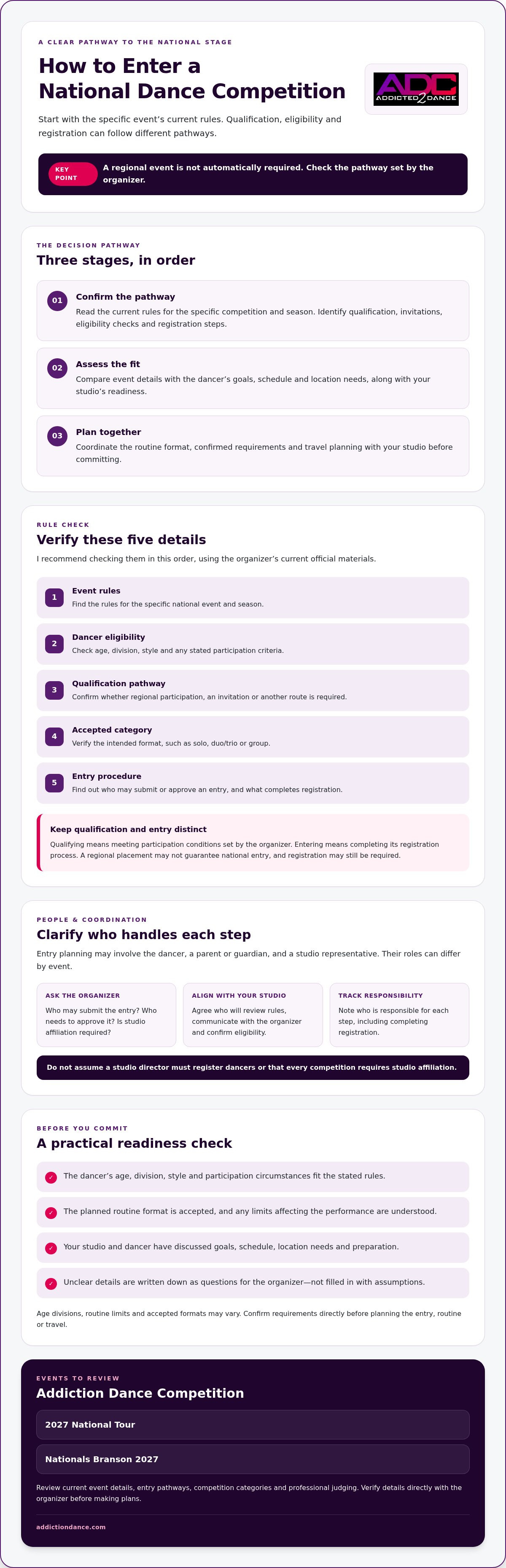
Before committing, verify requirements in the organizer’s current official materials. Rules can differ by competition and season, so an older event page or another organizer’s policy isn’t a reliable substitute. Use this sequence to identify what applies to your dancer and planned routine:
- Event rules: Find the current rules for the specific national event and season.
- Eligibility: Check age, division, style, and any stated participation criteria.
- Qualification: Confirm whether regional participation, an invitation, or another pathway is required.
- Category: Verify that the event accepts the intended format, such as solo, duo/trio, or group.
- Entry procedure: Identify who can submit or approve the entry and what steps complete registration.
Confirm all requirements directly with the organizer before planning your entry, routine, or travel. Age divisions, routine limits, and accepted formats may vary. If an event page is unclear or a detail is missing, note it as a question for the organizer instead of filling the gap with assumptions.
What eligibility details should dancers confirm?
Read the rules for the specific event, then check whether the dancer’s age, division, style, and participation circumstances fit. Confirm which routine formats are accepted and whether any stated limits affect the planned performance. A category name may not answer every question, so write down anything unclear and ask the organizer before finalizing the routine or entry.
This review also helps keep the decision grounded in the dancer’s goals. For broader context, a UC Irvine paper considers the merits of competition dance, offering a perspective to weigh alongside practical fit and the event’s official requirements.
How can you verify a qualification pathway?
Ask the organizer directly whether the event requires regional participation, an invitation, or another route. If a result or invitation is relevant, confirm how it is recognized for the specific national event and whether any registration steps remain. Keep the organizer’s written response with the applicable official rules so your family and studio have a clear reference as plans move forward.
Requirements should guide your next step, not leave room for guesswork. If you’re considering Addiction Dance, review its national dance events and confirm current eligibility, qualification, and registration details with the organizer before making plans.
Choose a National Competition That Fits Your Dancer and Studio
The right national event is one that fits the dancer’s goals and your studio’s capacity to prepare, not simply the one with the biggest profile. Compare events before choreography, registration, or travel plans are underway. The Association of Dance Competitions & Conventions offers context on the broader industry, while each organizer’s current materials remain the source for event-specific requirements.
Compare details you can verify directly with each organizer:
- Eligibility and qualification: Does the dancer and planned entry meet the event’s current requirements?
- Location and schedule: Can your family and studio manage the event dates and travel?
- Competition format: Do the categories and routine types match your goals?
- Studio readiness: Can your instructor and participating dancers prepare the entry within the available schedule?
A comparison sheet can keep the decision focused. List each event, then record confirmed details for eligibility, qualification, location, schedule, format, and studio readiness. Mark unanswered questions for the organizer. This makes it easier to distinguish verified requirements from assumptions when comparing options.
Which event format and category suit your goals?
A solo gives one dancer an individual performance opportunity. A duo/trio or group routine involves collaboration and shared preparation. Neither format is automatically the better choice. Consider the dancer’s experience and artistic interests, as well as the routine your studio can prepare with care. Before committing to choreography, check the event’s current categories and confirm that the intended format is accepted. This is an important part of deciding how to enter national dance competition events with confidence.
Discuss the options with the instructor, especially when a routine involves multiple dancers. The instructor can help you consider the preparation involved and whether a solo, duo/trio, or group entry fits this event and season.
How should families assess travel and event logistics?
Review the event location and schedule alongside family availability and travel arrangements. Consider the full commitment with your studio, including whether the dates work for the dancers involved. Don’t choose on prestige alone. An event may still be a poor fit if its format, timing, or logistics don’t align with your needs.
Addiction Dance offers the 2027 National Tour and Nationals Branson 2027 as options to assess. Confirm current event details directly before making plans, and use the 2027 National Tour guide for event-specific planning context. Once you understand the requirements and logistics, you and your studio can make a considered choice.
Prepare Your Entry With a Clear Studio and Dancer Checklist
A polished performance starts with a plan, but rehearsal is only one part of a national entry. Track administrative steps separately from dance preparation. This makes it less likely that registration details get lost in choreography planning, while keeping practice aligned with the event’s confirmed requirements and your instructor’s guidance.
What should dancers and families organize first?
Create a shared checklist with your studio and family. Record the organizer’s confirmed requirements, key dates, and contact details in one place. Assign responsibility for each step and update the list as items are completed.
- Organizer rules: Save the current official materials and note applicable eligibility, qualification, category, and routine-format details.
- Studio communication: Confirm who is coordinating the entry, what information the studio needs, and how the instructor will guide routine selection and rehearsal readiness.
- Entry tasks: Track registration steps and any approvals, then verify completion with the person responsible for submitting the entry.
- Travel planning: Review the confirmed event schedule before arranging travel and family logistics. If dates or details aren’t clear, ask the organizer first.
Keep responsibilities distinct: the organizer sets entry requirements, the studio helps coordinate dance preparation, and families can support communication and planning. If a rule changes or an answer is uncertain, update the checklist rather than relying on memory.
How can dancers prepare without focusing only on winning?
Set process goals that give practice direction. A dancer might focus on cleaner technique, more expressive artistry, steadier confidence, or stronger stage presence. These goals relate to preparation, unlike a particular score or title, which can’t be promised.
Feedback is most useful when it leads to a practical next step. Talk through notes with the instructor, choose a skill or performance detail to work on, and revisit it during rehearsal. For an overview of how adjudication may be approached, read this professional judging guide. Treat feedback as information for growth, not a guarantee of a specific outcome.
Scholarships should factor into planning only if the specific event’s current official rules confirm them and explain the applicable details. Otherwise, keep the focus on the experience and the dancer’s personal goals.
As you prepare, explore Addiction Dance events and confirm current entry information with the organizer. A shared checklist, steady studio communication, and purposeful preparation can help the dancer approach the national stage with greater clarity.
Explore Addiction Dance National Events and Confirm Your Next Step
Once you understand your goals and the entry checks involved, Addiction Dance is one organizer to consider. The company hosts regional and national competitions and conventions across the United States. Its confirmed national offerings include the 2027 National Tour and Nationals Branson 2027. These are options to assess, not a promise that every dancer or routine will meet the entry requirements.
What can dancers expect from an Addiction Dance event?
Addiction Dance competitions feature professional judging and categories that include solo, duo/trio, and group. The company also offers dance conventions and elite masterclasses as additional learning opportunities. Its stated approach includes a positive, family-friendly atmosphere. This describes the company’s event environment, but does not guarantee any individual experience or result.
If you’re weighing competition and convention experiences together, the dance competition and convention guide offers broader context. Use it to inform your questions, then rely on the organizer’s current event materials for the details that will shape your plans.
What should you confirm before pursuing a national entry?
Before choosing an event, check its current official information for the entry process, eligibility, qualification pathway, and available categories. Confirm which details apply to your dancer and planned routine. If a requirement or procedure is unclear, ask the organizer. Your studio can help coordinate questions about routine choice and preparation, but confirm with the organizer who is responsible for submitting or approving an entry.
For Addiction Dance’s 2027 National Tour and Nationals Branson 2027, verify current event information directly before making commitments. Check that the event details, eligibility criteria, qualification rules, categories, and registration instructions match your circumstances. Treat any unanswered point as a question to resolve, not an assumption.
The process comes down to three practical steps: understand the pathway, match the event to your dancer and studio, and confirm the requirements before moving ahead. The right next step is informed, verified, and personal. Explore Addiction Dance events and review the current details to decide whether one may fit your goals.
Take Your Next Step Toward the National Stage
A strong entry begins with clarity. The pathway depends on the organizer, so confirm current eligibility, qualification, category, and registration requirements before making plans. Then coordinate with your studio, choose a format that fits the dancer’s goals, and keep preparation aligned with the instructor’s guidance.
That thoughtful approach turns a big ambition into manageable next steps. You’ll be better prepared to compare events, organize the entry, and focus rehearsals on technique, artistry, and confidence rather than on an outcome no one can promise.
Addiction Dance hosts regional and national events across the United States, with professional judging and solo, duo/trio, and group competition categories. Its confirmed offerings include the 2027 National Tour and Nationals Branson 2027. Before committing, review current event details and confirm the entry pathway directly with the organizer.
Explore Addiction Dance events and find your next stage. With verified information and a plan that feels right for your dancer and studio, you can approach the national stage with confidence.
Frequently Asked Questions
Do you have to qualify for a national dance competition?
Not always. How to enter national dance competition events depends on each organizer’s current rules. Some competitions may require a qualifying pathway, while others may set different eligibility or entry requirements. Check the official rules for the specific event and ask the organizer or your studio to clarify anything that’s unclear. Confirm the pathway before choosing a routine or making travel plans based on an assumption.
Can an individual dancer enter a national dance competition without a studio?
It depends on the organizer. Some may accept individual inquiries or entries, while others may coordinate participation through studios. Don’t assume either approach applies to every competition. Review the current registration instructions and contact the organizer if they don’t explain who can submit or approve an entry. Confirm the process before selecting a routine or making travel plans, so the dancer and family know what coordination is needed.
How do you find national dance competitions to enter?
Start with organizers that hold national events, then compare their official information on eligibility, qualification, categories, locations, and schedules. Families based in Chicago, Akron, Omaha, Richmond, Las Vegas, Minneapolis, Miami, Houston, Grand Rapids, Memphis, Detroit, Bloomington, Philadelphia, Pittsburgh, Boston, Nashville, St. Louis, Davenport, Milwaukee, or Birmingham can use the same approach: verify event details rather than relying on location alone. Ask your studio which options fit its preparation plans.
What should you check before entering a national dance competition?
Confirm the event’s current eligibility rules, qualification pathway, accepted categories, entry process, and schedule. Ask who submits or approves the entry, since procedures can differ between organizers. Discuss the planned routine and readiness with your studio, too. Keep the current official rules and any organizer responses together, so your family can refer to confirmed details and avoid relying on general advice from another event.
Can a beginner compete at a national dance competition?
Possibly, depending on the event’s eligibility rules and the dancer’s preparation. Review the organizer’s current requirements, then talk with the instructor about technique, routine readiness, and whether the event fits the dancer’s goals. A national competition can be an ambitious learning experience, but no particular score, title, or result should be expected. Choose based on verified eligibility and a thoughtful assessment of readiness, not pressure to compete.
How do solo, duo, trio, and group entries differ?
These terms describe whether a routine features one dancer or multiple performers, but each organizer defines its own categories and requirements. Confirm that the event accepts the planned format and discuss coordination with the studio, especially for collaborative routines. Addiction Dance lists solo, duo/trio, and group competition categories. For a specific national event, check its current official details before settling on choreography or assuming a category is available.
When should you start planning to enter a national dance competition?
Start as soon as you’re considering an event. Early planning gives you time to check current rules, discuss dancer readiness with the studio, and coordinate family logistics. There’s no universal deadline or preparation timeline across organizers, so use the dates published for your chosen event. If the schedule or entry guidance is unclear, ask the organizer directly and build a realistic plan with your instructor and family.


